Colorado University Athletics
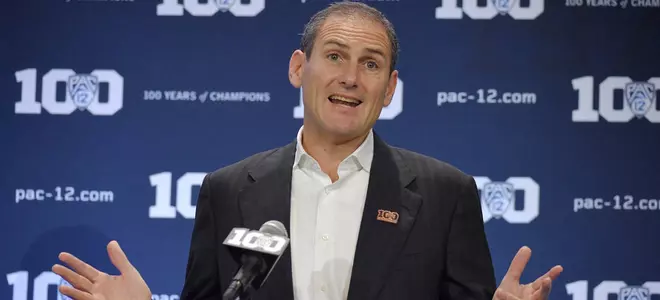
Pac-12's Scott Meets With Buffs To Discuss Time Demands
February 25, 2016 | General, Herbst Academic Center, Neill Woelk
BOULDER — Pac-12 Commissioner Larry Scott paid a visit to Boulder on Wednesday, meeting with representatives from Colorado's Student-Athlete Advisory Committee to discuss time demands on student-athletes.
Under Scott's guidance, the Pac-12 has been one of the nation's most proactive conferences in advancing and addressing concerns for the welfare and well-being of student-athletes. Already, the conference has implemented procedures and rules regarding such issues as cost of attendance, four-year scholarships and increased medical care; and last year, the Pac-12 became the first — and still only — conference in the nation to add student athletes to the league's official governance structure.
Now, Scott and the conference are focusing their attention on time demands of athletes — what those demands entail, how they differ from sport to sport, and how the Pac-12 could improve those issues. Scott's “Listening Tour” of all 12 campuses in the league will help the conference formulate legislation to be introduced at the January 2017 NCAA Convention.
“A very high priority for the conference has been student athlete welfare, looking at the whole student experience,” Scott said. “Since 2014 our presidents and chancellors have been leaders nationally in calling for reform. We've been fortunate since then that the top five conferences have autonomy … and we're more masters of our own destiny in terms of types of changes we want to make to benefit student athletes.
“The big priority now is really focusing on time demands and making sure all of our student athletes have the ability to fully engage in the opportunities available to them academically, socially and otherwise, especially within the Pac-12, where our schools represent the best of the best academically as well as athletically. We intend to be at the forefront of looking at policy changes in this regard.”
The Pac-12 actually introduced two time-demand proposals at last month's NCAA Convention in the second autonomy session — the meeting of the five major conferences who have been granted autonomy by the NCAA for decisions involving a variety of issues. The two proposals included suggestions for two weeks off after every season and contiguous eight hours every night with no athletic-related activity.
That led to a resolution that the “Power Five” conferences — the Pac-12, Big Ten, ACC, SEC and Big 12 — return to the 2017 NCAA Convention with what Scott hopes will be “a comprehensive set of reforms supporting student athletes in the area of time demands.”
“Our two proposals will be part of that, but we want to go further,” Scott said. “I intend for us to be leaders in this space. Over the next year, we're going to be working with other conferences on other areas that we think can help ensure student athletes have balance.”
CU cross country and track athlete Connor Winter, co-president of CU's SAAC, met the media with Scott after the commissioner's meeting with 16 CU athletes.
“It was really valuable to be able to see where we've come from and how we've been able to really make the improvements for the student athletes,” Winter said. “People are really looking at what can we do to make the experience the absolute best. We know we've got champions and we know we've got great students and great athletes, so we want to set them up for success. … That's really what this does. The legislation sets us up for success.”
The NCAA places strict restrictions on how many hours per week student-athletes can participate in athletic-related activities. But, as Scott noted after his meeting with CU's athletes, that time is not so simple as just counting hours at practice. Those “countable athletic-related activities” can also include stretching before practice, strength and conditioning, community service, injury prevention and mediation, and even assistance with recruiting.
“It's very multi-dimensional beyond the obvious two hours of practice a day,” Scott said. “It's a much more complex and holistic commitment.”
Members of the Power Five will meet in April to discuss legislation they plan to propose at next January's NCAA Convention. Scott will visit all 12 Pac-12 campuses before then in order to take as much information as possible to the next meeting.
One thing Scott has already discovered is that proposing blanket legislation covering all sports won't be easy, simply because every sport has different demands and requirements.
“I think there will be some things that are for everyone and then some would have to be sport specific,” Scott said.
The Pac-12 and Big Ten were the only two conferences at the recent NCAA meeting to present specific proposals concerning athlete time demands. But, he said, he expects all five conferences to be ready to move forward.
“I think all the conferences are taking this issue seriously,” Scott said. “I think we are a little bit further out in front of terms of coming with specific proposals. (But) I think it was a wakeup call for everyone.”
If legislation is passed at the January 2017 NCAA Convention, it would take effect for the 2017-18 school year. Scott believes his current tour of every Pac-12 school will play a major role in gathering the information that will help formulate that legislation.
“Our challenge will be how do you take all the feedback and aggregate that and put forth proposals to other conferences,” Scott said. “How do you synthesize the feedback, organize and really prioritize it? How do you get other conferences to see it the same way and come along? It's part of the art form of leadership and diplomacy that's required to make change in a complex structure like we have.”
Contact: Neill.Woelk@Colorado.edu