Colorado University Athletics
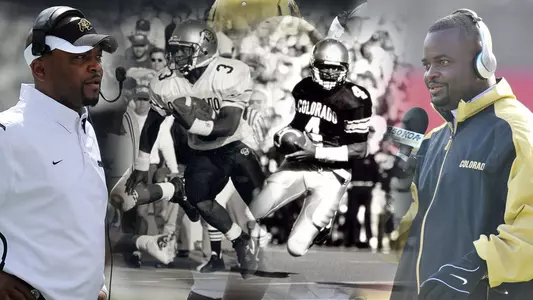
Brooks: Q&A With 1990's Pair Of QBs
October 01, 2010 | Football, B.G. Brooks
BOULDER - In 1990, the Colorado Buffaloes were one, so much so that CU might have been college football's most unified team. There were dynamic leaders at the top, there were superstars on the roster, and there were role players.
But the common denominator was unity, blended with uncommon leadership.
Almost on a weekly basis, different players stepped forward in different circumstances, pushing themselves and their teammates through what was arguably the most difficult schedule in CU history.
While leaders were plentiful on offense, that on-field duty normally falls to the quarterback. The Buffs had a highly capable pair who would play pivotal roles in their national championship season.
Junior Darian Hagan was the starter, senior Charles Johnson was his backup. Hagan missed parts of three games due to injury, including the 10-9 Orange Bowl win against Notre Dame that earned CU its national title. But Johnson was there when called upon in those crucial relief roles, which included games against Washington, Missouri (Fifth Down) and the championship night in Miami.
Hagan was a scrambling, free-spirited playmaker, running the option and making improbable pitches to his trailing backs. He was an able passer for CU's offense, completing 75 of 163 passes 1,538 yards yards and 11 touchdowns (eight interceptions), and ran 138 times for 442 yards and five TDs.
Johnson didn't have Hagan's quickness, but he was efficient in running the offense. He attempted 32 passes, completing 15 of them for 241 yards and two TDs (one interception). He ran 28 times for 37 yards and two scores.
Both former players have maintained ties with their alma mater. Hagan currently coaches the Buffs running backs, while Johnson is an assistant athletic director/external affairs at CU. "CJ" also co-hosts an afternoon radio show in Denver (102.3 FM).
With CU honoring the '90 team and coaches this weekend on the 20th anniversary of the national championship season, CUBuffs.com posed five questions to the pair of '90 QBs.
1. Where did the '90 Buffs draw their most inspiration?
Hagan: "In my opinion, we drew it off of each other. But at the same time, in the back of our minds, we were still playing for Sal's (Aunese) memory. We never lost focus of him, although we were playing for us. We knew everywhere we went we were going to be a marked team. Our mantra that year was 'The Will To Win' and whatever it took, no matter what it took, we were going to win that ball game. I'll never forget that."
Johnson: "I think Bill McCartney would be the obvious answer . . . but the interesting thing, one thing I learned in that '90 season, I think in a championship season you need multiple sources to draw from. While Coach McCartney was the primary source, depending on the week or the game, it was a different teammate. Of course, Eric Bieniemy was probably the second-most obvious source of inspiration. But I remember a practice where Kanavis McGhee and Joe Garten literally got in a fight because they were so inspired to win - and we drew from that. Each week we drew from something, so that was one of the unique aspects of that team. In fact, someone asked who were the captains of that team - and I didn't know. Normally captains are your team leaders and certainly Alfred (Williams) and Joe Garten were, but again, it was a different two or three guys each week."
2. Did this season have a transformational game?
Hagan: "I think it was pretty much all of them. The first game, right out of the gate, was a test of wills. We were up 31-17 and wound up tying the game (with Tennessee). Our defense lettered that game; to letter you need 100 plays - I think they had like 111 plays. They lettered that game. Going into the Stanford game, we had to have a fourth-quarter drive to win it. Then in the Texas game, we're losing going into the fourth and (Eric) Bieniemy gets us all together and tells us, 'OK, this is how we're going to win . . . The defense is going to get a stop right here, then we're (offense) going to drive, get a touchdown and win the ball game.' And that's exactly what happened. So pretty much all season, it was a test for us. We never could relax, which was good. The only game we got to relax in was the K-State game (a 64-3 CU win in the final regular-season game). That was the only one. Other than that, oh my God, it was tooth-and-nails and always something that made us crawl and scratch to get the victory. But that tested our manhood and it tested our coaches and our beliefs in each other."
Johnson: "I think it was probably Texas or Washington . . . the Washington game sort of gets lost in the shuffle a little bit. Tennessee obviously was a big one - the season opener. Stanford, we won on a last play, Bieniemy scores a touchdown. But Washington, I think we won 20-14 and they were marching. Deon Figures made a big play (interception) at the end of the game. But I think Texas probably the game that really got us focused and headed in the right direction."
3. What was the biggest break of the '90 season?
Hagan: "The clip in the national championship game (in the 10-9 victory against Notre Dame in the Orange Bowl) . . . The clip was the big one, 'Fifth Down' was the controversial one. There were a lot of games that we won in the last minute. But I think 'Fifth Down,' the clip and the fact that in all those games - all of them being tough, tooth-and-nail - we won them. And everyone else who had replaced us as No. 1 through the Top 20 started losing. We beat K-State in the last game of the year and we wound up going into the bowl game as No. 1 in the country."
Johnson: "You know, for me, I go back to the Washington game . . . I remember Hagan had gotten injured and we coming out of the North end zone and there was a third-and-long. I think we were winning at the time, but it was late in the game - second half for sure. And Mike Pritchard - again it was just one of those little plays, a non-descript third and maybe nine that you convert - but you go on and make two or three first downs. I think we ended up punting, but it flipped the field. And it certainly took Washington out of position to score a touchdown. But I think our season, if you think about it, was full of those types of deals. It was the Stanford game I mentioned. It was Texas, after being down at Texas and what Bieniemy did at the end of the third quarter to fire the team up. Missouri speaks for itself . . . but the season was full of those types of nuggets."
4. Who gets your vote as the '90 MVP - and why?
Hagan (laughing): "Oh, without question, me. No, we had a lot (of MVPs). Bieniemy probably would get the vote, because he wound up third in the Heisman (voting) and was our leader. He rushed for a lot of yards (1,628 in the regular season) and a lot of touchdowns (17). You could make an argument for (Mike) Pritchard . . . there were a number of guys. But I think hands down, it was Eric that year."
Johnson: "This is funny, but I think Mike Pritchard was voted MVP and he certainly was one guy. Eric Bieniemy is certainly another guy . . . Hagan, Joe Garten, Alfred Williams . . . I mean where do you want me to stop? But you know who the most valuable player to me was? George Hemingway. What we did was so dependent on our fullbacks' production, and he was such a good cerebral - not just such a big physical - back, but he knew, he had down to a science what we were doing offensively. In a way, again I can make a legitimate case for 10 guys easy, but I'd say George Hemingway in my book was the most valuable player on the 1990 team."
5. What's your favorite '90 memory?
Hagan: "Probably (overcoming) the frustration that we had for three quarters at Nebraska. The fumbles we had, then putting it all together in the fourth quarter (for a 27-12 win). This rowdy place that gets real, real loud was quiet as a church mouse. It was unbelievable, that feeling. We go down and score, they try to fake a punt, we stuff it, get the about on the 30, drive it and score and they're quiet. People start leaving. That's probably my best memory from that year - and obviously the national championship."
Johnson: "Probably has to be the Sheraton Bal Harbor (Miami) after the championship game - although that took place in 1991 . . . we're not that technical on this, are we? I just remember, for me it was one of my favorite moments because I realized at that point that that would be my last game. I remember just watching happy people, most of whom didn't play football, weren't on the staff, they were just impacted by what had just taken place. And I realized that what we had just accomplished was much bigger than the football team."
Contact: BG.Brooks@Colorado.EDU