Colorado University Athletics
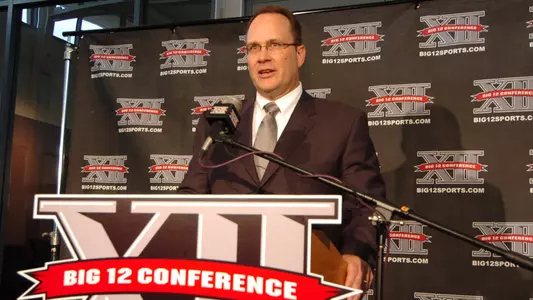
Brooks: Beebe Talked Tradition, Big Bucks To Save Big 12
June 15, 2010 | General, B.G. Brooks
The promise of a more lucrative television contract and additional monies from exit penalties ultimately might have kept linchpin schools Texas, Oklahoma and Texas A&M among his fold, but Beebe also leaned heavily on geography and tradition to keep his conference from disintegrating.
"A lot of people thought it wouldn't be good for college athletics if the Big 12 ceased to exist," he said. "It would have been a major travesty if our schools relocated with a conference not in this region."
In a nearly 50-minute teleconference Tuesday morning, an obviously relieved Beebe recounted what he called "a significant roller coaster ride" during a six-month period that last week saw Colorado and Nebraska leave the Big 12 and at least four other schools - Texas, Texas A&M, Oklahoma and Oklahoma State - decline invitations to accompany CU to the Pac-10.
Texas Tech's regents were scheduled to meet Tuesday afternoon and were expected, according to Beebe, to affirm their allegiance to the Big 12. To solidify the schools' intentions of remaining in the league, its board of directors "requested a public, unequivocal commitment for the future," Beebe said. "All nine have done it, and we're anticipating one from Texas Tech."
After CU and Nebraska, which is leaving for the Big Ten, stated their intentions to change leagues late last week, the Big 12 appeared on the verge of collapse. But bolstered by a show of support he said extended well beyond his conference, Beebe was able to convince Texas to stay - and the remaining nine schools fell in line.
"One of the big misnomers is that this is all about money, because they are committed to this conference for more reasons than that," Beebe claimed.
Although he conceded Texas "has a lot of influence; they're a very significant member institution," Beebe said it was equally unfair to say "one institution alone" was driven by the lure of more television revenue to consider moving to another conference. Oklahoma and Texas A&M, also coveted by the Southeastern Conference, were concerned about their market values in any future TV negotiations and "looked in earnest" at moving, Beebe said.
Although a new TV contract is not in place (the Big 12's deal with ABC-ESPN runs through the 2015-16 academic year), Beebe said other networks (primarily Fox Sports) have shown "a high level of interest" that could put the remaining 10 league members "on par with anyone in country" in terms of TV earnings. Also, Texas reportedly wants to establish its own network. TV revenue in the Big Ten, which has its own conference network, is said to be $22 million per school, per year.
Additionally, Beebe's league will get penalty money from CU and Nebraska for leaving. He said attorneys were reviewing league contracts, which state the conference can "withhold up to 80 percent" of each school's conference distribution in the next two years from TV and postseason (bowls, NCAA Tournament) appearances. Published figures have put the total at between $9 and $10 million for each school.
The Big Ten reportedly wants Nebraska to begin competing in 2011. Pac-10 Commissioner Larry Scott said last week he expects CU to join league play in 2012, but noted that could change.
Whatever CU and Nebraska owe the conference, Beebe said the larger portion of the monies would go to Texas, OU and Texas A&M - the money distributed with the blessing of the five schools that appeared to left out of possible major conference realignment.
Baylor, Kansas, Kansas State, Iowa State and Missouri, said Beebe, "were looking at possibly a different future . . . even if the Big 12 had repopulated, their (futures) didn't look too good without Texas, Oklahoma and Texas A&M.
"It hasn't been completed yet . . . there's a lot of last (minute) scrambling. But part of their thinking was that we would hold out the distribution that would have gone to us from those member institutions (CU, Nebraska) and use that to help Texas A&M, Oklahoma and Texas hopefully stay in the conference and overcome the significant revenue projections they were getting for going to another conference or two."
Beebe acknowledged that following such an intense period of speculation over who might be leaving, who's staying, who might be left out, a period of healing is in order.
"Any kind of exercise like this results in some bruises we have to heal," he said. "But I think there's also even a higher level of understanding of how much we need each other. And my full anticipation is that we move forward and heal the bruises and that we're going to have a level of commitment that we haven't had in the past. And a level of understanding of what these institutions mean to each other.
"A lot of these things come out in the fan world more than they do in the administrators' world or the coaches' world. I mean I've gotten a lot of texts from our coaches expressing extreme gratitude to keep this together . . .
"We certainly recognize that you can have trying times in any kind of human relationships where there's exploration of other possibilities . . . but when it comes together again, there can be a renewed, even higher, level of commitment that'll carry forward the conference to even greater days."
With the Pac-10 and Big Ten rumored to be eyeing the formation of 16-team "super conferences," the survival of Beebe's conference might have quashed that forecast - even if temporarily.
The "super conference" concept, said Beebe, "may be discussed for years to come . . . this process resulted in so many people in our (business) indicating to me and others how they felt it would not be beneficial to what we do to have mega-conferences that really become more like associations. We have a pretty good balance in this country in Division I . . .
"We serve for student-athletes and their experiences. We serve for the supporters and the fans in this region in the country, and their experiences and their pride in their institutions. And I really firmly believe that when we get too far outside the geographic region and you've got your teams competing against teams of people you don't even know, that's going to in the long run diminish the value and the experience in intercollegiate athletics.
"We're not professional teams moving multi-millionaires from city to city, who only have their jobs to worry about and don't have to come back and do class work and be in a community of students. So that's my firm belief. Maybe the future is going to prove me wrong; I hope I don't have to exist in that future. But we landed in a good place - not for just the Big 12 but for all of intercollegiate athletics, in my judgment."
Beebe declined to specify projected TV revenue from future contracts or to speculate on a new name for his conference: "We have to decide all that . . . I don't want to give my indication now and my members say, 'What the heck are you thinking about?'"
He also said the league "is not looking to expand, and we wouldn't with any institutions that aren't in our five-state geographic area."
With 10 schools remaining, regardless of what it's ultimately called, Beebe said conference members look favorably on a nine-game league schedule in football and an 18-game double round-robin schedule in men's and women's basketball. He also believes losing its championship game in football (the NCAA requires 12 league members but could be petitioned to allow a 10-team conference to stage a title game) won't be a major handicap in one of his schools reaching a BCS championship game.
Beebe characterized himself as being "blessed with perseverance, because if I didn't have that, it would have been a difficult challenge to get through it . . . I've always had an optimistic view, a glass-half-full view. And I felt like, through a lot of contemplation, that the best place for the member institutions that remain and even those frankly that departed, was to continue with this tremendous association."
Contact: BG.Brooks@Colorado.EDU