University of Colorado Athletics
Brooks: This Is Not Just Another Brick In The Wall
August 06, 2011 | Football, B.G. Brooks
BOULDER - The best way to rebuild is brick-by-brick, and last week Jon Embree needed 150 of them. So he telephoned Conley Smith, a former Colorado teammate in the mid-80s and now the owner of a local landscaping company. Smith delivered.
On Wednesday night when Embree's Buffaloes reported for their first team meeting of training camp, there were buckets of Smith's leftover bricks lined up at the front of the Dal Ward Auditorium.
Embree started with the seniors, then went class by class, giving a brick to each player. Then he called up his assistant coaches and presented a brick to each. The players are keeping the bricks in their lockers, most of the coaches have made a place for them on their desks.
The metaphors here are multiple, but here's what Embree has in mind: A construction project - a major restoration, if you will - is underway. Heavy lifting is required, and it's not going to done easily or overnight. It will be done one day at a time, one week at a time, one win at a time, one brick at a time - and there will be times over the coming weeks when bone-weary players question their commitment to seeing the project through.
Open your locker, look at your brick . . .
"I want them to understand when it gets hard - and it's going to get hard in camp, when coaches are wearing you out and I'm riding you like Seabiscuit - the reason why is that you're getting those things, that tradition, back," Embree said.
"That overrides everything else. It's not about you, it's not about how tired you are, how you feel . . . it ain't about you. It's about getting it all back."
The bricks also symbolize the "big game bricks" that once were prominent in a lower Dal Ward hallway leading to the locker room. Each time the Buffs won a significant game, the score and date of the victory were printed in gold paint on one of the hallway's bricks. Over the years, it became an impressive display, a tangible link to past tradition and high standards - until it was painted over under the former regime.
Embree wants it restored, and if the Buffs win at Hawaii in their opener on Sept. 3, it will be the first brick in the wall. The game is significant for other reasons, too: CU's road losing streak is at 18, dating to 2007, and the game, of course, is the first of the Embree Era.
The brick presented to him and his teammates, said senior tailback Brian Lockridge, "don't mean anything unless you value the significance of it. I think we all know what it means; it's about rebuilding something special here."
"It's all about tradition," added junior inside linebacker Doug Rippy. "It's something you can't argue against or fight against. It's something you've got to do. Honestly, we need to bring it back here. Receiving that brick from him means a lot to me because it comes from a former player here who has done it."
By now, after a spring under Embree and three days of his fall camp, players are aware that they've entered a no-nonsense environment. On game day at Folsom Field, there will be no inflatable tunnel, no thunder-chute, no smoke and presumably no mirrors. Embree and the Buffs will take the field behind Ralphie and play. Period. He wants his football done simply, cleanly and physically.
CU's intended mindset for 2011 - again exemplified by the bricks - has been made clear to all. Said Embree: "There's no gray area at all; I believe you have to set the tone for whatever it is you want to do for the year. I want them to understand that when we go into a game, there's no doubt in their minds about what it is that we need to be doing, what our mindset is."
Are the Buffs clear as to what that is? The message relayed via brick, noted junior linebacker Jon Major, isn't difficult to decipher: "Just like he intended it . . . when it gets tough, you want something tangible to remind you what our goals are. I understand what he means by getting those bricks back up (in Dal Ward). We've lost 18 straight on the road. If there's any ground zero, it's right there. That's where you've got to start from."
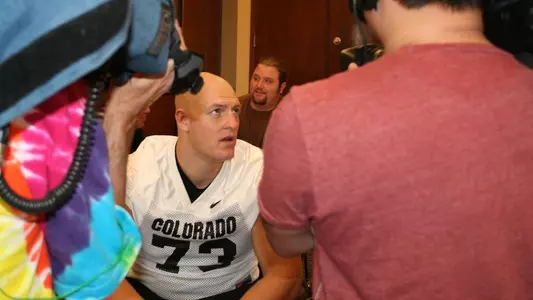
And Embree acknowledges how critical a swift, successful start will be for this team. That it's on the road makes it all the better, and certainly more challenging. "We've got our work cut out; that's what I think about Hawaii and I'm excited to go," Embree told Saturday's media day audience, adding that the extended travel to the islands shouldn't be that big a disruption for the Buffs because whatever road routine they've had since 2007 has flopped anyway.
"It'll be a little bit different, but it's good that we don't have a routine; we've lost 18 in a row," he said. "Maybe we should start taking buses, maybe that's what we have to do. Or do something. So it's good that we don't have a routine . . . I'm excited that our first game is on the road. Let's get this thing (the road losing streak) over with, get it over with."
The Buffs are a near consensus pick to finish last in the South Division in their Pac-12 debut season. Generating as much momentum as possible before the conference opener arrives (Oct. 1, Washington State) is "very critical," Embree said. "The way our schedule is, it goes from hard to real hard. There's no 'caterpillaring' your way out of it and let's hope for the best. It's important that we start fast for a lot of reasons.
"(Players) need to know, need to understand the importance of it. You want to start fast every year. If you just sit there and think 'we'll start in game four,' you're out of it. The nature of the program here at the University of Colorado, you're going to play good teams out of the gate. We can't afford to wait for a quote 'easy' game; we don't have any easy games. It goes from hard to real hard and the players have to understand that.
"I tell them all the time, I'm going to tell you the truth - and the truth here is that we have to start fast. We have to get going. So they need to prepare that way. We have to have a sense of urgency."
Once they open at Hawaii, the Buffs will play for 13 consecutive weeks without a bye, a brutal march that will bring significance to strength and conditioning coordinator Malcolm Blacken's mantra of "train for five (quarters)." He could add something about survival of the fittest and it would fit nicely, not the least bit overstated.
That demanding 13-week stretch, said Embree, will change how the Buffs approach their work in November: "We'll have to be creative in how we practice. You can't pound them every day and expect them to go out and do it on Saturday. You have to hit enough to know they still like hitting, still have that as part of their fabric, their makeup. We'll have to be creative in how we do that as the season goes on."
But as August heats up and the clock ticks toward an eight-hour plane ride to paradise, how the Buffs finish is not as critical as how they start. Since Embree and his staff arrived last winter, the emphasis has been on "changing the culture" in Dal Ward. A questioner Saturday wanted to know if that's happened yet.
Get back to me after the Colorado State game, said Embree. That would be three games into what might be the nation's most demanding schedule, one with no gimmes, no frills, no breaks.
Late on the afternoon of Sept. 17 in Denver, Embree believes he'll be able to speak more authoritatively on the changing culture of CU football. Better yet, he'd like two or three newly decorated bricks in a Dal Ward hallway to speak for him.
Contact: BG.Brooks@Colorado.EDU