Colorado University Athletics
Brooks: Buffs Hoops Teams Focus On Righting The Ship
January 31, 2014 | Men's Basketball, Women's Basketball, B.G. Brooks
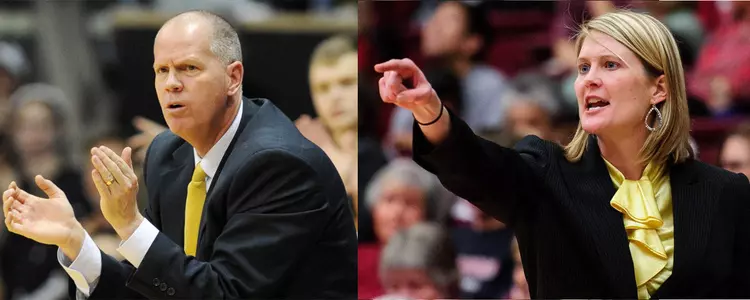
BOULDER - If necessity is the mother of invention, are injuries on a basketball team the father of re-invention? If you've been following Colorado men's and women's basketball, you've got a strong idea of where this is headed.
The late-January parallels between Tad Boyle's and Linda Lappe's respective teams are darkly similar. In late December, both teams were cruising along merrily, successfully. Both were ranked - Boyle's squad as high as No. 15, Lappe's as high as No. 11 - and focused on day-to-day, week-to-week improvement before opening play in the Pac-12 Conference.
Two weeks later, Boyle's and Lappe's hoops worlds had severely tilted.
To recap: Boyle lost leading man (scoring, assists, 3-point shooting and several intangibles) Spencer Dinwiddie for the season with a knee injury and rapidly improving reserve Tre'Shaun Fletcher for 6-8 weeks, also to a knee injury. Not to be outdone on the injury list, Lappe lost a backcourt combo - Lexy Kresl (leg) and Jasmine Sborov (foot) - that had opened in her team's first 14 games. Kresl was becoming a solid point guard, averaging 9.2 points, 4.4 rebounds and 3.6 assists. Sborov was dependable overall, contributing 7.8 points and 4.6 rebounds.
The CU men's record since Dinwiddie-Fletcher went out: 1-4, which includes the game (Washington) in which both were injured. The skid by Lappe's team isn't as easily defined by the absences of Kresl-Sborov; the slide was beginning before either was injured, with the past 11 games yielding a 3-8 mark.
Kresl has missed the past three games and could miss another four weeks, while Sborov has been out for six games and might not return until late next month. Did losing Kresl and Sborov speed up their team's descent over the last couple of weeks? How could it not? Same with the losses of Dinwiddie-Fletcher on the men's squad.
"It's always tough losing two players," Lappe said. "You don't want to change your identity, but you have to do some different things to be successful."
At least you have to try. Neither Boyle nor Lappe has plans for a pity party. We're at the halfway point of Pac-12 play, which means there's time for both to make something of the rest of the season - provided somebody(ies) on both teams turn opportunistic and take the necessary steps up.
ONE COMMON DENOMINATOR FOR both coaches: their pair of injuries has increased the minutes of freshmen who otherwise might have had the luxury of being brought along more slowly. What's underscored here is the oft-used assessment of freshmen: The best thing about freshmen is that they become sophomores. Boyle is leaning on first-year players Jaron Hopkins, Dustin Thomas and George King for amped up productivity, while Lappe has turned to Haley Smith, Desiree Harris and Zoe Beard-Fails.
Here's another shared need of both programs: mental toughness. Boyle wants his team (15-6, 4-4) to exhibit it in two foundational areas - defense and rebounding - while Lappe points to eliminating late empty possessions and finishing games for her team (12-8, 2-7). Of her team's last six losses, one was by three points, the other two by two. More efficient execution and grit down the stretch might have added three 'W's for her squad.
Both coaches are targeting weekend home games to begin showing improvement. Utah's men and women visit the Coors Events Center - the men playing Saturday at noon, the women Sunday at noon. Both games will be telecast on the Pac-12 Network.
I asked Boyle the other day if he was comfortable with saying his team had to "re-invent" itself in the wake of its two key injuries. His answer: "I wouldn't use that . . . that's somebody else's term. They can say what they want to say. My thing is, we have to continue to do the things that have allowed this program to be successful in the past. We just have two less players to do them with, but it doesn't mean it can't be done. Everybody has got to work a little harder, maybe a few guys in different roles, a few guys playing more extended minutes . . . it's a challenge."
Talk with Boyle on a regular basis about his team and the conversation always, always comes back to defense and rebounding. As a prelude to Saturday's Utah game and the pair of home games that follow - Washington State on Wednesday, Feb. 5, Washington on Sunday, Feb. 9 - Boyle wanted the last three season's home records when CU has outrebounded its opponents and held them to under 40 percent from the field.
If you need proof that winning those two areas benefit the Buffs in the CEC, here you go: In home games in Boyle's 31/2 year tenure, CU is 36-2 when winning those two categories. The breakdown: 6-0 in his first season, 13-1 in his second season, 12-1 last season and 5-0 this season.
"Our first team, with Alec (Burks), Cory (Higgins), Marcus (Relphorde) and Levi (Knutson) was a very explosive team . . . we had some offensive players. I think we were fifth or sixth (nationally) in scoring and free throw shooting," Boyle said.
What went unsaid: There obviously was room to improve in his two key categories. That team averaged 79.6 points and allowed 73.3. In the three seasons since, the Buffs' defensive yield per game has dropped to 63.0, 63.6 and 68.0 - with that last number obviously not in line with Boyle's goals.
But by years two and three, his message began to take root. CU's 2011-12 team with Carlon Brown, Nate Tomlinson and Austin Dufault began achieving what Boyle emphasized, as did last season's Buffs with Andre Roberson, Sabatino Chen, Shane Harris-Tunks and Jeremy Adams.
This season, said Boyle, "We're on pace (in winning the board/defensive categories) with the first year, but we need to be on pace with years two and three. The mindset of our players right now is not where it needs to be. And as a coach, I have to take responsibility for that."
BOYLE'S TEAM IS COMING OFF an "o-fer" in the desert - a 69-57 loss at No. 1 Arizona followed by an embarrassing 72-51 slap to the psyche at Arizona State. "(ASU) was a debacle and I take responsibility," Boyle said. "We weren't very good and weren't ready to play. We got blown out (but) we're better than that. Right now, the way we played in Arizona, we don't have an identity, nothing to hang our hat on night in, night out. That's always been and will be defense and rebounding. I've done a bad job of keeping these guys focused in those two areas . . .
"Right now we're not good at anything. We're not bad. Arizona State - that game aside - we weren't good in anything in that game. We've shown flashes; even in the Arizona State game we had great defensive possessions."
Obviously, there weren't enough to satisfy Boyle or, of more importance, to keep the game close.
Meanwhile, Lappe isn't reluctant to agree her team is into re-inventing itself after the loss of two starting guards. "A little bit, yeah . . . offensively and defensively," she said, adding that Kresl and Sborov "were very important for us on the defensive side of the ball. But since the USC game we haven't performed well offensively or defensively. It's just been a challenge on both sides of the ball. I know we have the ability, we just have to execute."
Having lost six of their past seven games and facing the Pacific Northwest swing (Oregon State on Feb. 7, Oregon on Feb. 9) after hosting Utah Sunday, the Buffs are in need of a "go to" finisher - Chucky Jeffery filled that role for most of her CU career - or a couple of players who can step up and help reverse what has become a troubling trend of wasted late possessions.
"One big battle is how to finish games," Lappe said. "We're having to do different things with different personnel (after losing Kresl and Sborov). One positive is that players have the opportunity to step up but they have to do it."
The bright side for Boyle and Lappe is that enough season remains for both of their teams to address what they can and keep climbing. "We have to keep plowing forward, keep our heads down, keep working and become a better team," Lappe said. "If you do things the right way and take care of what needs to be done, you'll come out of it. But we have to be consistently focused and tougher in every way."
Tad Boyle would second that for his team.
Contact: BG.Brooks@Colorado.EDU