Colorado University Athletics
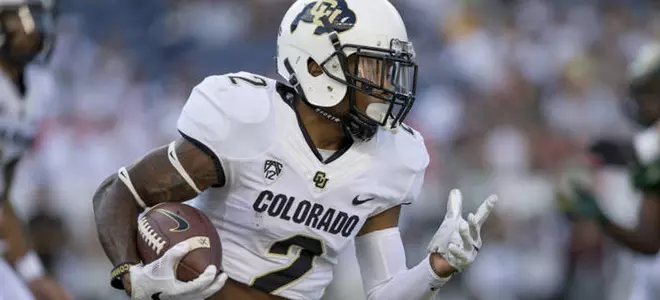
Woelk: Keys To Buffs-Ducks Game
October 01, 2015 | Football, Neill Woelk
BOULDER — Since Colorado joined the Pac-12, the Buffs' numbers against Oregon have been overwhelmingly in the Ducks' favor.
In the last four games between the two, Oregon has averaged 54 points points per game compared to 10.5 for Colorado. None of the games have been remotely close (although the Buffs did grab a very temporary 10-8 lead in the 2013 game).
But this year, the Buffs believe they're ready to compete with the Ducks. Colorado brings a three-game winning streak into Saturday night's nationally televised contest at Folsom Field (8 p.m., ESPN) while Oregon is still hurting from last weekend's 62-20 thumping at the hands of Utah. The Buffs believe it's an opportunity to end an 11-game conference losing streak and start their 2015 Pac-12 campaign on the right note.
What has to happen for the Buffs to turn the opportunity into a reality?
1. Fast start. There's no question the Ducks come into this game with damaged psyches, while the Buffs have thus far this year made good on their aim for a "fast start at Folsom," outscoring their opponents 35-7 in the first quarter of their two home games.
The Buffs need to continue that trend this week.
If the Buffs start fast, the Ducks can't help but wonder if another long night is in their future. The Ducks are already reeling from the Utah loss, and a few big punches by Colorado early would put the Ducks back on the ropes.
But if CU allows Oregon to jump out to a couple of quick scores, which has more often than not been the case in their series, the Ducks will regain their confidence quickly. Colorado had shown the ability to come from behind this year — the Buffs overcame a 14-0 deficit against Colorado State — but it's not something they want to attempt against the Ducks.
2. Running game. Much has been made of Oregon's pass defense, which struggled mightily against Utah, giving up 227 yards and four touchdowns.
But the Buffs first need to concentrate on stopping big back Royce Freeman. The 5-foot-11, 230-pound sophomore is a beast who popped CU for 105 yards on just 17 carries last year. The Buffs need to contain Freeman and force Oregon to depend on either Adams or Lockie to win the game in the air.
Don't be surprised if the Ducks turn to Freeman early and often. Running backs coach Gary Campbell told the Eugene Register-Guard earlier this week, "I think we're going to have to do that a little bit more. If your quarterback is either not performing or not able to perform, then you've got to lean on other guys."
Colorado, meanwhile, has to establish its running game. The Buffs have had two big rushing performances, but both came against lesser teams. This is a week when Colorado needs to establish a consistent running game, control the clock and keep the Oregon offense off the field.
3. Quarterback play. This is an obvious point in just about every college football game, but the questions marks surrounding both teams' QBs make it an especially intriguing issue.
For the Buffs, quarterback Sefo Liufau has been hampered by a shoulder injury suffered in the win over Colorado State. He played last week and put up efficient numbers in a 48-0 win over Nicholls, but he admitted earlier this week that he still feels pain when he throws. Wednesday, CU coach Mike MacIntyre said Liufau "threw the ball better today than he did last Wednesday," an encouraging sign, but how much he'll improve by Saturday is a big unknown.
For Oregon, the Ducks still haven't decided on a starter. Vernon Adams, who was ineffective in the loss to Utah, is still nursing a broken finger on his passing hand while backup Jeff Lockie is healthy, but did not fare any better against the Utes. Oregon coach Mark Helfrich has not tipped his hand as to which way he's leaning, meaning the Buffs are preparing for both.
Again, quarterback play is always a major factor. But with the unknowns surrounding the position for both teams, whichever quarterback establishes a hot hand early will go a long way in determining the course of the game.
4. Big plays. The Ducks have dominated this department in recent years. In the last four games, Oregon has 11 touchdown plays of 20 yards or more.
But CU's defense has been much better this year in preventing the quick strike. After allowing a 75-yard touchdown pass to Hawai'i in the first quarter of the season opener, the Buffs have allowed just one scoring play of at least 20 yards — a 25-yard scoring pass by CSU — in the last three games.
Of course, nobody — not even MacIntyre — is expecting the Buffs to completely shut down Oregon's quick-strike capability.
"Oregon's going to have a big play or two, they always do," MacIntyre.
The key will be whether the Buffs can limit those plays, and if they can regroup when one occurs and prevent it from starting an avalanche.
On the flip side, Oregon's defense has been gashed by big plays. According to goducks.com, Oregon has allowed four plays of 60 yards or more this year — only two teams in the nation have allowed more — and the Duck defense has given up 23 gains of 20 yards or longer. If the Buffs can hit hit the Ducks with a couple of long scoring plays, it will be a big step in seizing momentum.
5. Turnovers/quarterback sacks. If there's one place the Buffs have shown dramatic improvement this year, it's been turnover margin.
After intercepting just three passes all of last year, the Buffs have already picked off seven opponent passes this year, along with recovering a pair of fumbles. CU's offense has also improved in that regard, with just three fumbles lost and one interception this year — and just one turnover in the last three games.
Colorado has also been excellent in protecting the quarterback. Since allowing four sacks in the opener at Hawai'i, the Buffs haven't given up a sack in the last three games.
The Ducks, meanwhile, have turned the ball over seven times (four interceptions, three fumbles) and have forced seven (five interceptions, two fumbles). More importantly, the Ducks have allowed 11 quarterback sacks.
If the Buffs can force an early turnover or two — or at least get to the Oregon quarterback and get a field position advantage — it will be a big step forward in the momentum department.
6. Special teams. An area in which both teams have had their good and bad moments this year.
CU's kick return game has been solid. The punting game has improved dramatically since a blocked attempt early in the Hawai'i game, and Jay MacIntyre has added a new element to the punt return squad. The field goal block team had a huge play in the win over Colorado State and CU's kickoff coverage has been good. Still, the Buffs have shown a penchant for giving up the occasional big play.
The Ducks, meanwhile, had several breakdowns in the loss to Utah, including giving up a 69-yard punt return for a touchdown on a trick play and 33-yard run for a first down by the Utes' punter.
In close games, a special teams big play — or mistake — often makes the difference. The Buffs can't afford to make any mistakes in this area.