Colorado University Athletics
Brooks: Buffs Seeking To Reestablish Stability In O-Line
October 16, 2015 | Football, B.G. Brooks
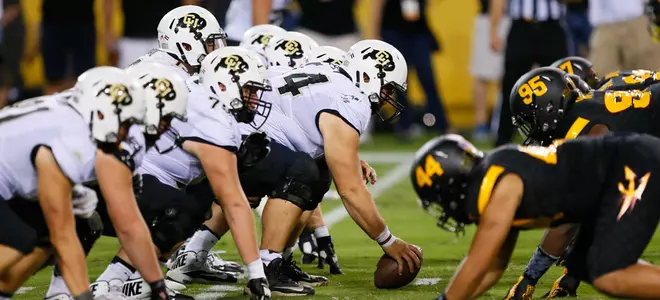
BOULDER – With the end of October and the midway point of the college football season in sight, Gary Bernardi figured his semi-rebuilt Colorado offensive line would have gained confidence, cohesion, experience and would be in optimum working order.
Instead, CU's O-line has become a mid-season work in progress.
"It's just the way it is," said Bernardi, whose August assignment of replacing two starting guards has been supplanted by an October challenge of what might best be described as the big-boy shuffle at tackle.
When the Buffs lost junior starting left tackle Jeromy Irwin to a season-ending knee injury on Sept. 12, Bernardi plugged in Sam Kronshage for the next three games. But Kronshage, a sophomore, suffered a concussion in the Oregon game (Oct. 3).
That prompted the shift of senior starter Stephane Nembot from right tackle to left tackle for last weekend's game at Arizona State. Redshirt freshman John Lisella II, making his first start, struggled and was replaced by junior Shane Callahan, who previously had rotated at guard with starters Gerrad Kough and Jonathan Huckins.
Need a diagram yet?
For Saturday's Homecoming game against Arizona (7:05 p.m., FS-1, Folsom Field), Bernardi hopes to have Kronshage back in the lineup at one tackle and Nembot at the other. If kickoff were Tuesday night, Bernardi would have started Nembot on the left side.
Kronshage, who is yet to allow a quarterback sack and leads the O-line with 14 knock-down blocks, said he is feeling better daily and expects to play. Fixing the line on the fly, he said, isn't ideal but neither should it be disastrous: "We've taken injuries and people have had to step in when they weren't expecting to. But you always have to prepare, which we do. It stinks, injuries suck. But you have to deal with it, overcome and adapt. You keep rolling with the punches."
But who Bernardi lines up first and where was to have been determined over the Buffs' last three days of preparation for the Wildcats (4-2, 1-2). He's taken every precaution to be prepared for whatever develops on Saturday night.
"I had three guys take snaps (at center) just in case I had to move somebody else around," Bernardi said early in the week. "I'm going to keep moving them, keep working everybody in those spots, but controlling it so we have continuity too."
Kough and Huckins, both sophomores, have started in their respective left and right guard positions for six consecutive games, as has junior center Alex Kelley. "Coach wants me to be an anchor in there, so I'm trying my best," Kelley said. "I'm good, I'm loving it."
THUS, THE MIDSECTION OF THE Buffs' O-line has been fairly stable, unlike the recent revolving door at tackle.
"It's not easy," Bernardi conceded, "but it makes it easier that there's guys like Alex to help with the communication and help carry those situations. But you've just got to do it. You have to adjust, improvise . . . I mean, what are you going to do? In the NFL they've got seven guys (in the O-line) that they travel with. They don't just stop the game."
A 34-year coaching veteran, Bernardi isn't a first-timer in preparing O-linemen to play all five positions and plugging them in wherever and whenever needed.
"I've been really happy for the most part over the three years (at CU) that when something's happened and a guy's had to go in he's done a good job," he said. "It happened three times last year and each time wasn't a disaster. Guys picked it up and did a really good job. For the most part that's happened this year."
As for Callahan, he's been practicing this week at guard and tackle and says he's comfortable at either spot.
"A year ago I would have said I wanted to play tackle," said Callahan, who played that position primarily at Auburn before transferring to CU. "But now, after shuffling so much, I really don't have a preference. I like playing O-line. Each (position) has its pros, each one has its cons. There's different things that are harder or easier at each position.
"But it's fun. I like playing different positions; you get a different outlook on things. And coach Bernardi has prepared us really good for it, which helps a lot."
The shuffling at tackle probably has been a contributor to – but by no means the biggest reason for – the Buffs' rising number of sacks and declining numbers in the running game. Last season, CU allowed a league-low 23 sacks. Through six games this season, that number is at 17, with 13 of them occurring in the last two games.
Protecting quarterback Sefo Liufau, said Kronshage, is "always a big emphasis . . . he got hit a lot last week (eight sacks by the Sun Devils), so everybody's got to improve. But, yeah, we've got to keep him cleaner."
Admitting that it might be unrealistic, Kelley nonetheless said the Buffs' weekly goal is to give Liufau ten untouched seconds on each pass attempt. "That might be impossible but that's our goal," Kelley said. "So we prepare like that every week."
Shuffling personnel at tackle, he added, isn't as much a factor in the sack total as inexperience: "It's not so much moving people around, but just the amount of young guys we have playing. I mean, some of these guys were playing high school football a year or two ago. Now they're trying to play Pac-12 against some of these guys from Oregon and other schools . . . once they get used to the speed they'll be a lot better.
"Yeah, we've got some young guys in there but they'll get used to it. It's been tough, but not terrible because I know how hard these guys work and how hard they prepare each week. So I know they'll be ready."
Pass protection, said Bernardi, is "a group effort – it always is. I'm sure if you watched the film, the quarterback would take a few (sacks) on him, the backs would take a few . . . it is what it is."
SAME FOR THE GROUND GAME. In non-conference play, the Buffs averaged 272 rushing yards. In two Pac-12 losses, they've averaged a conference-worst 63. The defenses CU now faces, pointed out Bernardi, are better and are capitalizing on his line's recent instability at tackle.
"It's a lot easier when 'GerriKo' (left guard Gerrad Kough) has the same guy beside him for six weeks," Bernardi said. "That's what happened last year except for a couple of occasions. I still maintain that when you lose two guys who have 60 starts between them you've got some developing to do."
Plus, the Buffs' running back rotation is still minus Michael Adkins II, who was averaging 70.7 yards (5.05 a carry) through the first three games. Sidelined by a hamstring injury, Adkins won't play Saturday night.
"Probably the guy who made most of the biggest plays hasn't played, so that makes a difference," Bernardi said. "Defenses now scout you and they have a few more complicated things they want to do. There's a lot of reasons (for sacks and the run game's decline). For three or four weeks we had three or four guys rotating, staying fresh and that was good, really good. But it's like everything else – the run game, pass protection, everybody's got to work together."
On Saturday night, the Buffs (3-3, 0-2) face what could be a turning point in their season. It's their last home game of the month – after road trips to Oregon State and UCLA to close out October, Stanford visits on Nov. 7 – and a chance to break a 13-game Pac-12 losing streak.
Plus, the Buffs left Tucson last Nov. 8 believing they never gave themselves a chance in a turnover-marred (two interceptions, two lost fumbles) 38-20 loss to the Wildcats. Those feelings have reoccurred in consecutive conference losses this season.
"Every game is a big game – it's the Pac-12," Kronshage said. "Is it a crossroads? I don't know. We're just trying to take the next game and win it. Then the next one . . . we're not trying to make it any bigger than it is. You just have to prepare and get ready to battle."
Added Kelley: "Coach Bernardi always says your next game is always bigger than your last. So this is the biggest game we've played so far."
Contact: BG.Brooks@Colorado.EDU