Colorado University Athletics
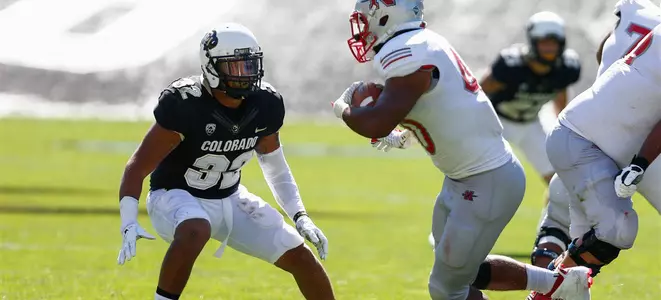
Brooks: Gamboa Debuts For Buffs As A Thinking Man's Linebacker
October 02, 2015 | Football, B.G. Brooks
BOULDER – Rick Gamboa fits no one's definition of a veteran inside linebacker. Redshirt freshmen need not apply. But Gamboa comes equipped with a veteran's mentality; even at 19 he's been playing his sport long enough to know what it takes to improve and that improvement occurs as much without pads as with.
When Gamboa was an impressionable young(er) linebacker in Sylmar, Calif., perhaps the biggest impression was made by San Francisco 49ers linebacker Patrick Willis. A seven-time Pro Bowl selection in his eight seasons with the Niners, Willis retired last March because of recurring foot injuries that he believed would diminish his level of play and eventually might cripple him.
Various reports have put the average NFL career at just under seven years, so Willis' eight stellar seasons at a high impact position were above the norm in length and performance. And Gamboa saw enough of Willis to be awed.
"Watching him, how fast he gets to the ball (and) how big an impact he makes when he's on the field," Gamboa said. "It's a sight to see."
Over the past two springs and summers, Gamboa watched hours upon hours of Willis on tape. But last winter Gamboa's tape study was augmented by an unexpected turn in the coaching world: the position coach Willis played for during half of his NFL career arrived to tutor Colorado's linebackers and coordinate the Buffs' defense.
Jim Leavitt touched down in Boulder at top speed with the volume turned all the way up. And he came in with enough Patrick Willis/NaVorro Bowman (fellow Niners All-Pro linebacker) anecdotes to satisfy even a tape junkie like Gamboa.
Not that Leavitt shares all of them or wants the Buffs to try and emulate either player, said Gamboa: "He tells us not to really focus too much on (Willis) just because he's just a phenomenal athlete and there's not many linebackers running that fast or are that strong and are able to make the plays he makes. We can't do the same things he does because he's such a good athlete. He's something else."
GAMBOA CAN DREAM, BUT THAT'S NOT what has kept him in Leavitt's starting lineup for the past two games. With returning "mike" starter Addison Gillam injured, Gamboa was elevated to the No. 1 spot for the Colorado State and Nicholls State games. He's also expected to open on Saturday night at Folsom Field against Oregon (8 p.m., ESPN).
In both starts replacing Gillam, Gamboa's productivity has been a bonus for the Buffs. He was the leading tackler (seven, six unassisted) in last week's 48-0 blowout of Nicholls State, and the week before in CU's 27-24 overtime win against Colorado State he collected eight (four unassisted). With 25 total tackles (14 unassisted), he currently stands third on the Buffs' seasonal tackle list, trailing fellow linebacker Kenneth Olugbode (32, 13 unassisted) and safety Ryan Moeller (28, 20 unassisted).
Standing 6-foot, weighing 225 pounds, and possessing passable speed, Gamboa concedes that "physical specimen" isn't the first term that Leavitt (or anyone else) would insert in Gamboa's bio. But Gamboa does more than get by with another attribute that many more physically gifted players lack – a passion to improve by dissecting the game and his position's role in it.
Talk to any CU coach or defensive player about Gamboa and the rewind button is pushed time and again. "He really studies the game; he's a very, very smart football player, one of the better ones I've had – and I've had a lot of good ones. Really, really sharp guy," Leavitt said.
Remember this: Pleasing Leavitt, eliciting that kind of praise, doesn't occur with sunrise/sunset regularity. Some of Gamboa's grasp of football might be innate, but Leavitt simply sees hard work paying off: "To be at the University of Colorado you have to be (sharp) . . . but he studies the game . . . he knows when he makes mistakes. He does a good job of coaching himself. Usually without me telling him, he knows the answer."
Which is nothing new for Gamboa. From his time at Chaminade College Prep to his redshirt season at CU to now, Gamboa has been a thinker, a film room devotee who accurately sizes himself up and takes advantage of what he sees on tape of offensive tendencies, angles, weaknesses and the like.
"Yeah, I might not be the biggest or the fastest guy, but I kind of use my smarts to my advantage – knowing where I have to be and knowing what leverage I have to keep and knowing what's going to hurt me so I can cheat to it a little bit more," he said. "It helps me get to places faster . . . it helps a lot."
Teammates quickly recognized what Gamboa brings to the defense. "You've got to take it on yourself to be a student of the game," said sixth-year senior safety Jared Bell. "It just doesn't come in practice. You have to do a little extra and Rick Gamboa does that."
But, added Bell, Gamboa's physical presence is not to be overlooked: "Oh, yeah, he's not afraid to come up and tackle and he's made a bunch of good tackles for us. He's a very physical inside linebacker; it's what we need in the middle. He makes plays in practice and translates that to the game. We have no reason to doubt him."
THROUGH FOUR GAMES, GAMBOA and the Buffs have been effective against the run, allowing 147.8 yards a game (fourth in the Pac-12). But Saturday night they face an Oregon offense that features the conference's No. 3 rusher (Royce Freeman, 112.5 yards a game) and averages 285.2 yards – second-best in the league. With unsteady quarterback play through their four games, the Ducks (2-2) are likely to show the Buffs a one-man parade – Freeman – and put them in the position of either slowing him or succumbing.
Gamboa's points of emphasis in his first game against Oregon are "being able to get to the ball a little faster and shedding blocks." He calls Freeman "one of the best in the Pac-12 . . . if you give him any small crease he can gash you. You have to get to the ball fast and get off blocks."
Although they might not go from play to play as quickly as they did for the last three seasons under 2014 Heisman Trophy winner Marcus Mariota, the Ducks still can turn up the tempo and disrupt a defense. Said Leavitt: "You've got to be ready for the tempo. If you're not they'll work you hard. No question about it."
"A lot of their (big) plays come off the defense not being ready or set because of how fast they're going," Gamboa added. "It makes it hard for a linebacker to follow their formations."
The Buffs are 0-4 against the Ducks in the Pac-12 since joining the league in 2011. A CU focal point Saturday night will be an efficient first quarter, something the Buffs haven't enjoyed in the past four Duck encounters. Oregon has outscored CU 99-10 in the first quarter of those four games, with last season's 13-0 deficit in Eugene the Buffs' closest after the first 15 minutes.
Leavitt points out that he was in the NFL when Mariota was spreading out and demoralizing Pac-12 defenses. But Leavitt also claims that current Ducks QBs Vernon Adams and Jeff Lockie are capable and that the weapons around them are plentiful.
"They've got great athletes, they know what they're doing and are well-coached," Leavitt said, adding that slowing the Ducks ground game is difficult "because they do so many things. They spread you out so much and make you be athletes. Their offensive line is very good and they've got a great running back. Their receivers are good, the tight ends can run. Again, there's not a lot of weakness. Really isn't."
But in an epic loss last Saturday night in Eugene, the Ducks were dismantled 62-20 by Utah. Oregon hasn't lost back-to-back conference games since 2007, when that team closed the season with three consecutive losses. The Buffs, said Gamboa, have dismissed the Utah score and all other numbers and are approaching this week as "a whole different game; every week in the Pac-12 it's like that. You just have to come ready to play."
A spectator rather than a participant in CU's past two losses to Oregon (57-16, 44-10), Gamboa called those two games "tough to see because of how fast downhill they went. I feel there's a difference this year. We have a lot of different guys. And there's a different system we're using. Hopefully everyone does their job, we keep it close and in the fourth quarter anything can happen."
In truth, the Buffs don't want just anything to happen. This season they would prefer something different – say, a win against a Pac-12 team they haven't been close to beating.
Contact: BG.Brooks@Colorado.EDU