Ex-Buff Fagan Carves National Media Career
October 29, 2015 | Women's Basketball, Neill Woelk
Editor's note: This is our third story in a series on University of Colorado graduates who have become leading voices in the national sports media. Earlier, we talked with ESPN's Chris Fowler and Fox Sports' Joel Klatt. Today, we catch up with former CU standout basketball player Kate Fagan, now a writer for espnW and regular on ESPN.
BOULDER — Cornering Kate Fagan these days for a few spare moments of her time is not an easy task.
She might be preparing for one of her regular appearances on ESPN's popular "Around the Horn" … or prepping to serve as a guest host on ESPN Radio's "His and Hers" … or working on her material for an appearance on ESPN's "First Take" … or doing some research for another "Hot Takedown" podcast for Nate Silver's fivethirtyeight.com.
All are part of her regular or semi-regular schedule.
Then there are her unscheduled appearances on the network, when she's asked to provide expert analysis on a wide range of topics, from basketball to soccer to social issues.
And, of course, interspersed among all of that, she must still find time to write — which is how she got her start and is still her first love.
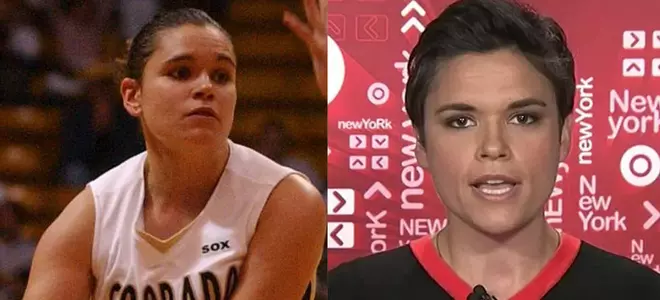
Colorado basketball fans will remember Fagan as one of CU's best players from one of the program's most successful eras. In her four years at CU (2000-2004) — two as a starter — the Buffs played in four consecutive NCAA Tournaments, including Elite Eight and Sweet 16 appearances. Her name is still scattered liberally throughout the CU record book, including career 3-pointers (sixth), season free throw percentage (first), career 3-point percentage (fourth), most 3-pointers in a season (fourth) and season 3-point percentage (second).
But she's made a name for herself today as a leading edge journalist and author, helping shape the national voice on a wide range of topics — and not just sports.
Currently, she's a lead writer for espnW. She's also written for ESPN The Magazine, ESPN.com and the Philadelphia Inquirer, along with a number of smaller publications (including the Boulder Camera, where she launched her journalism career). She also last year celebrated the publishing of her first book, "Reappearing Act."
What's next?
"I'm trying to find some balance of my own," she told CUBuffs.com recently. "I'd like to get back to writing a little more — I want to write another book — but I have to find the time to squeeze everything in."
Fagan once spent the majority of her time writing. In Philadelphia, she was the newspaper's beat writer for the 76ers, and also covered the 2010 soccer World Cup in South Africa. In 2012 — after writing several freelance pieces for ESPN The Magazine and becoming involved with a network project on the 40th anniversary of Title IX — she made the move to espnW. Her first pieces were "typical" sports pieces. She wrote about basketball, soccer and all kinds of other sports that fit the espnW description as "the home for women who love sports."
And then …
"Then it kind of hit me," Fagan said. "Instead of being afraid to write about issues that were important to me and important to society, like LGBT issues, why shouldn't I write about them? I cared about them. Lots of people cared about them. They were important. Why wasn't I writing about them?"
So she started. She wrote about Massachusetts basketball player Derrick Gordon, the first openly gay player in Division I history. She wrote about Michael Sam, the Missouri football player who came out before the NFL Draft. She wrote about Jason Collins, about Brittney Griner, about Ray Rice, about Hope Solo.
But not only did Fagan cover the news about these athletes, she wrote opinion pieces. Strong, powerful, passionate pieces that told the world why the stories were important.
"I don't know that everyone was ready to talk about these issues," Fagan says now. "I'm not sure if everyone was ready to have those conversations — but I kept asking myself, 'Why not? Why can't we talk about these things?'"
When Fagan began to turn heads outside of the conventional sports world, network folks noticed. Along with writing about the issues, she began to be called upon to offer analysis on the network's news shows — and at the same time, the network began to seek out fresh faces for Around the Horn. Officials called Fagan, and she made her Around the Horn debut just over a year ago.
Now, she's a regular.
"I think then it hit them, that we shouldn't just have these women speaking when there's a crisis or a gender issue," Fagan said. "I think they thought, 'Let's have them on a regular basis, because they can talk about the Mets-Cubs series or the Cowboys offensive line just like everyone else. It just kind of happened.'"
Fagan's interest in the media started during her playing days at CU. Former coach Ceal Barry remembers Fagan writing a weekly column for CU's website during the season, and also working a summer internship with Conan O'Brien while at CU.
But while Barry had hopes of Fagan becoming a coach, Fagan pursued a career in journalism — even though she never took a journalism class at CU. She convinced Boulder Camera editors to give her a chance to work as a freelancer in the sports department, then took a job as sports editor at the paper in Ellensburg, Wash. Next came a stop in Glens Falls, N.Y., then Philadelphia.
There, she was hired as general assignment reporter — but within a month, was promoted to cover the Sixers.
"They wanted someone young, who had a little digital background — social media, things like that," Fagan said.
And just like she had at every stop along the way — and just like she had in her basketball career — she worked to be the best she could possibly be.
"The Sixers job was a crash course in a lot of things," Fagan said. "I knew about basketball and how to cover the game, but I had to learn the business aspect of it almost overnight. Collective bargaining, contracts — those things I had to pick up as fast as possible."
Her success has been no surprise to Barry.
"She always was competitive in the classroom," Barry said. "I thought Kate was quick-witted, interested in the world around her and aspired to be the best she could be in all facets of her life."
Now, Fagan has found herself with the platform to not only write and talk about things she enjoys — sports — but also issues that are important to her. It's been a deeply personal journey that reveals new avenues on a regular basis.
"I love sports. I can talk about all the things that we watch and see every day, and that's fun," she said. "But that's not the stuff that's going to feed my soul. The social issues are what's important. Why are the challenges bigger for gays, for lesbians, for trans people? And why are we discussing these things only in private? Why not write about them?
"I think more than becoming a national voice, I just found my own voice."
Barry has watched with pride as Fagan's career as grown.
"Kate has been a leader in understanding that American culture is heavily shaped and influenced by our sports teams and the athletes on these teams," Barry said. "Some of this influence has been unfair and promulgated attitudes that target marginalized groups of people.
"What I am most proud of when I think of Kate's journey in the media is that she was not an established journalist, asking tough questions. Instead, as a young reporter, she risked her reputation by approaching topics that have been taboo in collegiate and professional sports for decades."
Fagan's career path has by no means been conventional. She did not study journalism in college — but has become a nationally recognized multi-media journalist. She started out as a traditional sports writer, but has blossomed into a nationally respected voice on issues that transcend the sports world.
Her advice to aspiring young writers?
"If everyone is talking about one thing, that doesn't mean you have to talk about the same thing," she said. "Take notice of what it is in your life that is important, what inspires you. The best way to find your voice is to look inside. Slow down and notice what's around you, what is important in your life.
"Concentrate on what interests you … that's where you find your voice."
Contact: Neill.Woelk@Colorado.edu