Colorado University Athletics
Brooks: For Forman, Looking Pac-12 Part Not Enough
May 19, 2015 | Football
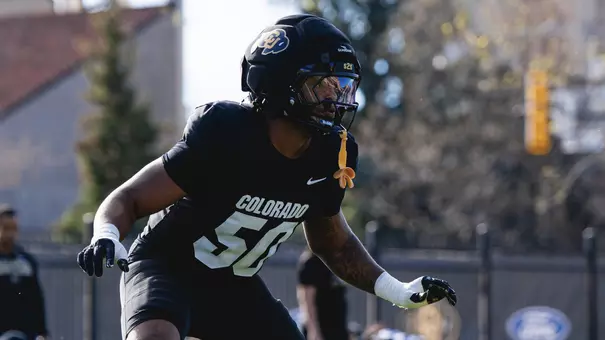
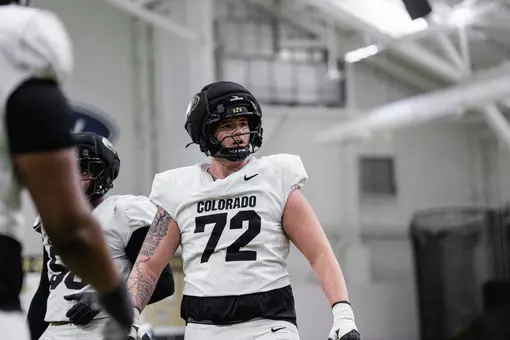
BOULDER – On several occasions since the conclusion of the 2014 season, Mike MacIntyre has said his Colorado football team will have a different look in 2015. More specifically, he believes his Buffaloes will look like a Pac-12 Conference team.
Now, appearances can be deceiving and aren't worth a soiled sock on fourth-and-one at the 2-yard line. Whatever leaner, more muscular, more chiseled facade the 2015 Buffs have acquired, the real rewards from passing everyone's eyeball tests will be found exclusively in performance.
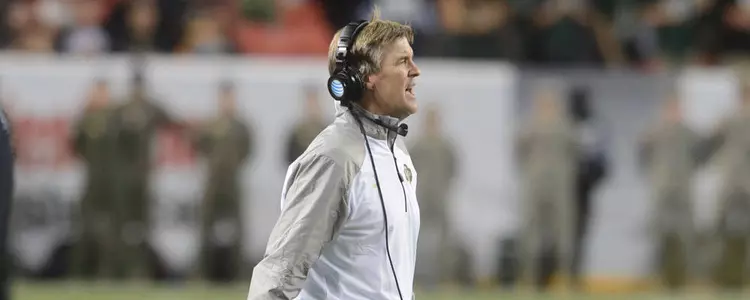
Nonetheless, Dave Forman, the man behind the makeover, is openly optimistic that a better looking Buffs football team will also be a better performing football team. A couple of months away from his third season as CU's director of sports performance, Forman, 36, has high expectations that what was accomplished during off-season conditioning work – especially in the area of attention to detail – will show up as handsomely as those new physiques in their new uniforms.
Things are changing in Forman's world. His current workplace is on the basement level of the rapidly evolving Dal Ward Athletics Center, but a new weight room is under construction in the soon-to-be completed Champions Center. Early summer occupancy is the target, but the move-in date remains fluid. Until then, Forman says, “We've got a place to be and weights to lift.”
The realization of a new facility and being in on its foundational level is “absolutely awesome, so exciting to see,” Forman said. “For us, newer is nicer, bigger is better. It's going to serve so many of our needs.”
And for a director of sports performance, it's a dream come true. “It's a rare opportunity to be at a place where there's building like this,” Forman said. “I don't want to say you get to put your stamp on things, but you have your way of doing things and you can be creative at this stage and have a way to facilitate that. That's really awesome, really unique.”
In his projection of the Buffs looking more like a Pac-12 team in 2015, MacIntyre will be quick to credit Forman, who somewhat downplays his role in the transformation. “It comes with the development of young guys and growth in general,” he said. “I really do believe (the Buffs will look the part), but honestly it's hard for me to notice because I see them every day. You notice it in old photos or videos, or when you look at some (weight) numbers or body weights or body comparisons.”
Forman's points about natural development and maturity have merit. In MacIntyre's first two seasons, the Buffs have been among the youngest teams in the nation. In year three, CU will go from a depth chart stocked with freshmen, redshirt freshmen and sophomores to one populated with experienced sophomores, juniors and a smattering of seniors. That's what Forman is talking about when he mentions “development of young guys and growth in general” and an overall better look.
AS FOR ATTENTION TO DETAIL, that requires discipline, and Forman and his staff focused on both during their off-season program. In individual postseason meetings with players, he said to a man they were seeing on tape and understanding the “effects of small mistakes” made during games – miscues such as lining up wrong, filling the wrong gap, not completely carrying out assignments, etc.
Forman believes establishing that attentiveness to doing the small things right can be accomplished in the weight room. “That's the approach we've tried to take this off-season . . . a more disciplined, systematic approach,” he said, adding that while he isn't implying discipline was completely absent when he accompanied MacIntyre to Boulder three winters ago, sharpening discipline was needed.
From season one at CU to the eve of season three, Forman is able to reflect on his approach with players and make this observation: “Maybe I'm being a little more flexible on my end.” He's able to say that because he's recognized the need for complete trust in building relationships with players.
“If they believe in what you're doing and they trust you they'll run through a brick wall for you, so to speak,” he said. “Building relationships is key, and probably the biggest thing I've learned in the last two years is the importance of that.”
Trust can't downplayed. He cited an anecdote from former Notre Dame coach Lou Holtz, who once said anyone you're talking to should be able to ask you three questions and have them answered before the conversation proceeds.
“The first,” recalled Forman, “is, 'Can I trust you?' And if you don't trust me the other two don't matter.”
In explaining how he might have become more flexible, less rigid with players, Forman said he and his staff simply are taking more time to explain why things are done in their strength and conditioning work. He wants the Buffs to have faith in the process, but he doesn't want it to be blind faith. Rather, it's educated faith.
“Some of these guys have been through three head coaches and that many strength coaches,” Forman said. In the next breath he rhetorically asks if players were told the former methods were right, what makes his and MacIntyre's methods any better?
Proof, at least in some of what transpired on the field last fall, came in Forman's postseason conversations with players and their willingness to concede that had they played as they were coached – paying attention to detail – games that were lost could have been won. It was all right there on tape.
“Most of them (players) said we had to go through it to believe it,” Forman said. “I don't know the reason or rationale for not doing it, but sometimes it's like with kids when you say, 'Don't touch that stove, it's hot.' Of course, they'll touch it. They had to do it. It's weird. But that's why now when we set specific goals, measurable goals, and tell them why it's important. I think we're getting through.”
Much of the progress Forman sees as year three of the MacIntyre era approaches is traceable to players' familiarity with what is expected of them and their “buying in. A culture is taking root,” Forman said. “It's time in the system, it's not about 'their' (another coaching staff) guys or 'our' guys. I think kids take those things at face value anyway.
“Whether it's good or bad, positive or negative, they now have experiences. They see when we say certain things, they work. And if they don't do them, it doesn't work. That builds a concept of understanding.”
AND TRUST. ALSO, HE SAID the idea of players holding each other accountable has risen dramatically and is central to team growth. At the end of a workout, if he brings particular groups or the team together, points to an individual and asks, “Did you work hard today?” or “Did you push yourself?” he already knows the answers.
“Every single guy worked,” Forman said. “And it's not like, 'I know I worked hard, but I saw that guy over there at the Gatorade (dispenser).' That can't happen. It has in the past but it won't anymore. Guys are holding each other accountable, they're pushing themselves but also pulling others along with them . . . we're there now.”
Off-season improvement stayed on an upward trajectory from day one through the winter, said Forman, but plateaued just a bit in the spring. That slight leveling off ups the ante for eight weeks of summer work that begins on campus June 1. Through recent NCAA rule changes, teams have a nine-week summer window in which to complete eight weeks of work.
In June-July, the Buffs – those enrolled in classes or who have met certain academic requirements – will condition Monday through Friday, taking weekends off and getting a slightly longer Fourth of July break. They will be given a week-plus of off time at the end of July, prior to August camp. Players report on Aug. 4, with the first practice the following day.
Per another shift in NCAA rules, coaches can be present during the June-July conditioning work, which Forman calls “a motivating factor . . . plus, there are more sets of eyes and that helps with quality control. It can be easy to lose sight of goals for some guys. But you're getting better or you're getting worse.
“It all points to those three hours on Saturday. June and July are a little closer (to the opening of camp) than January and February, so energy and excitement are building. But at the end of it all, as much as I love the weight room, they're never going to love it as much as I do or my staff does. Players want to play ball. Hopefully they'll embrace that what we do will help them be better at football – their jobs, their roles. We're not going to have a bench press contest with SC, we're going to play a full game. Saturday is still No. 1.”
Contact: BG.Brooks@Colorado.EDU