Colorado University Athletics
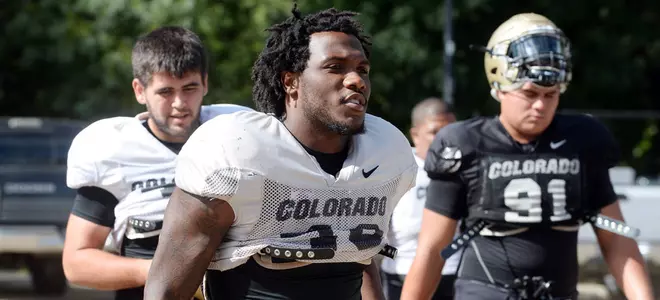
Brooks: Tailback-By-Committee Concept Hinges On Unselfish Backs
August 14, 2015 | Football, B.G. Brooks
(Fourth in a series of position-by-position previews of the 2015 Buffs to be posted on CUBuffs.com during the preseason. Today: Running backs/fullbacks)
BOULDER – If any of Colorado's running backs are dreaming of a 1,000-yard season in 2015, dream on. Maybe that's a little harsh, given the uptick in the Buffaloes' overall running game over the past two seasons. And fortunately CU's backs take a broader view – a team view – that encompasses more than individual numbers.
The Buffs certainly aren't without capable runners, an offensive line that figures to be strong, athletic and deep, and a passing game that will put defensive coordinators on edge (or tumbling over it). It's all about balance, and CU could be on the verge of finding that elusive 50-50 offensive mix that creates defensive nightmares.
Not that any of the Buffs' offensive coaches or backs are hung up on this, but the school doesn't have a rich recent history of pumping out 1,000-yard rushers.
Consider: CU has had two 1,000-yard backs in the last 11 years – Rodney Stewart in 2010 (1,318 yards) and Bobby Purify in 2004 (1,017). In his 1,000-yard season, Stewart had 290 carries while six years earlier Purify had 209. The Buffs identified their horse and rode him.
Consider II: CU's leading rusher last season – Christian Powell – carried 85 times for 448 yards and was among four backs who took between 79 (Phillip Lindsay) and 94 (Tony Jones) handoffs. The foursome's other member was Michael Adkins II, who carried 81 times.
Under third-year coach Mike MacIntyre, the Buffs clearly have been a by-committee running team, utilizing a three- or four-back rotation that likely will be evident again in 2015. Powell, Adkins and Lindsay return, and none of that trio objects to sharing the ball – as long as it keeps moving and the offense is routinely reaching the end zone.
“With the way our offense is and the way college football is going now, a multiple-back rotation is becoming a base offense – especially with the up-tempo that we like to run,” said Powell, the team's leading rusher for the past two seasons. “It'll keep everybody fresh, and with backs who have been working together for a while it'll keep that chemistry. You start knowing how to play together.”
Position coach Klayton Adams said much of his running back rotation “kind of happens because of need . . . if you've got a 12- or 14-play drive going you need a fresh guy in there. With six or seven carries in an eight-play span, there's the opportunity for a turnover. You get a fresh guy in there.
“All these guys have been growing as players and part of our jobs as coaches is to put them in the right situations. Having said that, going into the third year with this group, I think you're hoping all have become more well-rounded players. You might find you're able to leave a guy in there a little longer because he's improved himself and become more well-rounded.”
Among the priorities in this August camp is learning to run more efficiently in the red zone, said MacIntyre, who can see his offense rising from 37th nationally last season to a place in the top 25 this season. But the Buffs need more red zone oomph from their run game.
In 45 trips inside the opposition's 20-yard line in 2014, CU scored 29 touchdowns – 12 running, 17 passing. A more effective red zone and short-yardage ground game should alleviate some of the play-making pressure – particularly late in games – on quarterback Sefo Liufau.
Said Lindsay: “Our plan is taking pressure off of Sefo. He doesn't need to throw 40 or 60 times a game. We need to handle our business and do our jobs – and that's to run and make plays, first downs and touchdowns. I feel like this year we've come in with the mindset of doing that.”
Adams, who handles both the tailbacks and fullbacks, said the commitment to a strong running game hasn't wavered since he arrived with MacIntyre. He points to two seasons' worth of improvement in yardage gained as proof of that commitment, but in the next breath adds, “We don't really base (improvement) on the stats as much. They're a nice thing to look at the end and say, 'Are the stats agreeing with what we think?' You can come out of a football game and say we ran the ball well or we didn't.
“Sometimes the statistics don't necessarily agree with you. One of the things we focus on is rush attempts and pass completions. If you're in the situation where you can call a lot of runs you're probably doing a good job offensively. And if you're completing a lot of passes you're probably doing a good job offensively. That would be the one statistic (rush attempts) we would look at at the end of a game to say how well we managed the game.”
Total rushing yards, added Adams, don't necessarily reflect a running game's success. A big scramble by a quarterback can inflate ground yards. Sack yardage can deflate a rushing total. “Yardage can get lost in those areas,” Adams said.
Powell, a 6-foot, 235-pounder, was a high school fullback who occasionally lines up there for the Buffs. That offers more options for Adams, who can use Powell in the same backfield with Adkins or Lindsay. Adams' other fullback/H-back options are George Frazier and Jordan Murphy, both of whom – like Powell – are like are very versatile players who “offer something different. Frazier catches the ball well, is bigger (6-2, 250) and we can send him into the line.
“But in terms of handing a guy the ball, you're going to want a Powell in there. In terms of doing anything you ask, Murphy can do a lot. How you line up with fullback in the I (formation) depends on the game, the situations . . . but that group has lot of versatility.”
SLOWING IT DOWN: As a redshirt freshman last fall, Lindsay ran with an edge and proved harder to tackle than most imagined a 175-pounder (he's now 180) could be.
But in retrospect, Lindsay, who rushed for 391 yards (32.6 per game) in 2014, says he was trying to speed things up too much: “Last year I rushed a lot of things. Now I'm slowing down and reading defenses better. It's about being more patient and trusting my line. Last year I trusted my line but I wanted to go fast, fast, fast – everything fast because I'm thinking if I can get there faster than that person I can break it.
“But sometimes it's not like that. Sometimes it's slowing it down and letting the play develop. Then you hit it when it does (develop). That's what I've been working on and I feel like I'm getting there and getting comfortable. The line is too; it's time for us to take off.”
ON LEARNING TO FINISH: Adkins, who averaged 39.8 yards a game last fall, says the Buffs' emphasis on being a stronger running team and more balanced should be evident.
Another 2014 goal is finishing games, which MacIntyre believes begins with fourth-quarter trust in one another. When the Buffs finish practice with sprints, they've taken to holding up four fingers to signify the importance of improved fourth quarters in 2015.
Learning to finish, said Adkins, requires “more maturity and understanding what we do (in practice) is going to have an effect on the game, the season. You have to learn how to practice in a way that's going to help you in the games. It's obviously mental, but a lot of it has to do with maturity.”
THE IMPORTANCE OF 'THANK YOU:' Rushing 101 for running backs begins with a tip of the helmet to the O-line. Lindsay likes what he's seen so far in camp from the Buffs' front men: “They seem like they're ready . . . they're excited, they're rolling people up. As a running back you like to see that.
“You also make sure that you tell them; there's nothing better for an offensive line than to hear that they're doing a good job. Without them we can't run through anything. They make us – that's what it comes down to.”
ANY NOTICEABLE DIFFERENCES? MacIntyre is forecasting this as team-wide, and Adams says it's underscored in his group: “They've gotten bigger, stronger and have more top end speed.” He also calls his tailbacks and fullbacks “more seasoned” and says last season's experience – much of which was gained the hard way – will be invaluable this season. “There's no making up for game reps; they all make you so much better. We all learned so much last season.”
THE INSIDE LOOK AT . . .
Running backs/fullbacks
Coach: Klayton Adams, third season at CU.
Returning starters: TB/FB Christian Powell, Sr.; TB Michael Adkins II, Jr.; FB George Frazier, Soph.
Returnees: TB Phillip Lindsay, Soph.; TB Kyle Evans, Fr-RS; FB Jordan Murphy, Sr.; FB John Finch, Sr.
Newcomers: TB Patrick Carr, Fr.; TB Donald (Dino) Gordon, Fr.
Key losses: TB Tony Jones, TB Malcolm Creer, TB Terrence Crowder.
Stat line: In Powell, Adkins and Lindsay, the Buffs return three of their top four rushers from 2014. Together, they combined to average 120 yards a game last season, topped by Powell's 44.8 yards. Since Mike MacIntyre took over as head coach in 2013, CU's rushing average is up 40-plus yards per game, going from 110.3 in 2012 to 154.6 in 2014.
Bottom line: CU expects to run the ball better this season than last, but the emphasis isn't solely on better individual or team rushing numbers. Among Adams' goals is more attempts per game, which would mean the Buffs are controlling the ball better, getting first downs and helping alleviate pressure – particularly late in games – on quarterback Sefo Liufau. Adams likely will use a three-back rotation (Powell, Adkins, Lindsay), with Powell, Murphy and the versatile Frazier seeing situational use at fullback/H-back. With impressive camps, Carr or Gordon could make room for themselves in the rotation.
Next: Wide receivers
Contact: BG.Brooks@Colorado.EDU