University of Colorado Athletics
Forever At Folsom: Memorial Links Buffs To 9/11 Heroes
September 10, 2015 | Football
BOULDER — Ask anyone over the age of 18 where they were on Sept. 11, 2001, and they could probably give you a play by play of the moments leading up to seeing that first plane hit World Trade Center 1.
Then-Colorado head football coach Gary Barnett was sitting in his office, dumbfounded at the images flashing across his television screen.
“In silence, we all (the coaches) sat there for two or three hours and everybody forgot all about football,” Barnett said. “It didn't mean anything.”

Senior quarterback Bobby Pesavento was at home in his apartment, expecting just another day of preparation to take on Washington State in Pullman that upcoming Saturday.
“Coach Barnett addressed the team about the game next week,” Pesavento said. “He made sure that we stayed together and stayed close to our teammates, our brothers.”
Across the country, fireman Sean Norton was in New York City in his firehouse. FDNY Company Engine 1, Ladder 24 sits one block from Madison Square Garden on 42nd Street. Across the street in St. Francis of Assisi Church sat Father Mychal Judge, a Franciscan priest and chaplain for the men of E1, L24.
Upon experiencing the impact of the first plane, Father Mychal rushed downtown to what was soon to be renamed Ground Zero. The priest, who was kneeling before the towers praying the words “Jesus, please end this right now,” was later declared victim number 0001 of the attacks.
No two places could have seemed any farther apart that day than Boulder and Manhattan. While the sun continued to shine perfectly over the Flatirons, smoke, fire, dust and debris shielded the same sun from a city that was now a war zone.
Mere months after the attacks, the lives of the Colorado Buffaloes and the E1, L24 heroes would intersect and change forever.
AN UNLIKELY BOND
Nov. 23, 2001, is another day that is seared into the memories of many. Say the words “62 to 36” to any die-hard Colorado or Nebraska fan and an intense reaction is inevitable. This particular Friday after Thanksgiving was destined to be historic. After falling to the Cornhuskers nine years in a row, the No. 14 Buffaloes were thirsty for revenge against the top team in the country.
Eager for domination, the Buffs produce an overwhelming victory. Running back Chris Brown rushed for 198 yards and six touchdowns while Pesavento passed for 202 yards, not turning the ball over once.
“It was one of the best days of my life,” recounts Pesavento. 'Football-wise, we accomplished what we wanted to accomplish. It goes down as one of the best games in CU history. Defeating the best team in the country and that being Nebraska (was exciting).”
Barnett considers the game his shining moment at CU: better than Colorado's 1989 and 1990 defeats of Nebraska and Oklahoma, better than the Orange Bowl and even better than the Miracle at Michigan — all when he was an assistant under Bill McCartney.
“For me, at CU, of all of the games I was a part of, even through Coach McCartney's career, that one stands out,” Barnett said.
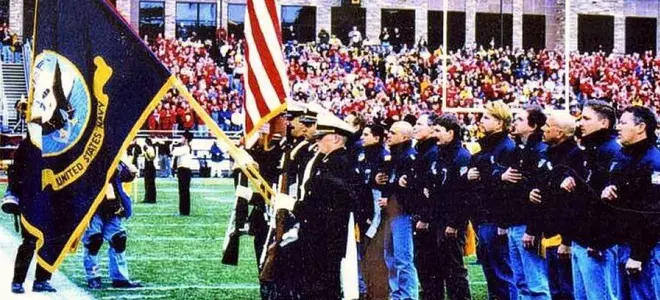
Amidst the celebration of the ending of a long-term drought were 13 men sporting FDNY hats and thick New York accents. A mere 73 days after somehow escaping the depths of hell with their lives, the members of E1, L 24 were in Boulder. Seventy-three days after seeing their chaplain, their brothers and sisters and their fellow New Yorkers perish before their eyes, 13 firemen were in one of the most idyllic environments a football fan could dream of.
When the day was over, 13 heroes who never signed up for what they experienced were given a reason to smile again.
“The guys who were able to go out there (to Boulder) were able to get away from Manhattan and get away from the pile and all of the digging,” Norton, who was a junior officer at the time, said. “We could get our minds off of everything that was going on out here (in New York) and just enjoy a good college football game.”
The intention, according to Barnett, was just that.
“(We wanted to give the firemen) an escape, something to be positive about,” Barnett said. “For me, it was making sure that they knew that we were so happy that they were here and so thankful for what they had done for our country.”
Pesavento suggests that the inspiration that led to the legendary CU victory came from the heroes from New York.
“To hear them talk and see their faces, and to imagine everything that they witnessed and had to go through, it's very hard to explain,” the quarterback said. “But it definitely lit a fire in the group of guys that were about to take the field. We wanted to go out there and play for them and not only get a victory for CU and our teammates, but for those guys who made the trip out.”
For their part, the firemen brought with them a banner that read “FDNY Loves the Buffaloes.” The moment of unraveling the banner before the game and the applause that ensued is one that Norton will never forget.
“I remember they had us go out on the field and unfold this banner and do a 360 to show the entire stadium what it said,” Norton recounts. “The applause and the standing ovation that we got was heartwarming. It almost brought tears to my eyes how great they made us feel. It is unlike any other feeling I've probably ever had.”
This was the first instance that E1, L24 and CU were able to support each other. The firemen were awarded an escape while the players were given inspiration as they headed into their own battle, a Big 12 Championship game against Texas. As the team travelled to Irving, where they would defeat the No. 3 ranked Longhorns, 39-37, Norton and his brothers flew back to New York City where they returned to a harsh reality that was inescapable.
A CROSS OF STEEL
Fast forward to Sept. 14, 2002. Three days after the first anniversary of the attacks, the same group of men, this time carting fireman Jimmy Cody, were at Folsom again for the Buffs' battle against Southern California. Although the outcome was not so spectacular — the Buffs lost 40-3 — something of a greater significance was gained.
A major leader of the Ground Zero clean-up crew and one of the roughest, toughest and most respected firemen in New York City, Jimmy Cody dedicated his life to the rebuilding of Manhattan. A humble and sensitive man with the hardest exterior, Cody used his “spare time” to weld crosses from the steel that once made up the World Trade towers.
Cody welded 344 crosses: 343 for each of the widows and widowers of first responders killed on 9/11 and one for Mike Spivey, a former Colorado defensive back and the team chaplain. Cody held on tightly to what that one day in Boulder the year prior had meant to his brothers. To communicate his thanks, he gifted the cross to the Colorado football team by way of Spivey. The cross, made of steel from World Trade Tower 2, would be placed on a slab of marble from the towers and would also be displayed with a piece of glass from World Trade Tower 1.
Cody's etching on the glass reads, “CU Buffs + FDNY, True Brotherhood.”
These remarkable symbols of strength, courage and perseverance traveled to Boulder, packed tightly in Cody's carry-on. He presented them to the team before they played USC.
Spivey's message to the team that morning is one he vividly remembers.
“I said to the players with the firemen there that morning, 'I hope that you never have to experience what these men have experienced but should you ever face tragedy the way they did, I hope you have the courage and the heart and the fortitude to stand and perform with brilliance and with the selflessness that they have,'” Spivey recounted . “That was vital to me that our players, CU football, understood that they could do that, that they could be more than just a football player. They could be someone that represented something on a higher plane.”
These three pieces of history, forever unique to the Colorado football program, traveled to every game from that point in 2002 until the end of Spivey's tenure as team chaplain in 2007.
FROM THE DARKNESS, CHAMPIONS EMERGE
Those relics were perhaps no more critical to the strength of the Buffaloes than through their 2004 and 2005 seasons. A period of well-documented tumult, the young Buffs were at the center of a media circus, with players absorbing the brunt of a controversy that was out of their hands. But despite the controversy, the Buffs still claimed the Big 12 North championships in 2004 and 2005. Through the media scrutiny and pressure, a constant source of inspiration was the cross.
“When an emergency situation opens and these first responders do what they do, it takes a tremendous amount of courage and fortification within the heart and mind,” Spivey said when describing what the cross represented for the team. “We wanted the players to understand that they were doing the same thing; not on the same level and not at the same tragedies of course, but with the same respect for what they do and what they represent.”
When they looked at that cross, the players saw that strength was possible. They were taught that perseverance and courage are obtainable. In the face of battle, whether it be a burning building or a football field, you are your brothers' keeper. No bond is stronger than between those who face adversity together.
“We're men, we don't cry,” Norton said when describing the parallels between a football team and a firehouse. “When you lose a family member and a brother, you will cry. Who are you going to cry to? The brother standing to your left and the brother standing to your right. They're going to be the ones holding you up, just like a football team.”
A RING WELL-DESERVED
When the Buffs won the Big 12 North, they received rings, as is customary. It was only natural that a significant part of the ring be dedicated to those who gave the Buffaloes their extra strength. On one side of the ring was the etching of a photo that had been made; in the middle sat the steel cross with its marble stand and the piece of glass. Coddling the cross was two fire helmets, one from Engine 1 and one from Ladder 24. Atop these relics sat fifth-year senior Sam Wilder's football helmet. This season was dedicated to overcoming obstacles so it was only right that the ultimate prize, a championship ring, be dedicated to the heroes that personify perseverance.
After the 2004 win, Barnett felt that it was critical to award the men in New York rings; they were a part of the team, and although they weren't on the sidelines every week, the spirit of the firemen was with the Buffaloes.
“As a leader and a teacher, you talk about doing the right things and then you have to actually do the right thing,” Barnett said. “That seemed to me to be the right thing to do.”
Initially, Sean Norton was confused at the reception of his ring.
“We weren't in the game, we weren't part of the team, we didn't even to go the school so why were we getting one?” he said.
Once the surprise wore off it began to make sense and his gratitude was immense
“From my understanding, we gave them the morale boost they needed to do what they did,” Norton said. “It was overwhelming for them to even think about us at that point. We spent a weekend there but for them to continue to think about us after that game and after that weekend and to bestow upon us this absolutely beautiful ring, it's heartwarming.”
THE COAT
After Father Mychal's passing, Jimmy Cody became the sole owner of the bunker coat that they shared. That coat was worn by Cody for months after 9/11. He put out fires and recovered bodies and cut 344 steel crosses, all while carrying Father Mychal with him.
Today, that coat hangs on the northeast side of Colorado's club level at Folsom Field. Cody gifted it to someone within the program after he received his championship ring; he was still looking for ways to show his gratitude to a group of kids who allowed him and his brothers a little healing through football.
For Pesavento, who sees the coat every time he attends a CU game, the effect of that one weekend in November 2001 is still felt.
“The fact that those guys were fighting so hard to save people's lives and try to keep a city together that was going through hell and the fact that we were able to put a smile on their faces for a few hours on a Friday afternoon means the world to me,” Pesavento recounted. “They (the firemen) will never forget what they were doing day in and day out for the people of New York City and we will never forget what we did for those guys for those four hours that they were able to escape the hell that they were living in.”
Friday marks the 14th anniversary of 9/11, a date that claimed 2,977 lives.
Saturday, when the Buffaloes take on UMass, thousands of fans will pass through the club level. Of those, a few will stop to look at Cody's bunker coat.
If those few take that moment to look at the coat and remember 9/11, the sacrifices made and the significance of its placement overlooking Folsom Field, then its purpose is fulfilled.
FOREVER AT FOLSOM
Although their individual names have been forgotten and only three of the original firemen remain at E1. L24, their spirit of perseverance and brotherhood remains within Folsom.
“The players could understand and see the values of what the firemen represented and what New York represented and that you can come out of dark places and be viable and strong in the face of tragedy,” Spivey said. “It did have a very impactful lifetime effect and influence on the players in the way that they came together and learned how to perform.”
Firefighters are there to save. They run in when everybody else runs out. On Sept. 11, 2001, 343 first responders selflessly sacrificed their lives to save thousands of others. The surviving members of E1, L24 also saved something in the Colorado team. They supported the team's dreams, demonstrating that perseverance and courage against the most hellacious situations is possible if you have your brothers.
But the unique fact is that the group of young Buffs gave E1, L24 something, too. Football, although just a sport, shapes millions into the people that they become because of its lessons of toughness and strength. Like firefighting, the sport is a battle that can only be won if every one of your brothers is dedicated and stands by your side.
The young CU team gave of their honor and compassion and love.
Most importantly though, through Colorado football, the young Buffaloes gave FDNY a reason to smile again.