Colorado University Athletics
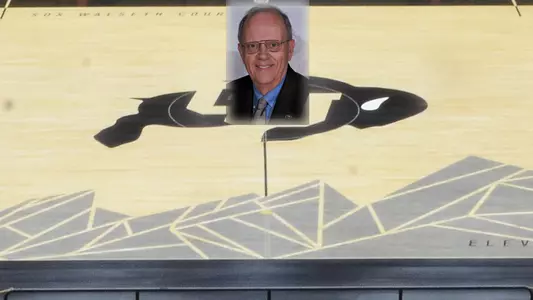
CU's Clough Wraps Up Career As Professor, Faculty Athletics Rep
May 23, 2017 | General, Herbst Academic Center, Neill Woelk
BOULDER — Dr. David Clough still remembers the reaction he received when he attended his first national meeting as the University of Colorado's Faculty Athletic Representative in 2005.
The sympathy Clough received from his cohorts was palpable. "When I said my name and institution, you could hear the people say, 'Ohhhh,'" Clough remembers.
It was not, to be honest, the perfect time to be the FAR from Colorado. The school had been embroiled in several controversies in the previous months and years, each of which received national (and mostly unwanted) attention.
"To be honest, we were in the dumps," Clough said. "There hadn't been a lot of positive publicity."
But now, 12 years later, that atmosphere has changed dramatically.
"It's not something I thought about consciously at the time, or really at any time in these last 12 years," Clough said. "But when I reflect on it today, all that stuff is gone — it's really gone, and it is broader than just athletics. The university is in a good spot. To be a part of that trajectory is something I'm proud of. When you look at where we are today compared to where we were in 2004 and 2005, we're just in a much better place."
Clough is admittedly not a man prone to reflection. But he's been doing more than his share lately as he puts the wraps on his career at CU — not just as Colorado's FAR, but also as a professor of chemical and biological engineering, a position he has held at CU since 1975.
"There's been too much to pick out the most memorable moments," Clough said. "It's overwhelming. You don't think about it as you are going through it all because you are always involved. You are in the flow and you're doing your best to do everything you need to do. You certainly don't have much time to sit down and reflect."
This is, of course, where most folks will ask, "Just what does a Faculty Athletic Representative do?"
The official job description lists seven duties, the primary of which is "to certify that all student-athletes meet all NCAA, Pac-12 Conference, and University requirements for initial and continuing eligibility for athletic participation, both practice and intercollegiate competition, and financial aid."
Other duties include monitoring and evaluating academic progress of student-athletes, working directly with the athletic department's compliance office to ensure adherence to NCAA, Pac-12 and CU regulations, representing CU to the NCAA and Pac-12, serve as a liaison between CU Athletics and the Boulder campus faculty, and interacting directly with CU student-athletes.
Clough, however, broke those duties down to three much simpler areas.
"One is institutional control, which says the tail doesn't wag the dog," Clough said. "Another is academic integrity. In other words, we're not going to be UNC or Syracuse or all of these other cases of academic fraud taking place. We're going to try very hard to have a solid program. The third is student-athlete well-being, which is relatively self-explanatory. You want your student-athletes to have the best experience possible, as students and as athletes.
"If you take those three legs, that is essentially what we look at as FARs. When you're trying to figure things out, you look back and say, 'Those are the guide rails,' when making decisions and advising."
At Colorado, the FAR is appointed by the chancellor and reports to the chancellor. He or she is not under the direction of the athletic director, thereby providing a strong measure of autonomy when it comes to such things as compliance and eligibility.
The NCAA also requires every school to have a FAR, meaning there are roughly 1,100 FARs spread out across the nation (355 in Division 1).
At some schools, such as CU, they are active participants in the workings of their athletic departments.
But in other places, they are still what Clough calls the "Where do I sign?" FARs, those who do the bare minimum. "The director of compliance comes up and says, 'Sign here,' and that's about the extent of what they do."
That kind of FAR, however, is disappearing. The NCAA's increased emphasis on academic performance, specifically the Academic Progress Rate that monitors every school's performance, means the role of the FAR has evolved.
"Good FARs are very engaged, very involved," Clough said.
Clough actually became involved with CU athletics long before he became a faculty athletic rep. His interest began when he was a graduate student at CU in 1968 and had a cross country standout in a class in which he served as a teaching assistant. His interest grew when he became a professor, and soon he was a resource upon whom the athletic department called upon regularly, particularly if a student-athlete expressed an interest in studying engineering.
"I just gradually got to know more and more engineering students who were athletes," Clough said. "Coaches would find out and I got to know the coaching staff as a result. Some of it was by offering to help, some of them came to me."
He thus was a natural for the FAR position when Phil DiStefano — the FAR from 1999 to 2005 — was appointed permanent chancellor in 2005. And it was then that Clough quickly became an expert in something that is integral to every athletic department in the nation — the Academic Progress Rate, a complicated NCAA report that measures a school's four-year academic progress. A poor report can result in loss of scholarships and other penalties, making it imperative that schools not only monitor the progress, but understand the intricacies.
Clough not only served as a member of the NCAA Committee on Academics since its inception (a committee responsible for oversight of the Academic Performance Program and Academic Progress Rate measure), he helped develop a spreadsheet that made it much easier to predict how certain circumstances — transfers, poor grades, etc. — would affect a team's APR.
It is now a research tool used by more than 100 colleges and universities across the nation.
"One of the most important things you have going on is the APR," Clough said. "Say something happens in men's basketball, or is about to happen. I get a call immediately from a coach who asks what the impact will be on APR. Coaches today speak APR. They know the importance of it, they are aware and they care. The idea of a coach back in the 1990s having a zero percent graduation rate and not caring — that's all gone."
Clough is understandably proud of the fact that CU's annual APR measure is well above the NCAA requirement. Colorado's most-recent score, announced earlier this spring, was once again the highest in school history for the sixth consecutive year.
"As I come to the end of my faculty career, it is gratifying to reflect on the academic strides that CU's student-athletes have made since I was appointed Faculty Athletics Representative (FAR) in 2005," Clough said when the score was released. "The current APR scores, when taken together with graduation rates and team cumulative grade point averages, provide indisputable evidence of the academic success of our student-athletes."
Along with the graduation rate and overall academic success, Clough is also proud that CU's student-athletes are engaged in a variety of majors — including approximately 30 in engineering.
"You have to help student-athletes find something that is their passion and not find something to stick them in," Clough said. "Then, you see all these athletes go through graduation and they are excited about what they've studied and where they are going with their degrees."
Over the years, Clough has had his share of student-athletes in his classes, a list ranging from Jim Hansen (CU's last Rhodes Scholar winner) to Maddie DeWinter, this year's senior Scholar-Athlete Award winner.
"As a faculty athletics rep, you always have to keep in mind you are a faculty member," Clough said. "I do not neglect my students in favor of student-athletes — and vice versa. I don't favor student-athletes who are engineers."
But he does have an impact on all of his students, athletes or not. That much was evidenced by last weekend's surprise going-away party, which saw more than 175 people in attendance, including a long list of his former students and former student-athletes.
"It was wonderful," Clough said. "It was an amazing cross-section of people from my time being involved with athletics and my time as an engineering professor. I'm very proud of the things I had the opportunity to do here at the University of Colorado, and the people I was able to help in whatever way I could."
Contact: Neill.Woelk@Colorado.edu