Woelk: 10 Takeaways From Buffs Vs. Cougars
November 11, 2018 | Football, Neill Woelk
BOULDER — It has become an all-too familiar refrain over the last couple of seasons: the Colorado Buffaloes heading down the home stretch of the season looking for a sixth win and bowl eligibility.
In the last two years, CU has had eight chances to claim a sixth win — three last year and five this year — but each time has come up short. The latest attempt was Saturday's 31-7 loss to Washington State.
Now, the 5-5 Buffs (2-5 Pac-12) have two games remaining: their 11:30 a.m. home finale Saturday against Utah at Folsom Field, followed by the Nov. 24 regular season finale at Cal. Two wins would guarantee a winning season — only the second since 2005 for Colorado — while at least one win would make Colorado bowl eligible and keep the door open for a winning year.
But before looking ahead to a visit from the Utes, we'll take one more look at last weekend with our weekly 10 Takeaways:
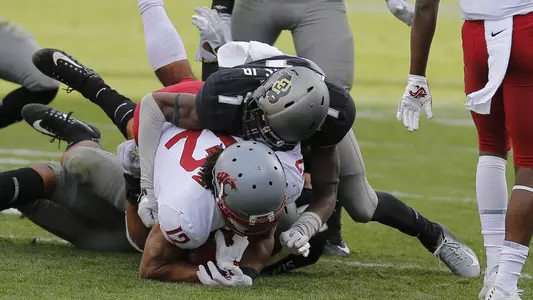
1. CU's defense played well enough to win Saturday. Don't let the 31-7 final score fool you. Matched against the nation's most prolific passing attack, Colorado's defense kept the Buffs in the game for three quarters before simply giving in to exhaustion. Defensive coordinator D.J. Eliot's game plan was sound, and the Buffs executed it well.
Colorado held the Cougars to 10 points in the first half and just one touchdown in the third quarter — and that came on a short field following a Colorado fumble at the CU 32-yard line.
The most-telling statistic came in time of possession. While not always a great barometer of a game, in this instance it told the story: WSU held the ball for nearly 42 minutes, while the Buffs had possession for barely 18. It meant CU's defense was on the field for more than two-thirds of the game. That's too much against any offense, but particularly difficult against a pass attack that protects its quarterback well and allows him to extend plays, while also giving receivers extra time to run defensive backs ragged.
That leads us to …
2. Most-telling statistic 1A: Colorado's offense ran just 54 plays Saturday, a season-low. But even more telling was this: the Buffs managed just seven snaps all day on Washington State's side of the field (plus territory). On those plays, CU managed just six yards.
For the day, CU was 2-for-11 on third down, did not attempt a fourth-down conversion and had just two possessions of longer than two minutes. The Buffs finished with just 75 yards rushing, and 64 of those came on one run.
Somehow, CU has to rediscover the run game that put together games of 209 yards and 166 yards against UCLA and Arizona State.
3. Lack of complete games has been an issue. It's now been five weeks since Colorado has put together a game that meshed solid performances from the offense, defense and special teams.
The last time the Buffs managed the feat came in their win over Arizona State when they had 494 yards total offense (328 passing, 166 rushing) and held the Sun Devils to 367 in a 28-21 win. The Buffs also had a solid seven-minute edge in time of possession, did not commit a turnover and were solid on all special teams.
Since then, they haven't been able to put all three together again. They've had big offensive outputs (34 points vs. Oregon State, 34 points against Arizona), good games against the run (limiting USC to just 51 yards on the ground) and good games on pass defense (holding Washington to 150 in the air). Those efforts have come against some good teams.
Now, they need to put all those phases together again in one game.
4. Good to see Laviska Shenault Jr. back. While he wasn't 100 percent, the CU sophomore wide receiver was clearly effective with 10 catches for 102 yards. He could certainly be a difference maker in the last two games.
5. Targeting calls have become impossible to figure out. It's not just Saturday's game, when CU lost linebacker Nate Landman to a targeting penalty in the first half. It's every week in games all across the nation.
What is painfully obvious is that officials — both those on the field and those in the replay rooms — have failed to develop any semblance of consistency when it comes to making the call. Plays flagged for targeting one week go unchecked a week later, and vice versa. While player safety should no doubt be the top priority, the lack of consistency in the way the penalty is called is causing more confusion than anything else.
Our solution:
At least give officials the latitude to determine if the helmet-to-helmet hit was intentional. Too often, offensive players duck into a tackle at the last second and the defensive player is ejected.
Go ahead and throw a flag, but allow the officials to make the determination if the hit was intentional. If not, issue a 15-yard penalty but allow the defensive player to stay in the game (and perhaps issue a warning, with a second violation then resulting in ejection).
But as it stands now, there is no consistency to the way it is called. Defensive players are ejected for plays they simply can't avoid — and in the same game, similar plays have no repercussions.
6. Buffs have no problem with fast start. But ... One of the more bizarre statistics of the year: Colorado has scored first in eight games this year — and is 3-5 in those games. Yes, CU has scored first in each of its five consecutive losses.
Meanwhile, CU is 2-0 in games in which the opponent has scored first (UCLA and Arizona State).
As for the fourth quarter, the period Colorado owned early in the season now belongs to the opponents. After six games, CU had outscored the opposition 36-6 in the fourth quarter. But in the last four games, the Buffs have been outscored 55-3 in the final period.
7. It all starts in the trenches. CU head coach Mike MacIntyre said WSU's offensive line was one of the best the Buffs would face, and the Cougars lived up to that billing. Colorado entered the game with 25 sacks this season, but could not get to WSU quarterback Gardner Minshew all day.
Colorado's defensive plan was sound. They managed to get some pressure on Minshew and forced some early throws, and CU's defensive backs made some plays. But in the end, WSU dominated down the stretch, especially when CU's offense couldn't stay on the field and the defense began to tire.
Offenses come in all kinds of flavors, but it still boils down to the old maxim: if you control the line of scrimmage, you control the game.
8. Young players continue to develop. Injuries have taken a toll on the Buffs this year, at least as much — and perhaps more — than any other team in the Pac-12.
But if there's a silver lining, it is that the injuries have thrust young players into key roles and they have responded. Saturday, we saw sophomore defensive back Aaron Maddox get his most significant playing time of the year, and he answered with seven tackles, including one for loss. Also playing well was sophomore safety Derrion Rakestraw (two tackles and pass breakup) and redshirt freshman defensive lineman Terrance Lang.
9. The Buffs can't afford to let frustration rule the day. There's no doubt the Buffs are frustrated. A five-game losing streak — particularly on the heels of a 5-0 start — can't help but have that effect.
But CU's young players also know there's something still to be gained from this season, while the seniors don't want to go out on this kind of note. If they can keep their heads up, they still have a chance to play well and finish on a strong note.
10. Mark Wetmore is a University of Colorado gem. OK, this has nothing to do with football, but Wetmore's cross country teams had another outstanding weekend and deserve a little notice.
At Friday's NCAA Mountain Region, the women finished second and earned an automatic bid to the NCAA Championships. The men, led by a championship finish from Joe Klecker, finished third and earned an at-large NCAA Championships bid.
Sound familiar? Of course it does. CU's men have advanced to the NCAA Championships an astonishing 27 straight seasons, the longest active streak in the nation. The women, meanwhile, will be making their 25th trip in the last 26 years.
Such success over such a long period tends to be taken for granted. It has gotten to the point that CU's runners are usually disappointed with anything other than a "podium" finish (top three) at the NCAAs, while CU fans simply expect the program to be one of the best in the nation every year.
But that streak of consistently being two of the nation's best programs over the span of nearly three decades shouldn't go unappreciated.
So, here's a shoutout to Wetmore and the Buffs cross country teams.
They deserve it.
Contact: Neill.Woelk@Colorado.edu