Colorado University Athletics
Pac-12's Kliavkoff Delivers Pointed Remarks At Media Day
July 29, 2022 | General, Neill Woelk
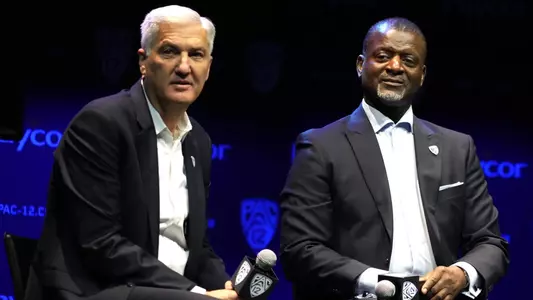
LOS ANGELES — Pac-12 Commissioner George Kliavkoff took the gloves off Friday at the conference's football media day.
First, Kliavkoff expressed confidence that the remaining 10 members of the conference would remain a cohesive unit in the wake of the announced departures of USC and UCLA. Then, he directed a pointed shot at the the Big 12 for that conference's behind-the-scenes activity in the recent realignment sweepstakes.
Asked why he remained confident that the remaining 10 members of the conference would maintain their solidarity, Kliavkoff said he had received that assurance in the regular meetings of the schools over the last month.
"We've had two board meetings a week for the last four weeks," he said. "Looking my colleagues in the eye, understanding their commitment, that their first priority is making sure that the Pac-12 survives, thrives and grows and is successful. They're committed to the conference."
Then, he added this:
"With respect to the Big 12 being open for business, I appreciate that. We haven't decided if we're going shopping there or not yet."
The statement was a thinly veiled response to rumors that began flying in the wake of the announcement from the two Los Angeles schools. Many reports had more Pac-12 schools — including Colorado — allegedly involved in discussions with the Big 12 about joining that conference. Kliavkoff has remained relatively quiet on the topic, but evidently chose Friday's Media Day as an opportunity to clear the air.
"That remark was a reflection of the fact I've been spending four weeks trying to defend against grenades that have been lobbed in from every corner of the Big 12 trying to destabilize our remaining conference," Kliavkoff said. "I understand why they're doing it, when you look at the relative media value between the two conferences. I get it, I get why they're scared, why they're trying to destabilize it. I was just tired of that."
Indeed, after the initial speculation and mostly unfounded reports concerning more schools from the Pac-12 allegedly interested in leaving the conference, it is becoming apparent that the conference very likely still has more media appeal than the Big 12.
When Oklahoma and Texas leave the Big 12, national reports have indicated they will take with them roughly 70 percent of that conference's media value. While losing the two Los Angeles schools is no doubt a big loss for the Pac-12, they still represent only about 30 percent of the league's overall media and market value.
The Pac-12 has already initiated its media rights negotiations with its current partners, but Kliavkoff said he doesn't expect any new deal to be reached anytime soon. The league's current contracts expire in 2024.
"We are in the enviable position of being next to market after the Big Ten," Kliavkoff said. " We already have significant interest from potential partners, including both incumbents and new traditional television and most importantly digital media partners. This interest is driven by the strength of our schools' brands and markets and a recognition of our continued leadership position in college football across the Western and Mountain time zones. With the value of premium college sports rights continuing to rise, multiple interested media partners and limited opportunities, particularly in the west, we are confident in the long-term value of our rights … We still believe that after the current cycle of media rights deals, we will be very well positioned among the Power Five from a revenue-per-school standpoint."
And, he noted, should the right opportunity present itself, the conference would be open to adding new members.
"We are actively exploring expansion opportunities," he said. "As we consider these opportunities, we will look at media value, athletic strength, academic and cultural fit, and geography from a recruiting and student-athlete experience standpoint."
Kliavkoff also addressed several other issues during his address and Q&A session:
On Name, Image and Likeness: "I believe it is time for the 10 FBS conferences to step in and agree to NIL legislation and a strong, effective and expeditious enforcement mechanism. All 10 conferences are strongly in favor of student-athletes being able to benefit from their NIL. But we also need three simple and obvious guardrails: NIL should not be used as an inducement. NIL should not be used as pay-for-play. And the amount earned as NIL payments should be commensurate to what the NIL provided and not a veiled inducement or pay-for-play. These are current NCAA rules that the NCAA has unfortunately chosen not to enforce in the wake of the Supreme Court decision in Alston. Recodifying and enforcing these three simple NIL rules will protect our student-athletes while still allowing them to earn."
On the ever-increasing amount of money involved in college athletics: "College athletics has a unique structure where conferences and schools compete against each other for resources to support their individual student-athletes, but the long-term viability of the enterprise relies on schools and many conferences being healthy and able to compete. Our long-term measure for the success of college athletics cannot be how much money we consolidate into ten or five or two conferences, but rather should be our ability to support the largest number of student-athletes while still facilitating competition between schools and conferences. We should be measuring how many lives we can change by providing scholarships to students that otherwise would not attend college. We should be measuring total financial aid and our ability to provide the highest level of athletic competition to our student-athletes without unnecessary travel, time demands and other burdens on competition impeding their academic success. We should be measuring our ability to provide competition in a manner that does not harm our student-athletes' physical and mental health."
Contact: Neill.Woelk@Colorado.edu