October 21, 2026 | Football
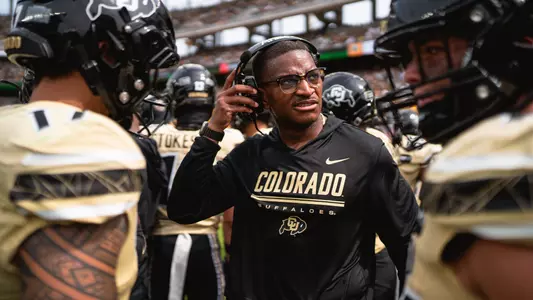
BOULDER — Chris Marve calls the plays. He stands in front of the room. He was the one at the podium on Tuesday answering for a Colorado defense that leads the Big 12 in tackles for loss. And he would like it known that none of it belongs to him.
"I call the plays, but it's not my unit," Marve said. "It's the players' unit, and how they want to operate and what they want their experience to be. I get the opportunity to lead. I get the opportunity to stand up in front of the room. But it's not my unit. It's theirs."
That is the second of two rules the first-year defensive coordinator has built his group around. The first comes up any time someone asks about an injury.
"If you are on the field as one of the 11, you're a starter," Marve said. "If you're on the field, you're a starter. I don't care where your name is on the depth chart. If you're on the field, you're a starter. So the expectation is how you play, how you approach, and your finish needs to give us an opportunity to have success as a team."
Both rules were tested in a 27-24 loss to Utah last Saturday, when the Buffs' defense was on the field for 80 snaps and 37 minutes against an offense that arrived averaging 42.8 points. Utah left with 27, a season-low 131 rushing yards and no rushing touchdown. The defense forced two interceptions and made the fourth-quarter stop that gave the offense a chance to tie.
The Depth Chart is a Suggestion
The "you're a starter" rule has had plenty of work. Colorado lost linebacker Tyler Martinez at Baylor, and Gage Goldberg, a second-year linebacker, has stepped into the three-linebacker packages. RJ Johnson has gone from spot duty to a full workload at corner in the last two games.
Marve won't pretend the Martinez loss was painless. The staff calls him "T-Dollar," and the coordinator said he doesn't know "if you ever fully replace him." But he also said the alternative — a defense that collapses when one name changes — would be his own fault.
"I think it's poor coaching if, before the season begins, you don't have systems in place so if you do lose a player, you're not able to be in a position to still have success," Marve said. "That would be poor leadership to me."
On Johnson, he offered a glimpse of the room's humor and its standard in the same breath.
"Coach Fletcher's done a great job with old Reginald — that's what the RJ stands for," Marve said. "He might not like that I said that out loud. But you can see the look in his eyes changed. He's had composure and poise in big moments, and he's really taken the coaching. The light's coming on for him. It's about doing it consistently and being able to get it done this week."
Whose Unit It Is
The players describe the same arrangement from the other side. Safety Randon Fontenette, who led the team with 13 tackles against Utah, said the week's single word of emphasis — population, as in hats to the ball — came from Marve, but the execution is on them.
"Coach Marve preached that all week," Fontenette said. "So just continue to have population to the ball, 11 hats flying to the ball. I feel like we can stop any quarterback in the country playing like that, together as a unit."
Defensive tackle Dylan Manuel, who intercepted Devon Dampier at the CU 6 to end Utah's last first-half threat, pointed to the room's one-word mantra.
"Coach Marve is probably one of the best leaders I've ever had around," Manuel said. "He just keeps us level-headed and steady. It's one thing we always say, which is 'good.' So no matter the circumstance — good. We always gonna go out there and show who we are."
That mindset is also what Marve points to when asked why a team whose defense has outplayed its offense for most of the season hasn't fractured. He has heard the premise. He doesn't accept it.
"I'm not in that locker room every day, all day," Marve said. "They are. We got the right kids. We have a phenomenal head coach, and we got young men who are bought in. The context in which we play and how we play doesn't matter. It's about our approach and what we want to get done."
Playing Well is Relative
Marve is just as unwilling to grade on a curve. Asked why the staff keeps asking for more from a unit that has posted seven or more tackles for loss in every game [verify], he zoomed out.
"The mission for us as a program is to win," he said. "Our role in that mission is to deploy the most effective defense possible that leads to that mission. Playing well is relative. We want to win games."
The one game that didn't meet that bar — a 41-7 loss at Northwestern — is the one he keeps coming back to.
"You can't win giving up 41 points," Marve said. "Bottom line. I don't care what offense you're going against, the play style, the location, whatever the uniform they have on. So I had to take a long, hard look in the mirror. What can we do better? What calls fit our personnel the best? And the approach that we've had since that game has helped us limit more scores."
Saturday at Oklahoma State, the assignment is Drew Mestemaker, whose 34 completions of 20 or more yards rank second in the country. Marve's answer to that was the same one he gives to everything else: it is not about the call.
"When they have it blocked up, when they have leverage, when they have grass, or they have numbers — then what?" Marve said. "If you go one-for-one on defense and it's 11-man football, the ties go to the offense. So how we play is more important than what I call."
Which, by his own rule, makes it the players' problem. He seems fine with that.
"I have young dudes who are not only talented, but also want to work," Marve said. "So I'm thankful for that."
Players Mentioned

DB
/ Football
LB
/ Football
DB
/ Football
DL
/ Football
LB
/ FootballSunday, October 25
Sunday, October 25
Sunday, October 25
Sunday, October 25