

Colorado University Athletics
Q&A WITH JEREMY BLOOM
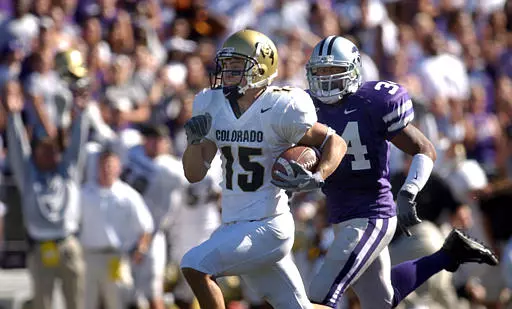
The Buffalo Sports News sat down with Colorado student-athlete Jeremy Bloom prior to the beginning of fall football practices to get his thoughts on why the two-sport athlete decided to return to the university, the differences between football and skiing and other issues.
Buffalo Sports News: You came back to play college football at CU. Why?
Jeremy Bloom: It's where I love to be. In my press conference I said 'money doesn't bring happiness,' and I think some people took it the right way and some people took it the wrong way. Money can bring happiness, but right now in my life, it's not what would. It's not my first priority.
I don't have a family that I have to support. I make a good living skiing. These opportunities here (at CU), if I turned my back on them, they'd be gone. This opportunity to play football here, if I said 'I'm going for the money and the endorsements,' it's over, and I'm ineligible forever and I can't come back.
BSN: So that's what motivates you to continue to play college football?
JB: Truthfully, growing up, I always dreamed about playing college football - especially at CU. But I was one of the smallest guys on the field, and I always heard people tell me I couldn't do stuff. So that just makes it that much better to be here and be a part of this team. I stood there in those stands (looking over at Folsom Field) when I was a little kid back in the '90s. And back then, what kid didn't want to play for CU?
BSN: You mentioned endorsements. When you went to your would-be sponsors and told them about your decision to play college football again, what was their response?
JB: I think they understand because most of them have been with me for a long time, since I was 10 years old. They knew that I played high school football; I don't think they knew I'd pursue it at this level.
The hard thing is the sponsors I have don't want me to play football; they want me to ski. The NCAA sees it the other way around. They want me to play football because it brings me more attention. But by playing football, I'm not getting as good as I could be at skiing.
I want to continue to progress, but when I only have three days of on-snow time from April to December and the rest of the team lives in South America for a month; it's hard to progress at a sport that way.
But they understand, I think. They remind me that when done with football, knock on wood, and I'm healthy and I can ski, they'll be there for me.
BSN: So the Winter Olympics in 2006 is one of your goals?
JB: It's definitely in the back of my head. I feel like with the sport of skiing, I've accomplished most of the goals that I've set out to: World Championships and World Cup Champion. The one that's eluded me is that Olympic Gold.
I felt like in 2002 coming in ranked No. 1 in the world, I was in the perfect position. And I missed out on it and that's hard. I think going through that experience and taking it to the next Olympics will make it a little bit easier.
BSN: Skiing is an individual sport. Football is a team sport. How is preparing for the two differently?
JB: There's a big difference in the impact of people around you watching you. In skiing, the impact is me. If I mess up like I did at the Olympics, I deal with it.
Of course, my parents are disappointed for me, but it's not like I let down a hundred other guys who are going through the same thing and worked just as hard as I did. It's like that in football. Football brings an added pressure because it's not just yourself - it's your teammates, it's your fans, it's your coaches, your student body who support you.
And that can add up to a lot of pressure, especially as a punt returner, which is like being an individual. (laughs)
BSN: Obviously, you were born with a lot of athletic talent as a skier and a football player. But not everyone with talent takes advantage of it. What do you attribute your success to, both as an athlete and as a person?
JB: I think some luck, being put in situations and having great coaches who allow me to do both (sports) - especially at a young age. And listening to what my parents always told me when I was little. They told me, 'You can accomplish anything in this world if you put your mind to it.' And I remember asking them, 'Can I go to the sun?' And they always said 'yes!'
So it was just growing up like that and having that confidence. And going through this, I've heard the word 'no' all the time. It's been about getting by that word and taking it to the next level.
BSN: What was it like competing in and winning the Superstars Competition?
JB: It was great. One of the best parts about it was I got to compete against my idols. Hines Ward: He's like what I want to be. He's a littler receiver who can play a lot of positions. It was great because I got to pick their brains and ask them about the NFL. And then to come out on top and win was a big honor.
BSN: Was it tough leaving the money behind?
JB: It wasn't tough leaving the money behind because I thought I could donate it. But the NCAA did a whole investigation of Superstars to see if I'd still be eligible or if I did anything wrong. They cleared me, but they told me that they wouldn't allow me to donate any of the money. That was hard because I don't really understand why.
BSN: What's your favorite charity?
JB: I've worked with the Denver Rescue Mission and I look forward to working together with the Colorado Cancer Foundation. And I also have a proposal in my hometown of Loveland to build a Little League baseball field. That would have been really cool too; unfortunately, that hasn't happened - yet.
BSN: You mentioned Hines Ward. Who are your other idols?
JB: Growing up, my idol was John Elway. I wanted to be John Elway. More recently, Lance Armstrong. He's been a huge inspiration to me ever since I read his book. He's truly fascinating as a person, as an athlete and what he's overcome. Talk about an athlete overcoming adversity; he's done it. It's remarkable.
BSN: What are your goals individually and for the team?
JB: Individually, to use the year behind me to mature and learn from the mistakes I made and improve my game as a receiver and as a punt and kick returner. As a team, take one step at a time because teams, especially new teams that don't have the leadership they had last year and are filling in new positions, tend to look at the big picture - the Nebraskas and the Big 12 Championship. I think if we take one step at a time and develop as a team, we'll be successful.
BSN: What do you want to be doing 10 years from now?
JB: I don't know, man. I don't know what I'm doing in a week. To make it as general as I can: Keep following my heart. Keep doing the things that make me happy and not doing things just to earn money or get attention.
BSN: You mentioned your family. How important is your family to you?
JB: I feel it's so important to have that support system and to know my family is there for me whenever I need it ... that makes the biggest difference in the world.
BSN: What's your biggest thrill?
JB: My biggest thrill ever was CSU last year. As far as a thrill, I don't think anything will ever compare to it. Going through the lawsuit, going through life playing football, everything I went through, and that lawsuit put all that attention on me and expectations on me, and to do it in front of 75,000 of my hometown fans .... There's no bigger thrill.