RUNNING FOR GLORY
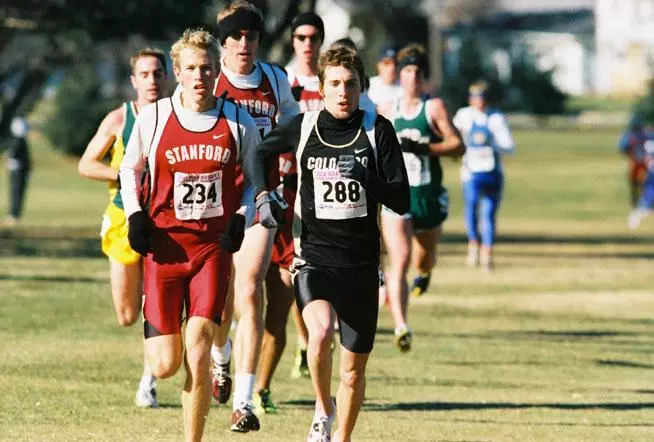
Dathan Ritzenhein Continues to Outpace the Competition
by Kevin Mullowney
“That day, for no particular reason, I decided to go for a little run. So, I ran to the end of the road. And when I got there, I thought maybe I’d run to the end of town. And when I got there, I thought maybe I’d just run across
? Tom Hanks in “Forrest Gump”
Dathan Ritzenhein has to share the same mentality as our fictional friend. Why else would he subject himself to the rigors of a runner’s lifestyle?
And we’re not talking about sprinting. Ritzenhein is an endurance runner; the long-distance guy, a man who runs 80-plus miles per week as part of his training. To put that number in perspective, compare it to the activities of the average American.
A researcher at the
Ritzenhein started running as a 10-year-old in
He joined a track team in seventh grade and clocked two miles in 12 minutes. He was the third fastest boy on the team. But that wasn’t fast enough. Every day, all winter, Ritzenhein ran the same four-mile course. Flowers began to bloom, grass started to grow and the first robin of the spring was spotted. Life was blooming all over
This improvement encouraged Ritzenhein to push harder. By his freshman year in high school, he was serious about the sport.
In
When it c
Ritzenhein had what could be called the greatest freshman year a collegiate runner has ever had. During the 2001-02 season, he set freshman course records, was named Big 12 Conference Newcomer of the Year and finished fourth at the national championships. He was on the fast track to stardom, so to speak.
But then, his plans were derailed.
Ritzenhein missed the majority of the 2002-03 school year due to a series of injuries. First, he suffered a stress fracture in his right femur in August 2002. After several weeks on the sideline, he was able to resume workouts. Shortly after returning to the track, however, he suffered a lower back injury that sidelined him for another two weeks. And finally, Ritzenhein was diagnosed with a stress fracture in his left femur that put him out of commission for almost four months. All in all, Ritzenhein missed approximately eight months during the season.
But he didn’t let these setbacks keep him down. He made the most of his return to competition, winning the “Gold” race at the NCAA Pre-Nationals in
On
Following the Big 12 Championships, Ritzenhein was poised for a big performance at the NCAA outdoor track and field championships in June. There, he would finish second in the 5,000 meters, narrowly missing his chance to take home another national championship to go with his cross-country title.
Ritzenhein finished the race in 13 minutes, 52.13 seconds, getting out-kicked in the last lap by Robert Cheseret of
Ritzenhein set the p
Despite this defeat, Ritzenhein has been declared by many as the future of American distance running. The immediate future looks to be painful, however, as another stress fracture in his left foot forced his hand regarding his event choices at the U.S. Olympic Trials. The original plan called for him to run a 5,000 in Europe the weekend prior to the Trials in hopes of achieving the “A” standard (13 minutes, 21.5 seconds) that would allow him to pick which event made more sense at the trials. Due to the injury, however, Ritzenhein was only able to run the 10,000.
To ready himself for what was going to be a very painful qualifier, Ritzenhein put himself through intensive cross training for 90 minutes to two hours a day ? running in water, working out on an elliptical trainer, riding an exercise bike and swimming. He did anything he could to stay fit without putting any undo pressure on an already sensitive foot.
Distance running has always seemed to come down to who wants it the most. Whether in the 5,000 meters or a full marathon, it comes down to strength and endurance. But the last one percent ? the part that separates the winners from the losers, blocks out the pain of fractured feet and toes and ignores the burning feeling in your lungs ? is heart.
“Dathan is a unique talent, he does possess natural talent, but he is also willing to put in the work. He leads a lifestyle that is conducive to training hard and running fast.” says CU assistant track coach Jay Johnson. “When you are willing to go to bed at
Heart is something Dathan Ritzenhein in spade. He has the kind of heart that only the elite athletes have; that certain makeup that allows him to drain his bodies of everything, beat himself to the brink of destruction and then somehow suck it up, take that extra step, cross the finish line and hoist his arms in triumph before collapsing in a heap.
Hampered by the stress-fracture, Ritzenhein was the last finisher on the track in the 10,000-meter final at the U.S. Olympic Track and Field Trials. He would defeat only four opponents, none of whom finished, in the 26-man field. Ritzenhein finished more than two-and-a-half laps behind winner Meb Keflezighi, but was determined to finish, regardless of the agonizing pain shooting up his leg.
But Keflezighi had already qualified for the Olympic marathon. Not wanting to distract from his efforts in that event, he has decided not to run the 10k in
“I plan on running in
It won’t be the only new experience for Ritzenhein. Shortly after the Olympic Trials, the redshirt junior-to-be announced that he will forgo his remaining eligibility at CU in order to turn pro. He informed head cross-country and track coach Mark Wetmore of his decision.
“We are proud of his accomplishments here and grateful for the time he spent with us,” Wetmore said about Ritzenhein’s decision. “He is an enormous talent and will certainly be a protagonist in the
As he leaves, the star runner is grateful for his time in
“I wouldn’t be able to do this without my three years at
And judging on past performance, there’s no telling how high his star will rise.