

Colorado University Athletics
THE MAGNIFICENT SEVEN
The Class of 2004 is a Diverse and Talented Group of Hall of Fame Members
by Brian Dvorak
The fifth class that will be inducted into the University of Colorado Athletic Hall of Fame
This year’s Hall of Fame event took place Oct.28, at the Omni Interlocken Hotel & Resort.
Here’s a look at the year’s deserving class:
DON BRANBY
Three-sport athletes are commonplace in high school athletics, but are a rare commodity in the college ranks. Don Branby was the definition of such a multi-dimensional talent, however, during his career at the
This three-sport letterman shined on every front. He made his mark on the gridiron, where he was named All-American in 1952 while leading CU in the Big 7 Conference. At his best in big games, Branby recorded 20 tackles in a 21-21 tie against perennial powerhouse
Although his career was unfulfilled in the profession ranks, the New York Giants drafted him with the 79th pick in the 1953 draft, his passion for sports remained. He played service football for the four years he served in the Air Force after leaving the Giants and remained involved in athletics while coaching for
FRANK POTTS
When you think about track and field at the
Potts coached the cross-country and track teams for an astounding 41 years from 1927 through ?68. After completing his career at OU as an NCAA pole vault champion, he accepted the coaching position in the summer of ?27 and amazingly never left CU. Whereas most coaches today earn their stripes as graduate assistants, Potts was the man in charge from day one. Imagine a head coach of any collegiate program taking over the reigns immediately after graduating from college.
During his Joe Paterno-like career with the Black and Gold, Potts coached more All-Conference and All-Americans than you could even imagine. His two most famous track-and-field athletes were Gail Cruter, who was CU’s first NCAA champion in the high jump, and fellow Hall of Fame inductee
A true Buff, Potts even stepped in to lead the football program during the World War II era and went a respectable
BILL TOOMEY
Legendary athletes Jack Nicklaus, Muhammad Ali, Wayne Gretzky and Tiger Woods all have at least one thing in common with 2004 inductee William “
During his career at CU in the early 1960s, Toomey was named All-American twice in the pentathlon and received the Alumni “C” Award in his senior year for excellence in the classroom, where he majored in advertising. After completing his career at CU, Toomey went on to be the
In addition to his outstanding career in track and field, he earned his master’s degree in education from Stanford and was elected into the Colorado Sports Hall of Fame in 1971. Toomey has spent a great deal of time working with underprivileged children and served as a member of the President’s Commission on Olympic Sports. Today, he owns his own company, Sports Directors Unlimited, and makes appearances as a motivational speaker.
JOHN WOOTEN
Baseball has Jackie Robinson, who blazed the trail for African-American athletes in professional sports. For the
Wooten not only left an indelible mark on the university in terms of opportunities for diversity, he was a standout offensive guard from 1956 to ?58. His agility and quickness helped him earn Big 7 All-Conference honors in his junior year and All-American recognition as a senior. The Cleveland Browns selected Wooten in the fifth round of the 1959 draft and he went on to anchor a line that blocked for the incomparable Jim Brown.
After his playing career in
SHELLEY SHEETZ
When Shelley Sheetz came to the
As pure and talentedof a point guard as the now Big XII Conference has ever seen, Sheetz dominated with her court vision, skills and leadership. She was CU’s first, and only, Kodak All-American in women’s basketball. And the individual honors did not stop there. She was chosen as an All-American by the AP, Basketball Times and USWBA in her senior year, and was one of the five finalists for the Naismith Player of the Year Award. Sheetz finished her career as CU’s second all-time leading scorer, and in the top three in assists, free-throws, steals and three pointers. She was a first-team All-Big 8 performer three times and earned Big 8 Player of the Year accolades in the 1994-95 season.
After departing
“That win against Stanford put us on the map and was validation for how hard we all worked,” the former point guard said.
Shelley Sheetz definitely made her mark, helping to catapult CU’s women’s program to national prominence.
EDDIE CROWDER
Before
“When I arrived as coach in 1963, it was a great opportunity and challenge for us to restore a program that was once successful and to take it to the next level.” he said.
Crowder quickly established an identity in
He was named the school’s second athletic director in 1965, and was responsible for bringing
He still lives in
CLIFF MEELEY
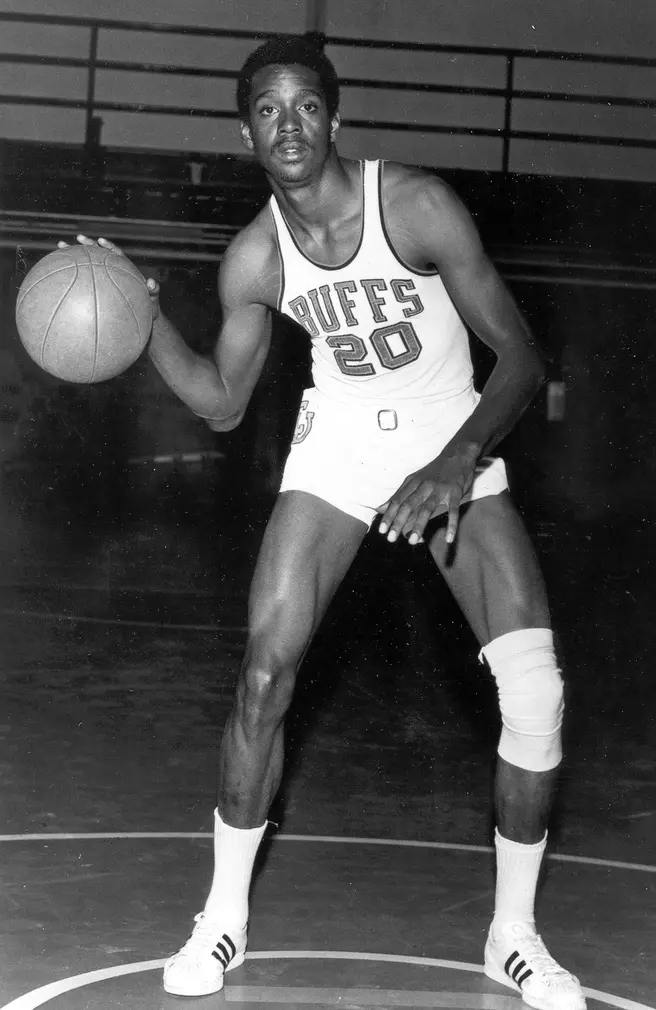
For a school that is known for its football, there is one name that is synonymous with its men’s basketball program. That name is Cliff Meeley.
He played for three years and left his mark as arguably the greatest player in CU basketball history. From 1968 through ’71, he was one of the most dangerous scorers in college basketball. Meeley finished his career as CU’s all-time scoring leader with 1,940 points. Thirty-three years later, he still holds a prominent place on the record books as the second leading scorer and rebounder of all-time. He also remains at or near the top in a dozen statistical categories. His career rebounding average of 12.1 per game illustrates how complete of a player Meeley was during his career.
The Buffs won 49 games during Meeley’s three-year career, including a Big 8 title in 1968 when they went from worst to first in the conference. He went on the play six years in the NBA for the Los Angeles Lakers and Houston Rockets, and is one of two men in CU basketball history to have their jersey retired.
“Looking back on my career, I want people to remember that I scored and rebounded,” he said. “My game was not limited, I played good defense and worked hard during my three years to have a solid all-around game.”