

Colorado University Athletics
Buff Blitz: Jeremy Dodson
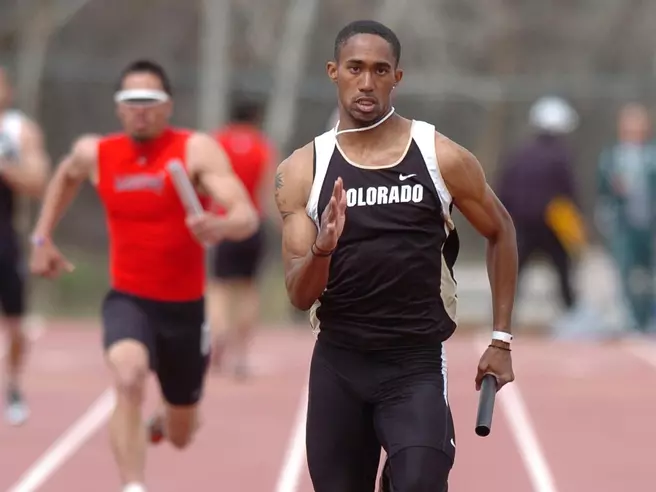
Sophomore sprinter Jeremy Dodson is one of many Colorado track & field student athletes preparing for the 2008 Big 12 Outdoor Championships which will be held May 16-18 at Potts Field in Boulder. A native of Denver, Dodson currently ranks among the Big 12's top five performers in the 100 and 200 meters. Dodson took a few moments about sprinting and being a student-athlete at CU with CUBuffs.com:
AM: You must be excited to compete for a Big 12 title in front of your hometown fans? What will that mean to you?
JD: To me, it means “CU track and field Showcase.” The
AM: This being the Big 12 Championships and the fact that it is on your home field ? does your preparation for the meet alter in any way?
JD: Not too much. The preparation the few days before the meet will probably be altered, as we don’t have to travel. We can actually continue to practice harder a few more days instead of anticipating a long day on the plane or bus. Then the day of, we don’t have to worry about where to eat or what time the team leaves as we are only a hop, skip, jump away literally from the track. It will be the first time many of us can roll out of our own bed for a track meet.
AM: Do you see CU having any home-field advantage going into the Big 12 Championships? Other teams may have trouble acclimating to the
JD:That is the highest advantage, the acclamation to the high altitude. And I know it will affect the distance runners even more than it does sprinters, but not being able to breathe is a huge problem for anybody. So it just leaves us with much less to worry about when it comes down to crunch time. Not only will altitude be an advantage, but the fact we practice everyday on the track makes us more familiar with our races.
AM: With a season that runs nearly seven full months, what can you do (as an individual or as a team) to maintain your mental edge?
JD: This sport is undeniably mental, and its all about getting to know your body even more than before. So the more you know your body, the more you can understand what you can and can’t do to push your limits. And once you can push your limits, you become more confident in the runner that you are and can be, and confidence is everything when talking about a positive mental state.
AM: Now that you have almost two full seasons at CU under your belt, how has your time here compared to your time at
JD: Even though I’ve been here more than I have at
AM: You have earned All-America honors at both
JD: Well they both have their deeper meaning. At
AM: Your two older brothers were also High School All-Americans. Growing up, what was the competition like between you guys?
JD: Of course you could say it was healthy competition. We all wanted to beat the other and would do anything to do it, but after the race, we were always still going to be brothers. With all of us together, we were able to grow competitively within the sport and not just within each other. Also it brought me down to earth because I was never the fastest or best, so it developed us to be humble in spirit at whatever we do. We will always compete, but we will always be on the same team.
AM: You recently were the recipient of the Athlete’s Choice Award at the CU Sports Performers of the Year (CUSPY) Awards. The award is given annually to an athlete who, “demonstrated outstanding spirit, enthusiasm and leadership while overcoming adversity”. What does this recognition mean to you?
JD: Honestly, I was ashamed at first because I’ve been through plenty of “adversity,” some good and some bad, so I didn’t know what I was really being honored for. But one I realized, I really felt like a part of the CU community, and more thankful than ever to the athletes here.
AM: Gearing up for the postseason, are there any pre-meet rituals or superstitions we should know about?
JD: Ha Ha, I don’t have any superstitions or rituals, but I do try to keep with what I always do. Like the saying goes, “Stay with what works,” which I can’t mention off top, but I do have to say that my iPod is a must. It calms me down and gets me mentally prepared. You could say it’s a body part for me, as you can always see me with it. But if I am without it, the end of the world won’t be arriving anytime soon.
AM: How have head coach Mark Wetmore and sprints coach
JD: Being as they are so honorable in achievements and accolades, they really should be considered for Hall of Fame soon, real soon. So with that, a person might think that they are above anything amateur. Yes, they are on a pedestal of greatness, both of them, or rather all of them, but they never stay on top of the pedestal for long because they always come down to our level and help us reach the same spot as they are in. And seeing them do that, only models not only to me, but to the team as a whole.
AM: Besides your home field, is there any place in particular that you enjoy going to compete?
JD: I always love to race in
AM: You have proven yourself to be an exemplary student-athlete, as you are a member of the Big 12 Commissioner’s Honor Roll. You must be very proud of that accomplishment.
JD: Truthfully, I did not know that until just now. And as of right now, I am smiling. But really it’s an accomplishment, but I just don’t want to take school for granted, as I am trying to get all I can out of it. And also, I want to be a good representation of not only the CU Track team, but the coaches, athletes, and spirit of the
AM: Running competitively nearly year-round must be taxing on the body. Are there any particular measures you take to ensure your body is in peak condition?
JD :REHAB... the word of the year, at least for me it is. As much as I expect from my body, I must put double back in to take care of it, because unfortunately there’s no sale at the mall for new legs. Then the second word of the year for me is... WEIGHTS. I am a very skinny sprinter, with a million dollar speed, or maybe thousand dollar, trapped in a two-dollar body. So to keep up, I must maintain the little things with my body, because everything matters when it comes to the matters of the body.
AM: Big brothers aside, were there any track athletes that you aspired to be when you were younger?
JD: I was never into track when I was younger as I am now. I was always the kid the crowd clapped for at the finish because I was so far behind, so I never paid too much attention to the sport. I was a football or basketball player. But I could remember watching the Olympics and seeing Gail Devers and Flo Jo tear up the track so gracefully.
AM: Are there any track athletes you liken yourself to still?
JD: Honestly ... not really. I’ve grown to understand that I’m my own athlete with my own mind, and imitation in this sport may harm you more than help. But I do respect Tyson Gay and Asafa Powell a great deal, Tyson more because he mentored me my freshman year. Plus, everyone always says jokingly that I look just like him. I can’t see it.
AM: When the season ends, what will your off-season regiment consist of?
JD: REST, because as of right now, it’s already been a long season, but I’m hoping that it gets even longer as the summer months come around. That is the only you can think of when the season ends, but you also start to think about the season to come.
AM: What are you goals for the upcoming postseason?
JD: The only goal for any track runner at this time, to make it on the Olympic team. Although this year in my event, the talent depth is so profound, I only hope to make the relay pool and gain the opportunity to just be at the Olympics. But before all that, I do want to prove myself in the collegiate ranks, as my past years injuries have beaten me down constantly.
AM: What long-term goals do you have in mind for your remaining time at CU?
JD: Of course to graduate with my respectable degrees, but also to also to just continue to do with what I am blessed with to gain another national championship.
AM: Any plans this summer?
JD: I am going to do what I do best.... Sleep. No actually I have summer school and good stuff like that, so I am just trying to return in the fall in one piece, the same piece I started with before summer.