

Colorado University Athletics
Joanne Reid Recounts Trip To Europe
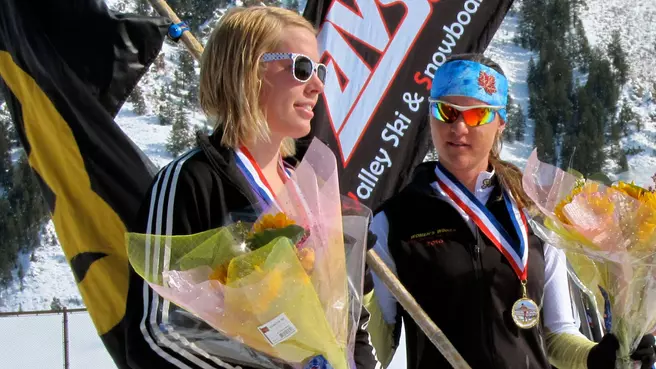
University of Colorado sophomore Joanne Reid recently returned home from a trip to Finland and Estonia as part of the U.S. team that qualified for the World Junior Cross Country Championships. On her way back to the states, she wrote a memoir for CUBuffs.com. Enjoy!
You bring home so much from a
World Junior Championship that doesn't cause the airline to charge
you huge fines for overweight baggage. Last year I brought home
with me a friendship so strong it caused her to transfer to the
University of Colorado at Boulder, an understanding of what it
means to be the "best junior in the world," a healthy respect for
the brilliance of four wheel drive. I brought home the
memories of my first international competition ever.
This year, I could tell you that the wax tech gave me enough kick wax that I had to keep asking him to take more and more off until we almost started over. I could tell you that in the classic leg of the pursuit Jessie (Diggins) broke a pole, that in the skate leg of the pursuit I tangled with a Swede and did a 180. And that would be interesting to the reader, but to the racer it is there, it happens, and it is brushed off because in the grand scheme it is not important. You get up and you keep skiing, no matter the cost, and you have to forget the bad parts and keep going.
But the good parts always
stick. This year, it was easier to slide down the hallway of
the wax building than it was to walk in ski boots, so everyone from
the tall, hulking sprinters to the tiny 14 year old Mongolians were
running and sliding their way through. Luckily, since we are
skiers, we have perfect balance and none of us ever collided or
crashed into each other all week even though there were over 40
teams there. I'm kidding, but I'm pretty sure the huge
Russian yelling at me after I body slammed him wasn't kidding about
whatever it was he was saying in his native language.
I could go on and on about the little parts. I could tell how
the Czech coach's face lit up when he was greeted in his native
language, and how his athlete did a double take to the same.
I could tell you that the pursuit exchange flew with insane speed
because my college roommate, who is one of my best friends, taught
me how to do it with Leki poles.
But if you get me started on my roommate, Eliska Hajkova, I will never shut up, because our lives are entwined so thoroughly that it is sometimes difficult to figure out which one of us did which thing (although I can tell you she will be the one first across the finish line). Was it her that went to World Juniors or me? I'm kidding, although she graced the World Junior Championship with her presence no less than four times, and the U23 championship once, delivering more top 10s than any American skier ever has. Her list of skiing credentials far outshines anyone I've ever personally been acquainted with, let alone laughed with, skied with, lived with.
Growing up where I did, my experience of skiing was radically different from everyone else's. Where they lived through the brutally cold winters of Alaska, or the rains of New England, training with full teams and support crews, I roller skied and (when I could) skied under the brilliantly sunny skies of California with two parents and two older brothers as my team and wax crew. Not to say my experience was worse, or that I had to work through adversity or some such jazz, but merely that it was different, and I think in some ways it actually was better for me than skiing in a place that snowed might have been.
We are all together here, skiing as one team, under one flag, trying to show the world that America is not tailing off the edge of the world in cross country skiing. From our different backgrounds and different experiences comes a smorgasbord of different strengths. While some of us are small and light and build our endurance to last through half hour to hour long races, others of us are strong and powerful, and train so that they can go for just three minutes, but those three minutes faster than you could ever have dreamed. Whether you are used to the icy snow of New England, or the wet snow of the Sierras or the powder of the Rockies, you are skiing here, on their snow. It is up to you to show your teammates any tactics that you learned on your home courses, should they come into play.
But I digress. What
you want to hear is what World Juniors is like. Although
mostly unknown in the U.S., to Europe Nordic skiing is, shall we
say, a big ******* deal. The World Junior Championships
(always put together with U23s Championships) is a solid week of
the future of skiing brought together on one course to justify to
ourselves this crazy thing we do. If Nordic skiing is the
most aerobically demanding sport in the world, then our competition
is almost literally a competition to see who is the fittest person
in the world. Not an easy task by any measure, and then you
throw the uncertainty of ski waxing into the fray, the importance
of which is vastly underrated to the observer.
In all fairness, rather than cheering just for the racers,
the fans should run through the huge, beautifully constructed wax
rooms and cheer on the wax techs that have been there since the
small hours of the morning, testing and waxing and testing and
waxing over and over and over. Because it is to them we
always owe at least a small portion of our success. With bad
skis, you simply cannot win a competition as fierce and as grueling
as this one.
I think we are all a bit jealous of runners deep down, because although our sport is so much more fun for us, all they bring to a race is a uniform, running shoes and some socks. We arrive in a foreign country with anywhere between six and 25 pairs of skis, at minimum two pairs of poles and enough ski clothing for a couple people. But it is just as deadly to be too warm as it is to be too cold, so we choose our layers on race day with care. That's not adding in the three pairs of boots we need, plus the running shoes to those of us who run, hats, gloves, and possibly even rain gear.
With such a challenge comes of course, the draw of drugs, so our week begins with blood tests, a 'random sampling' consisting of the top ranked racers. I'm not a medical student, but I'm also not entirely certain what a hemoglobin test is for except for scaring the living daylights out of people from altitude. However, in that respect, it succeeded quite admirably, and if you see my living daylights I'd like them back.
Without further ado, we roll straight into racing. Eight skiers a day, four from each gender and country compete. For the waxers, that's a lot of waxing already, and then you throw in the pursuit, which requires two pairs of skis per person, and hardcore racers who ask for two or even up to four pairs of race skis to test. On the last day, that leaves (at a bare minimum) eight pairs of skis for the Junior relays, and 16 pairs of skis for the U23 pursuit. I'm sure the waxers are obscenely grateful that they have no decided to hold those two races on the same day.
Interval starts are the least interesting to watch from the viewpoint of the casual observer, but the crowds here are not casual observers and they are keenly interested in the happenings of the day. Equipped with timing chips that are deadly accurate, the timing crew, via the commentator, keeps the crowds informed of the standings so that they can scream appropriately load for the leaders. But don't get me wrong, you can be a somewhat fast American skier like me and still have that crowd yelling like it's nobody's business.
From there we head into the sprints, the preliminaries held as interval start but the heats a six person head to head grudge match. It's a mix of luck, skis, tactics, brute strength, and willpower. If you thought the crowd screamed the day before, today they are rioting. When the A Final comes around, those six skiers are fighting for the podium, and they will fight until the last glide across the finish line. Not a sprinter myself, I didn't compete in this competition, but we were delighted to find all the races filmed by Estonian television.
The pursuit comes up next, a day of pure insanity in which there is not just a mass start of almost a hundred skiers, but those same skiers switch equipment halfway through and keep on rolling. I'm sure there is no love lost between the top Norwegians and the top Germans fighting to win the race, but as comparatively lowly U.S. skier, I didn't observe their (surely epic) battle. Someday, perhaps the U.S. will find itself in the fight for the top, but for now we are still working our way up. In the opinion of a not very experienced 18 year old girl, that will be the day when we learn to open our eyes and learn from those around us, rather than remain in our very America-centered world.
And then, finally, it's junior relay day and U23 pursuit day (U23s don't get to have their own relay day). As mentioned before, this is the waxing nightmare, and waxing a cross country ski is a nearly impossible task to begin with. And today is the day we have waited for all week. It's not just people you are cheering for this time, but a country. The crowd is berserk in the stands, on the side of the course, everywhere just screaming and raving while the skiers rage around the course, spurred on by everything from team pride to the sheer number of decibels.
Only four skiers from each country get to represent their colors on the race trails. Two classic legs followed by two skate legs leaves us a lot of possible ways to make mistakes, but also a lot of ways for us to work together. While Jessie Diggins was having a killer race and powering by five or six teams by herself on a 3.3km loop, her three teammates, myself included, were watching her on the huge screen in the stadium, cheering and screaming as loud as the fans. When she entered the stadium (very quickly, but to me, the anchor, it seemed like forever) her success gave me more strength to ski than I would have normally had.
It is like electric energy all over the course. In the time between your relay tag and your finish, or your next tag you are part of a living history of skiing. Everything that you ever trained for is evident here, in the excitement of the fans, in the love of your teammates. You are skiing for no reason, and every reason. And when you are done, to someone else you will be just a name somewhere in a list of other names a time in a sea of numbers. But is your name, and your numbers, and that can never be taken away nor deleted.
From that race I remember a bit of pain from the exhaustion of my legs, but mostly I remember noise. Noise because every corner you turn, every hill you top, every stroke you ski there is someone there cheering for you, spurring you on. Italy is screaming "die, die, die", the U.S. is screaming "go, go, go," Germany is screaming "los, los, los," and the sheer number of languages being shouted on that course is staggering.
But no matter how you
finish (although we finished quite well), your team is there
waiting for you at the end, waiting to tell you that you are
amazing and that they think you're awesome and that that darn Italy
spent the whole time telling them to "die!" How rude. There
is a half an hour breather and you turn around to cheer for your
guy's relay team, then you run around and try to trade away your
USA gear for the gear of different countries, then you run around
cheering for the girls in the U23 pursuit, then the guys in their
pursuit, and then you've been at the venue for 8 hours before you
finally run back to the hotel and pack your bags.
And as swiftly as Jessie Diggins skied her relay leg, you've just
left behind all your new or possibly old friends that you seem to
only see during international competitions, and are traveling back
to the place from whence ye came. We scattered everywhere,
some of us continuing on in Europe, some of us heading home to our
various college races from the East to the West to Central
division. Some of us flew out of Tallinn to Alaska, some of
us out of Helsinki to Alaska.
We disappear into our old lives as quietly as though we've never been gone, but the memories we retain of those races, and the knowledge of what it means to race faster than the dickens is still with us. And we do not cry when we leave, because we know we will see each other again, that our love for skiing will take us together for many years to come, from Junior Worlds to U23s, to Scandinavian Cups, to Opa Cups, and perhaps someday even World Cups.
We see each other on the collegiate circuit, where we are each other's rivals and competition, and we temporarily forget what it was like to ski shoulder to shoulder, and cheer for each other. But not to worry, we'll soon remember