

Colorado University Athletics
Bill Fanning, Student Of The Game And A Teacher In Life
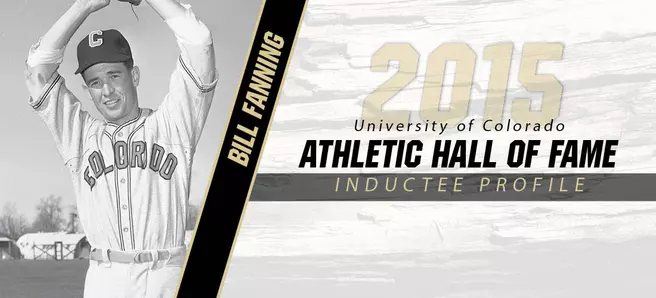
The second of 11 CU Athletic Hall of Fame profiles, leading up to induction ceremonies on Thursday, Nov. 5, at the Coors Events Center. This year's class will also be honored during the Colorado-Stanford football game on Saturday, Nov. 7. Click here to see the CU Athletic Hall of Fame Class of 2015. Click here for induction ceremony information and registration.
As a versatile player on the diamond and later while coaching from the dugout, Bill Fanning was always a student of the game of baseball.
One legendary night in Greeley in the early 1960s, years removed from his standout pitching career as a Colorado Buffalo, Fanning wielded his baseball wisdom from the dugout, coaching for Grand Junction High School in the Colorado state playoffs.
With runners from the opposing team on first and third, Fanning implemented the play heGÇÖd carefully devised. The pitcher casually took a step off of the rubber, making himself an infielder. With the ball in hand, he faked a throw to first, then turned and easily threw out the lead runner at third.
As FanningGÇÖs son, Bill Jr., remembers, GÇ£They had the guy by at least four feet at third base. The umpires didnGÇÖt know what to do until one of them finally came up to my dad and said, GÇÿBill, we didnGÇÖt see. We were all looking at first baseGÇÖ.GÇ¥
The well-rehearsed ruse, which fooled umpires, spectators, and opponents, is believed to be one of the first times any team had attempted the now-common fake pickoff play (Major League Baseball actually made the play illegal in 2013). For decades, FanningGÇÖs fake pickoff has been utilized on baseball diamonds across the country, a play that came about thanks thanks to the studious nature of Bill Fanning Sr.
Fanning initially served in the Navy before arriving at the University of Colorado, and played alongside Hall of Famer Luke Appling while serving. He honed his knowledge of the game, however, playing under legendary CU head coach Frank Prentup.
GÇ£Frank gave my dad and all the players a rulebook when they started out. He was insistent on studying that book,GÇ¥ recounts Bill Jr.,GÇ¥If my dad was reading anything, you can bet he was reading his rulebook.GÇ¥
As a player under coach Prentup, Bill Fanning could do it all on the diamond. A four-year letterman from 1946-49, Fanning crafted his legacy as a Buffalo mostly from the pitcherGÇÖs mound. During his junior year, Fanning was responsible for all of CUGÇÖs league wins in the Big 7 conference, collecting second-team All-Big 7 accolades with a 6-2 overall record. He pitched 60 2/3 innings that year with a combined 2.23 earned run average and 51 strikeouts.
Fanning also batted a very respectable .373 (28 of 75) from the plate during his junior season and even successfully stole home during a win over New Mexico. As a Buffalo, Fanning was considered a pitcher and a utility infielder because of the skill he displayed in the field with the leather.
During that same junior season in 1948, Fanning displayed his natural versatility, playing all around the diamond in a two-game series sweep over the Oklahoma Sooners. After helping the Buffaloes win both games with a hot bat and playing from seven different defensive positions, Fanning was presented with a box of GÇ£DuzGÇ¥ laundry detergent after several Oklahoma students proclaimed that, GÇ£Fanning GÇÿDuzGÇÖ it all.GÇ¥
When asked about the GÇ£DuzGÇ¥ moment before he died in February of 2013, Fanning said, GÇ£That was the highlight of my career.GÇ¥
The following year, Fanning dished out a masterpiece against the Missouri Tigers, striking out six batters and allowing just three hits during a complete-game 1-0 victory for the Buffaloes. Although struggling through health issues during his senior season in 1949, Fanning still earned All-Big 7 honors and finished his successful college career with a 5-3 record, 44 strikeouts over 52 2/3 innings and a 3.08 earned run average in his senior season.
During FanningGÇÖs years at CU, he became a cog in coach Frank PrentupGÇÖs lineups and pitching rotation as the Buffaloes transitioned from the Mountain States into the formidable Big 7. Fanning was undoubtedly up for the competition, and according to his Bill Jr., he carried an attitude of, GÇ£If youGÇÖre going to be the best, you have to beat the best,GÇ¥ into his coaching days at Grand Junction, where he laid the groundwork to much of his baseball legacy.
After a couple of short stints playing semi-professional baseball, Fanning channeled his immense knowledge and passion for the game into an illustrious high school coaching career. He was named the national high school coach of the year in 1984, in addition to being named ColoradoGÇÖs coach of the year on four separate occasions. Fanning accumulated over 400 victories (the first to do so at the time) over the course of his 35-year coaching career, including a then-record 43-game winning streak.
His son reflected on his fatherGÇÖs coaching style saying, GÇ£He insisted that his players leave their attitudes and egos at the door and he insisted that they were fundamentally sound. Quite frankly, we as a high school team were more fundamentally sound than most major league clubs you see play today. We knew what to do with the ball.GÇ¥
A master at winning one-run games, Fanning also insisted that everyone that played for him have fun.
GÇ£That was a requirement,GÇ¥ Bill Jr said.
After growing as a player and coach with a concrete understanding of the rulebook, Fanning extended his athletic experience and expertise by dedicating 39 years to officiating baseball, football, and basketball games, earning him a spot in the Colorado High School Activities Association Hall of Fame.
A member of the Colorado High School Hall of Fame, the National High School Sports Hall of Fame and the Colorado Sports Hall of Fame, FanningGÇÖs true legacy is perhaps best understood less formally.
GÇ£The one thing that impresses me the most and continues on to this day, is the impact that he had on the guys that played for him,GÇ¥ his son said. GÇ£He was so good at teaching kids and gaining their respect.GÇ¥
A student of the game between the lines and inside the outfield fences, and a teacher of life on the outside, Bill Fanning had a positive influence on countless lives, and his legacy and wisdom lives strong through the lives of all those he touched.