Colorado University Athletics
Brooks: Pheil Has Feel For Rugby
September 29, 2009 | Tennis, B.G. Brooks
"I didn't even know the rules until March or April and I'm still learning them - let's be honest," the gregarious Pheil conceded with a laugh the other day.
So how can a neophyte in the sport (she's been in it all of six months) be on the brink of possibly becoming an Olympian?
Good question . . . better story.
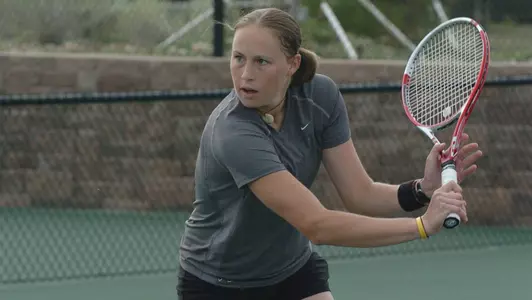
Since she was a 7-year-old in Asheville, N.C, tennis had been Phiel's life. But last winter, two of the most important women in her life - her mother, Carlyn, and Colorado tennis coach Nicole Kenneally - intuitively noticed that the spark was dimming.
"I wasn't performing like I wanted - partly because of injuries, partly because my game wasn't coming together," said Pheil, a junior who arrived at CU in 2007 on a tennis scholarship.
It wasn't difficult to see why Kenneally had recruited her; Pheil's high school tennis mark was 81-1 and her serve had been clocked at 110 miles per hour. She was a three-sport star (tennis, track, cross country) and keenly competitive.
But two years into her CU tennis career, after that spate of mostly minor injuries, Pheil's zeal for what she envisioned as her life-long sport began to wane.
Leave it to mom to notice first.
"I was stressed a lot . . . but tennis had always been such a big part of my life, I couldn't imagine not playing," Pheil said. "But it was something my mom said: 'You never talk about how much you love playing anymore.'
"I was like, 'I don't' . . . . It had become a source of so much stress, which was sad to hear myself say. But it was a kind of truth that I'd kept to myself for a while."
Four days after that, in a previously set meeting with Kenneally, who was unaware of the telling mom-daughter talk, Pheil had no more than settled into her seat when Kenneally observed, "What's going on? You seem frustrated, you don't seem happy."
Pheil simply shattered: "I just broke down and told her, 'I don't know; nothing's coming together. It's not how I wanted it to be.'"
At that point, the most Pheil knew about what she wanted was this: She needed a break from tennis, she didn't want to abandon her teammates, she knew she couldn't remain on scholarship, she had a longing to immerse herself in a team sport.
But rugby?
A friend on CU's club rugby team had asked Pheil to come out as a spectator, and that piqued Pheil's interest. Prior to that, she said she was "confronted several times in random places" about playing the sport: One was during intramural dodge ball play, another came in an airport when a passerby asked if she was a rugby player.
"I don't know if it was my build . . . but I guess I looked like a rugby player," she said. "So if I look like a rugby player, maybe I should try it, right?"
Don't conjure the wrong image here; Pheil is 5-foot-8 and athletic, but as for looking like a rugby player, who could tell? Yet not long after she stepped onto the field, looking the part was replaced by playing the part.
"I started playing and kind of like I do with everything, I dove with two feet in," Pheil said. "It was great, and I said I want to focus and be the best that I can be - but that's kind of my mindset in general with everything.
"I love team sports and rugby is the epitome of that. The rules are really abstract. You have to pass backwards and you can't see your team - you just hope they're there. It's a lot about trust and communication. You have to know your team, how they run and the cuts they make. It's very, very team oriented.
"That fact alone I love about it. But I also love that I haven't had (a team sport) in so long."
She played about a month with the CU club "and had no idea what I was doing," she conceded.
But she obviously was a quick study. She joined a "sevens" summer league - it refers to the number of players (conventional rugby is played with 15 players) and is a much faster game.
The nearest "sevens" league was in the Denver suburb of Glendale, and Pheil used it as a launching pad. She was one of 12 players from the Western United States chosen for a West All-Star team that played in the National All-Star Championship (NASC) and, in late August, in the national championships in New York.
The NASC "is kind of like a recruiting search engine - the USA women's coach was watching and scouting for new players at that tournament," Pheil said, noting she was among 16 women invited to New York a week before the nationals "to play and train on the USA development team for 'sevens.'"
Said Phiel: "I can't tell you how much I learned. It was amazing, one of the best weeks I've ever had."
Her recruitment didn't stop there; she was invited to a USA rugby camp "that's kind of considered the player pool" for World Cup play. She'll compete with 31 other women in early October for 12 positions, but before those selections are made, the 32 players will play on randomly selected 12-member squads over the next three years in International Rugby Board (IRB) competition.
Rugby "sevens" could become an Olympic sport in 2016. It is competing with golf, karate, squash, baseball, softball and roller-sports for two available spots. Many consider golf and rugby the favorites.
The two selections could be made when Pheil is competing on Oct. 9 in the USA camp, which she says "will either be the best place or the worst place to be, depending on the decision."
Pheil left the CU tennis team (she won 12 doubles matches and eight singles matches in two years) with Kenneally's blessing and considers her former coach "an immediate ally. That made (her decision) tremendously easier."
But giving up her scholarship has made things a bit more challenging. An aerospace engineering major, Pheil, 20, has worked three jobs - "It's less time-intensive than it sounds" - to help make ends meet.
Her steadiest job is helping operate the wind tunnel and torsion machines in the aerospace laboratory. She's also interned for an engineering company that designed the 2012 London Olympics kayaking course and often works weekends for a local company that supplies DJs for "some big parties."
Kenneally and Pheil's parents have been supportive of her head-long plunge into rugby.
"I think it's an opportunity of a lifetime," Kenneally said. "In the spring when we were talking a lot, I could tell by her body language how excited she was. Look at her five months ago and where she is now - on the cusp of being a future Olympian.
"She's a hard worker and determined; success will only follow. I'm excited to see where the 2016 Olympics are held . . . I might make that my first Olympics."
Maybe Pheil's parents will, too. Accustomed to watching her play tennis, they've never seen her play her new sport.
"They were a little skeptical at first, but I don't know if they would have come out and told me that," she said. "I send them pictures and on paper, they can see how I'm doing.
"I think they're really happy for me. They know how much I love it and my happiness is good enough for them. I think they wished they lived closer so they could watch me."
Laughing, she added, "But I don't know; they haven't seen me play it yet, so once they see it, they might change their minds."
Doubtful. Enough people who know rugby have seen her come pretty far, pretty fast - and in a brand new sport, no less. What's there for a parent to dislike?
Contact: BG.Brooks@Colorado.EDU