Colorado University Athletics
Brooks: Pac-12 Volleyball An Eye-Opener For Buffs
October 20, 2011 | Volleyball, B.G. Brooks
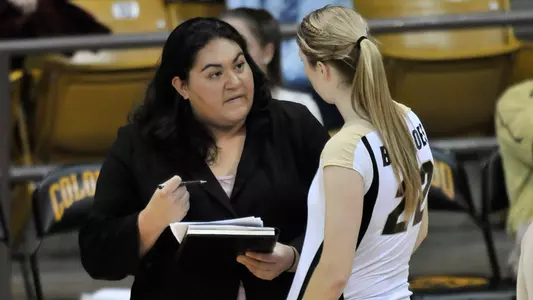
Kritza had been in Boulder (and the Big 12) for a year when the westward shift was announced. Ever so slowly - her records in her first two seasons were 7-22, 6-20 - she believed progress was being made in the old league when the new league beckoned.
The Big 12 had its elite programs, but alongside the Pac-12 it was an apples-and-oranges comparison of, say, Manhattan, Kan., to Manhattan Beach. In anyone's book, that's not close to being a tossup, and Kritza was correct in assuming the bar was about to be raised.
"It hasn't stopped moving," she said with a laugh the other day in her new office in CU's gleaming basketball/volleyball practice facility. "Some of our older players, some who had played against that (Pac-12) caliber of player in high school and club ball knew . . . Kerra Schroeder (a junior from San Diego) understood. But it's significantly different, and you don't understand it until you go through it - no matter how painful that is."
Need a reminder on the Pac-12's overall strength in women's volleyball and the pain that can be inflicted? Take a peek at this week's AVCA Division I Top 25. Five of the first seven - No. 2 Cal, No. 3 USC, No. 5 Stanford, No. 6 UCLA, No. 7 Washington - live in the Pac-12 and another member (Oregon) checks in at No. 18. That's half the league in the Top 25.
For objectivity's sake, the Big Ten, which obviously is mathematically challenged, lists seven of its 12 members - including No. 1 Illinois - in the AVCA Top 25. And CU's former conference boasts a trio.
Apologies to Penn State, which has won four consecutive NCAA women's titles, but it's hard to argue against the Pac-12 as your perennial women's volleyball mecca. Since the NCAA began contesting women's championships in 1981, Pac-12 teams have won 13 titles and finished as the runners-up 14 times.
BUT THE LEAGUE'S STRENGTH isn't confined to the top. Kritza points to the overall strength in the Pac-12: "Teams near the bottom are picking off teams in the middle. That doesn't necessarily happen in the Big 12. The highest ranked team (Texas) in the Big 12 is 10th (nationally). Then there's a big drop-off between the next ranked team. You're always going to have your elite three or four teams (in the Pac-12), but it's the rest of the conference that makes the difference. The middle to the bottom part of the Big 12 is not as strong as in the Pac-12."
Of scaling the ladder in the Pac-12, Kritza adds, "The rungs are a lot farther apart . . . it's a lot harder to climb."
Along with the adjustment to more top-flight talent in their new league, the Buffs have had to cope with a modified travel schedule. The Big 12 featured a mostly Wednesday-Saturday schedule; the Pac-12 prefers Friday-Saturday or Friday-Sunday. With the Big 12's schedule, coaches prepared for one opponent at a time. In the Pac-12, you do two-fers, preparing for your Friday-Saturday matches.
And many times those are against a pair of Top 10 teams. Consider: The Buffs opened Pac-12 play at home against Utah on Tuesday, Sept. 13, then packed their bags for a West Coast swing that took them to then-No. 1 California that Friday night and then-No. 2 Stanford a night later.
Doubling up on preparation is "not an impossible task," said Kritza, "but when you're preparing for No. 1 and then No. 2, without having the experience or that kind of talent, that's what makes it hard. You have to expect your players to really play out of their minds for two matches in a row.
"Now, playing Friday-Saturday with travel in between is pretty difficult. We're on the road at Washington-Washington State, and even Cal-Stanford is a little different. But we'll get used to it. Every other coach in the league is telling me we will. I've played a Friday-Saturday schedule before (at other coaching stops), but those teams were nowhere near the caliber (of the Pac-12).
"So you can manage the recovery and get your players prepared. But unfortunately, when that second match hits there's no way, unless you've purposefully prepared for the second match, there's no way to not have some sort of fatigue or residual effect from the first match. There's a 20-hour rule - the matches have to be 20 hours apart in this league."
HOPING THE SECOND HALF of Pac-12 play brings an upswing, Kritza's team launches its last 11 games this weekend with another of those back-to-back dates with the West Coast heavyweights. Friday night brings a match at No. 6 UCLA, and on Saturday night the Buffs trip across L.A. to play at No. 3 USC. (Can you say brutal?)
CU's overall record is 5-14, and that first Pac-12 win - even winning a set - has eluded the Buffs in their first 11 matches. There have been close encounters of the heart-breaking kind - falling 25-23, 25-23, 25-23 against Arizona State last week at home comes to mind. Kritza files that match under "One That Got Away" rather than "We Needed A Miracle."
"What winds up happening in conferences that aren't difficult, you can get a run of four or five matches and get momentum - and you pick up a few more simply because of momentum," she said. "Here, you have to create your own momentum. This is true for every team in the league, even teams at the top. They are constantly on guard; teams at the top of the conference are constantly having to keep their performance up because somebody else can sneak in and beat them because of the overall strength of the conference.
"It's hard for players to play so far above their heads in some matches. When you've been kicked in the teeth so much, when a breakthrough opportunity arises, sometimes you don't know how to respond. That's difficult for young players. You have to take the matches you can get . . . there are some where the universe has to align right and we have to play lights out. We know that and accept it. But you go with everything you have and try to pull an upset. There are some where we match up and we play well. Then it becomes more hotly contest and your confidence kicks in. We've missed a couple of those - and it's here we go again."
Kritza said new assistant Leonid Yelin, the veteran head coach from Louisville (15 years, overall record of 366-112), is helping reverse that mindset: "He's a great addition . . . he's honest with them, saying, 'You don't know how to win, but we're going to teach you.' . . . . We're focusing on things we can control; you can't make a girl grow four inches before the next match."
Still, losing brings frustration, and Kritza concedes it is "the hardest thing to fight off. As soon as the frustration creeps in, then the results and performance go along with it. We have to continue to be positive and appreciate the effort. We're asking, 'Are we doing everything possible as players and coaches to get better?'
"We don't allow them to let the frustration become more important than the work we're doing. We have to stay the course; you don't start changing things left and right. You stay the course because there's a lot of hours on the court that these kids have put in, and just because they're not getting results yet, you don't want to detract from their development.
"I make changes . . . I substitute quite a bit and do everything I can strategy-wise. But I can't expect there to be a magic solution. We have to get better, we have to get much better. You do that with recruiting and with hard work. There's no secret to it. Unfortunately it takes time; you can't flip things as quickly when you're playing against teams like this."
If frustration has an upside, this is how Kritza sees it: "If it doesn't set in, it means they're just happy to be here - and that doesn't cut it for me."
CU'S PAST VOLLEYBALL SUCCESS often was closely aligned with California players, so Kritza believes the school's move to the Pac-12 will enhance recruiting in a state where the sport's popularity was born on the beach. Just as California offers a mother lode of high school football talent, there is an abundance of top-tier volleyball players.
"The sport is so strong there, the roots are so deep . . . it's a beach game and players are there in sheer volume," Kritza said. "There's plenty of good kids; some want to go away to school - but just far enough, not halfway across the country.
"It's like as soon as we entered the Pac-12, we became an option for some kids who weren't looking at us before. It's a combination of the fit with the school, but also the prestige of the league. If you're among the best players in the country, you want to hone your skills by playing against the best. You're going to go where the best players are. It automatically wins us credibility . . . there's such respect in the volleyball world for this conference."
Kritza hopes to tap into that situation of prime California players perhaps wanting a change of scenery, as well as improve her recruiting on the home front. But, she adds, "We have to be successful to make that happen."
Overall, she is "very excited" about a November signing class that should yield three to five prospects, with more recruits expected in the late (April) period.
"With the core group of players we have now, we're going to welcome in a wholly different level of athlete and talent, but they'll really mix well together," Kritza said. "We'll start seeing the results we want. It really does take a different caliber of athlete and playing experience and attitude. We've gone out and looked for that, and we've found it in a lot of areas.
"You have to have recruiting as a high priority and it has to be continuous. It can't be just one elite player; you have to get one every year and then some. We have taken recruiting as a huge priority. If I expect my players to give me all they have in the gym, then on the flip side as coaches we have to do the exact same thing. We have to keep bringing in great players for each of these players to play with. That's how you build a sustainable successful program. You don't just try to take what you have and work miracles."
Kritza believes success in the Pac-12 opens doors for postseason success. "If you can climb into the upper echelon of this conference, you're talking about legitimate shots at regional championships, Final Fours and national championships. That's why this league serves this program well; you're prepared for that type of postseason play."
THAT'S CURRENTLY LITTLE MORE than a dream in Boulder, but it never hurts to dream large. Her team's W-L record might not indicate it, but Kritza sees progress on the court and most definitely in recruiting. And those brutal road trips even have an educational value.
"With every road swing, we're learning something," she said. "But I can't shut off that competitive side either. I want it so bad for these kids, I want them to experience success. I know it'll come for them, but our seniors are running out of time . . . they know I'm never going to give up on them, but they also know I'm never going to let them stop working. It's not in my DNA.
"The coaches knew what we were getting into. But it's different when you have an 18- or 19-year-old mind trying to wrap itself around this . . . when we get it, it'll be fun."
Halfway through her first season in the Pac-12, Liz Kritza's key word is patience. (PS: It's being uttered elsewhere on campus as well.)
Contact: BG.Brooks@Colorado.EDU