Colorado University Athletics
Brooks: Karl Says Run, But Be Patient With The Process
December 02, 2014 | Men's Basketball, B.G. Brooks
BOULDER - George Karl has been to a couple of Colorado men's basketball practices this season - his second visit to the Coors Events Center being Tuesday morning. Karl, says CU coach Tad Boyle, has an "open invitation" to drop by, observe and share his observations.
And Karl does.
Because Karl's resume speaks of his offensive genius in the NBA and way before then, Boyle likes to pick Karl's brain and marvel at the up-tempo numbers that seep out. Boyle's dedication to defense and rebounding hasn't waned, but he's interested in the Buffs getting as much out of their offense as possible - particularly at the CEC's 5,430 feet of altitude.
The Buffs are at the very front end of an offensive makeover, trying to implement the faster pace that became Karl's trademark with the Nuggets. It's predicated on spacing, fast, smart decisions and efficient ball movement, not allowing the ball to "stick" in any player's hands for more than one or two seconds.
The ideal scenario(s): outrun the defense to the other end of the court and score on a layup, or failing that, have a fast enough "pace of play" that prevents the defense from comfortably getting set. Get a good shot up in 12 seconds or go to a three-stage attack plan, with the first look always being inside.
Playing fast worked well enough for Karl, who left the Nuggets with the second-most wins (423-257) in franchise history and a 106.1 point per game average in his final season (2012-13). Boyle isn't looking for a triple-digit scoring average from his fifth CU team, but he is looking for the Buffs to push the pace at every opportunity.
Of course, opponents - let's say Wyoming - can prevent that and Boyle is trying to find preventative measures to deal with the kind of Cowboys slow-down that contributed to the Buffs scoring only 33 points a couple of weekends ago. He met with Karl before this season began and likely will again before the season ends, based on Karl's availability.
I asked Boyle about Karl's take on what the Buffs are attempting offensively and he initially deferred to Karl. Then, with a grin, he said, "When we're scoring in the 80s and 90s I think he feels pretty good about us; when we're scoring in the 50s and 60s, I think he's saying, 'What the hell are you doing?'"
AS FOR CU'S LOW-WATTAGE outing in Laramie, Karl might not say anything. Then again, Karl rarely keeps his thoughts to himself. His relationship with Boyle began forming during the NBA's most recent lockout season (2011-12) when several area coaches called on Karl and "talked about their thoughts on playing fast, why we liked fast," Karl remembered.
Karl likes it because he doesn't care for basketball conformity. "My theory is with the three-point line and the way the game is going, most coaches want to limit possessions," he said. "I don't like playing like everybody plays; the other way to play is to pick up the tempo and play fast, take some of the controls off of your shot selection, let your players have a little more freedom, demand them to be defense oriented. I think it's actually a simple thing."
Ironically, the simplicity of playing fast and the effect on a defense registered with Karl from what he saw in two other sports. He "kind of gravitated" to a higher speed offense watching Oregon football, and Spanish soccer in World Cup play.
"Everything was based on quick decisions, fast decisions and not allowing the defense to get stationary," he said. "I think basketball is the same way. You try and read defensive mistakes as quickly as possible. And once you get the defense into 'scramble and recovery' you keep it in 'scramble and recovery.' I think that's what Oregon football does. What I've been told by football players and coaches is that Oregon football looks complicated, but it's really pretty simple."
Could be that Ducks quarterback Marcus Mariota just makes it look that way, and a backcourt featuring a player of that caliber would make Karl's offense, Boyle's offense - any offense - run fast and smooth.
With a few exceptions, said Karl, most players' confidence comes from scoring, and the Buffs encountered great difficulty in last season's final two games - Arizona in the Pac-12 Tournament, Pittsburgh in the first round of NCAA Tournament play - because "they couldn't score. To me, the most intimidating thing in basketball is when you can't score. It's hard to coach a team when they're frustrated."
In those two season-ending losses, the Buffs scored 43 and 48 points, respectively, which undoubtedly factored into Boyle's off-season look into offensive upgrades.
Now, Karl isn't advocating total abandonment on the defensive end - quite the contrary - and Boyle wouldn't be seeking Karl's counsel if that were the case. "In pro ball," said Karl, "my tradeoff was, 'I'm going to give you freedom to play, but you're going to give me defensive effort' . . . the foundation of basketball starts with defense and offense is second.
"So if I'm going to give you the freedom to play 'more free,' then you've got to do what I want you to do defensively. It's pretty simple; you play defense, you try to create as much offense with your defense and that creates fast. Bad shots, shot blocks, deflections, turnovers - all that stuff creates fast."
In Karl's first season with the Nuggets (2004-05), they were 6th in the NBA in defense. In subsequent seasons, they were 8th, 9th, 6th, 8th, 16th, 19th, and 11th. A coincidence that the 'D's low-water marks under Karl were in Carmelo Anthony's last two seasons? Probably not.
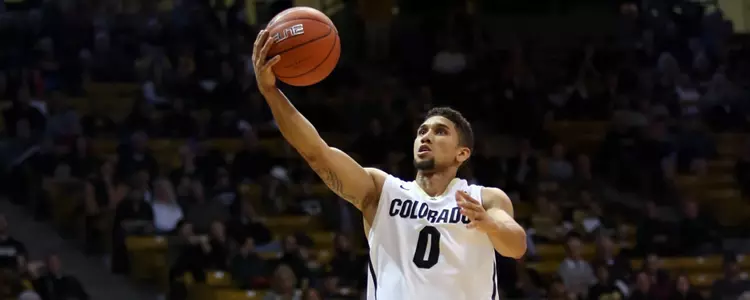
AFTER SPEAKING WITH KARL following Tuesday's practice, CU senior Askia Booker said he realized that the Buffs are "getting better but we're not as far (along) as we should be" in their new offense. "(Karl) said when he was with the Nuggets it took him almost three years of running it to get it to where he wanted to be. We only have 30-something games in our season and they have 100-plus, counting playoffs . . . but we're going to try and make it work as fast as possible."
Booker said Karl urged him to pay attention to detail: "The small things that add up to really big things -- the pick and roll, getting the ball into the paint as much as I can personally, sucking the defense in, looking for my threes."
Consistently hitting the 3-ball is an area Boyle wants to see improve, and the other two priority items in Karl's play-it-fast offense - hitting layups and free throws - are achievable when the treys aren't falling. Karl's game-to-game goal: 30 layups, 30 free throws and 30 assists. His biggest taboos: players letting the ball "stick" in their hands instead of moving it and taking long 2-point jumpers.
Karl also put a premium on depth, noting that regularly using eight or nine players allowed his offense to stay fast and fresh while defenders were tiring and making bad decisions. And remember, the altitude is your friend.
"No question," he said. "My main mentor, Doug Moe, said you have to run . . . don't get me wrong, I think I've played fast wherever I've been, but we (the Nuggets) went off the charts with it . We demanded it, coached it, philosophized it and never backed off it - especially after the 'Melo' trade."
Boyle's "trade deadline" is national letter-of-intent day, but he's got enough capable players to run his new offense. Proficiency in it, said Karl, "is a process . . . how far did you get this year? How comfortable did you get this year? The big thing, I believe, is players like to play it."
Plus, he added, "It helps get good players to come to your school . . . and as a college coach, that's important."
Yeah, just a little.
Contact: BG.Brooks@Colorado.EDU