Colorado University Athletics
Brooks: Marolt Returns, Takes Looks Back And Ahead
May 23, 2014 | Football, General, Skiing, B.G. Brooks
BOULDER - Bill Marolt is still wound up, but he's winding down - voluntarily and on his own terms. He's stepping back and coming home, in this case home being a cherished workplace (Boulder) rather than his birthplace (Aspen).
But home is Colorado and his heart is nowhere else.
Among the state's most recognized sons, Marolt must be high on the list. He's a University of Colorado alum, a former CU skier, CU ski coach and athletic director. He's an Olympian, a former U.S. Ski Team coach, former alpine skiing director and as of February - following the Sochi Games - the former President and CEO of the U.S. Ski and Snowboard Association (USSA). He's also been vice president of the International Ski Federation, been on the USOC Board of Directors (and will remain) and been a National Governing Bodies Council director.
Have I left out anything? Probably. His familial duties include those of husband, father and grandfather. Various Hall of Fame membership cards might fill a second wallet.
Marolt and his wife, Connie, returned to Boulder in mid-May from Park City, Utah, where he headed up the USSA for the past 18 years. The Marolts plan to spend their summers (and football seasons) in Boulder and the colder months in a Scottsdale "casita" they've owned for about 15 years.
 |
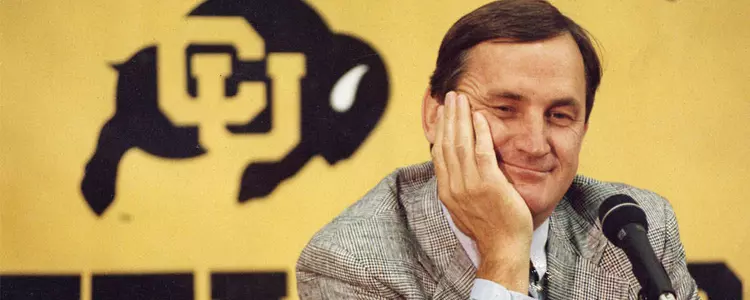
| Bill Marolt, CU Athletic Director from 1984-96 |
The only downside he can imagine in a mild Arizona winter is the scarcity of ski slopes - but that craving isn't what it once was. "It'll cut back on the skiing a little, but that's OK," he said. "The older you get you just ski flatter hills with no moguls. So it's still good . . . I'm happy to be back. I'm sure Connie and I'll enjoy it. She's fired up. She loves the community and we have lots of good friends in this area. We'll have a good time sitting out here (at Folsom Field) come September."
Eyeing his 71st birthday on Sept. 1, Marolt remains in good health. Only "a creaky knee" hurt at Copper Mountain - he was taking a summer look at a USSA training center project and slipped on a rock - prevents him giving himself a clean bill of health. He'll continue to ride his mountain bike here and likely will find a substitute for the $22.5 million Park City training facility - the Center of Excellence - that's part of his USSA legacy.
"We had a good staff there that took care of me," he said, grinning.
We were sitting at a table in the deserted Varsity Room in the Dal Ward Athletics Center, a building constructed during Marolt's watch as CU athletic director (1984-96). From two stories below came the rumble of heavy equipment; ground was broken two weeks ago for a $143 million facilities project that began in Folsom Field's north end zone and northeast corner. The targeted completion date: Late August, 2015.
Not quite three full months into retirement, Marolt jokes that if there is one thing he now has plenty of, it's time. But for a guy who has been mostly in overdrive for 50-plus years, downshifting doesn't come easy. I asked him how he plans to dial it back without creating a surplus of spare time.
"That's the hard part," he said. "I've been involved in athletics one way or another since I was a kid. It's really been my whole life. So to step away from something you're really passionate about, something that you know a lot about and had success with, yeah, it's hard to step away from that. There are certain things that you get tired of and are not going to miss, but what you will miss are the events, watching the athletes perform at the highest levels.
"All of the things that you hear people say who are leaving something that they've been passionate about, those things are true. It'll be a period of adjustment, and frankly, I need to sit back for a period of time then I've got to find some other projects to keep myself busy."
His involvement in U.S. skiing won't be completely severed; he will stay "at an arm's length" - or a telephone call or email - away, he said. "But once you've moved out of it, new people move into the roles and it doesn't take very long for them to assume leadership. You just move on - and that's what I plan to do. The good thing is I'm looking back at fond memories with no regrets."
If there were regrets from his dozen years as CU's athletic director, the stack was short.
 |
| Bill Marolt, with football coach Bill McCartney, celebrating another Big Eight championship. |
TAKING A CHANCE ON A COACH
In his first year on the job as CU's AD, Marolt made a major move that puzzled, maybe even enraged, many Buffs football fans: He extended the contract of coach Bill McCartney. At the time, McCartney's Buffs were 1-7 and headed for a 1-10 finish.
But the next season, the climb began. CU finished 7-5 in 1985 and five years later won a national championship. After Marolt gambled on McCartney's extension, the Buffs went 87-30-4 over the next 10 seasons, with nine bowl appearances, three conference (Big Eight) championships and a national championship (1990).
It was the Golden Age of CU football, and Marolt attributes it to a kind of harmonic convergence of leadership at the university. He was hired by former CU President Arnold Weber, who, recalled Marolt, "made some tough decisions about the (athletic) department and what it was going to be. Ultimately he understood that football was going to drive this deal.
"By the time he left, the university and athletics were really positioned. Then when Gordon (Gee) came in, he was the ideal guy (as president). He wanted to have a strong athletic department and a strong football team for all of the reasons I just said. Everything aligned; Gordon was the president, Jim Corbridge was the chancellor, I was the AD and 'Mac' was the head football coach. And we were together. We went through some tough times but survived them and ultimately won."
Gazing out of the Varsity Room windows at the names of former CU football players now in the school's Hall of Fame inscribed on the stadium, Marolt said, "And those were some pretty impressive athletes."
Now that he's back in Boulder, among Marolt's goals is renewing his relationship with McCartney. "We've talked from time to time, but one of my goals now is to reestablish that (relationship)," he said. "I'd like us to spend some together."
For all that Marolt learned in the classroom at CU in the 1960s, he furthered his "real world" education working as AD with McCartney and the Buffs' other coaches. "Everything I learned about what I do now or did do, I learned right here either as a coach or as an athletic director," he said.
Marolt called his first several years as CU's athletic director "really a tough experience, a battle for the first two or three years. But we got it figured out and then we went like crazy. I learned so much when I was the AD; I learned about leadership from working with our coaches - particularly with 'Mac.' I learned what good leaders have to do, how they have to act, what their real responsibilities are. My whole foundation for my career started right up there in the corner of the stadium."
A particular McCartney quote stuck with Marolt during his USSA career: "He always said, 'If you have a goal, you're not really committed unless you're willing to write it down and put it up on the wall.'"
What Marolt wrote and posted for U.S. skiing was this: "Best In The World" - and that's what it became.
 |
| Bill Marolt led Colorado to seven NCAA skiing titles from 1972-78 |
THE GOLDEN (SILVER AND BRONZE) TOUCH
Under Marolt's direction, the CU ski team prospered, winning seven NCAA titles in 10 seasons. U.S. skiing also went to the top of the mountain with "Downhill Bill" in charge.
With Marolt directing this country's alpine skiers, the U.S. won five medals in the 1984 Sarajevo Olympics. In the 2010 Vancouver Games, 17 U.S. skiers/snowboarders won 21 medals. In Sochi this winter, the skiing/snowboarding hardware count was 17. Of the 95 Olympic medals won by U.S. athletes in the history of the USSA, 70 of them were won under Marolt's leadership.
In a February interview with Street & Smith's SportsBusiness Journal before his final Olympics, Marolt said "a foundation existed" when he arrived at the USSA, "but we weren't sure who we were . . . we weren't sure if we were a fundraising org or an event org. Really, what we are is an athletic org. We're an org about winning. But we have to do all of those things well . . ."
The key, he continued, is having key people, recognizable personalities "that are easy to identify with. It doesn't matter if it's fundraising or sales but having the stars there ' whether it's Julia (Mancuso) or Lindsey (Vonn) or Bode (Miller) or Lindsey Jacobellis ' those personalities and the results they get motivate people. What our public wants to hear, a corporate sponsor or a donor, is excitement. They want to hear that we have a chance to have someone standing on the podium. We have to stay focused on athletic results and winning."
 |
| Bill Marolt and the National Ski Hall of Fame Medal of Honor |
Asking Marolt to pinpoint a most gratifying memory or experience with the USSA is close to asking McCartney "for his most memorable moment" as a coach, Marolt said. "Oh, boy, that's hard . . . there are just so many cool things that happened. It's about creating the right environment for athletes to chase their Olympic dreams. When you see one of our athletes stand on an Olympic podium or a World Cup podium or win a world championship, that's what motivates you, that's what gives you chills.
"For me to answer that would be really, really hard. I would answer it by just saying we had incredible athletes and our staff did a good job of providing leadership. It was all phenomenal what we were able to accomplish in Sochi, in Vancouver, whether it was Bode (Miller) winning World Cup titles, whether it was Lindsey Vonn . . . think about it: Lindsey won 59 World Cup races. That's like - I'm old - but it's like 60 home runs in the Babe Ruth era.
"You just go across every sport and you have a competitor or competitors like that. For me, it's the good memories of our accomplishments and that we were winning the right way and with the right attitude."
Marolt made his final Olympic trip - at least the final one in an official administrative capacity - in February. There was no time, he said, to be melancholy. His retirement was announced last August and, planning for the leadership transition, the governing board positioned former Olympian Tiger Shaw as Marolt's successor in October. A plan was in place, leaving Marolt to concentrate on what would happen in the Sochi snow - not what would come later.
"It wasn't melancholy (in Sochi) but it was when I got home," he said. "When you're in the game, in the fray, and you're focused on what's going on, that's where all your focus is."
Despite some media coverage to the contrary, Marolt said Sochi was an overall good experience. The venues, he said, were "well done, well prepared . . . it's like any outdoor sport: you're going to have days when it's not ideal, right? You can't control the weather."
In other areas where control was possible - ranging from food to accommodations to transportation to security - he described the outcome as good: "It was a good experience and most important, our athletes did a really good job."
He was accustomed to that as CU's athletic director, particularly in football. Which makes his school's nearly decade-long plunge puzzling.
 |
| Bill Marolt's decade-long tenure as AD helped put the Buffaloes on the national map. |
WATCHING THE BUFFS' LONG CLIMB BACK
Marolt hasn't met "Mac II" - second-year CU football coach Mike MacIntyre - and wondered, when introductions are eventually made, "Do they call him 'Coach Mac?'"
From his spot on the other side of the Rockies, Marolt watched Buffs football slide. And slide. And slide. Given the state of the program when he left Boulder in 1996, the program's downturn has been disappointing.
"It's disappointing because we had it running at a high level," he said. "The life lesson there is that you need to keep your eye on the ball. You can't take things for granted; you have to keep your eye on the horizon and make sure that you're maintaining your competitive position.
"It happens everywhere - sports, business, every enterprise. The leadership has to make sure that they're keeping their eye on the ball. It is about performance at the end of the day. When this team is performing and this place (Folsom Field) is full there's no better place in the country than right there in this stadium. It's an awesome sight. Obviously, it affects the economy, the university, the community and the state when it's going right.
"Having said that, I don't know 'Coach Mac' - do they call him that? - but I know Rick (George) well. He worked for us when I was the AD, and he's a passionate, high-energy guy who knows how to do it and is willing to spend the time and put the work and effort in it that it's going to take. My impression is that from the president down to the chancellor he's got support - and that's critical. You can win with that. It's impossible to have a successful program without that strong leadership from the top of the university."
Before CU hired George last summer, Marolt didn't get - nor did he expect - a call asking for a referral on the Buffs' AD-to-be.
"You know, it's pretty interesting and it goes back to what we were talking about earlier," Marolt said. "Once you're out of that hemisphere - like in U.S. Skiing - it's interesting how quickly you move away from the decision process. So the answer to that is no; I wasn't consulted about (hiring George). Obviously I followed it and was excited about it."
Did he make a congratulatory telephone call to George?
"Of course; I always do that," Marolt said. "And I'm sure that Rick and I will see a lot of each other over the next year."
 |
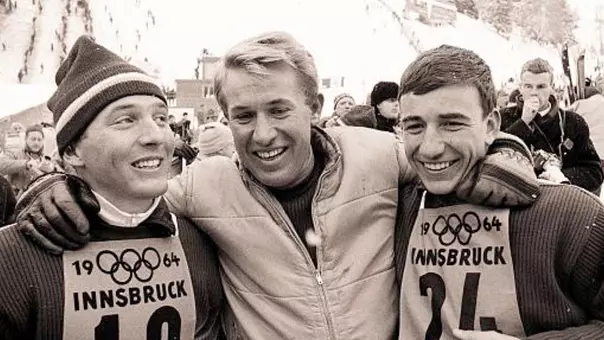
| Bill Marolt as a CU skiier in 1966 |
Marolt believes CU - the university as a whole - took a critical next step three years ago when it joined the Pac-12 Conference. A move to the Pac-10 was considered in 1994, two years before Marolt left, but was shelved because CU had committed to the formation of the Big 12 Conference.
"The timing just wasn't right," said Marolt, noting that at the time CU's president, chancellor and athletic director were chairing those positions in the Big 12's administrative rotation. CU's decision to stand pat was the right one, he said, "And there's no question that the decision that was made three years ago was the right decision. I think it's an awesome thing. Just in terms of our campus, the relationship between athletics and the overall campus is enhanced by our move to the Pac-12 . . . we're more of a sister institution in that conference with its other universities."
CU's commitment to a major athletic facilities upgrade, said Marolt, should enhance MacIntyre's rebuild: "In college athletics now it's the quote 'arms race' but it's true. Whether it's perception or not, it's true. It's really important that you put on your best possible face with your facilities. And it's not only for our recruits and our teams, it's to the public, it's the image you portray. This is a first-class university, this is a big-time school.
"It's important that we put on our best possible face and that people see us as first class in everything - first-class in terms of education, first-class in terms of faculty, staff, students . . . and with the athletic facilities it's really important that we do this. In many cases (athletics) is the way that people learn about the university - who we are, where we are. More importantly, it's the way a lot of students maintain their contact - through the athletic department and the athletic teams. Again, that's why it's so important from Rick on down that people do a good job . . . it all needs to be as good as you can make it."
It was that way a long time ago when he was athletic director, and he intends to be around to see it come full circle.
Contact: BG.Brooks@Colorado.EDU