Colorado University Athletics
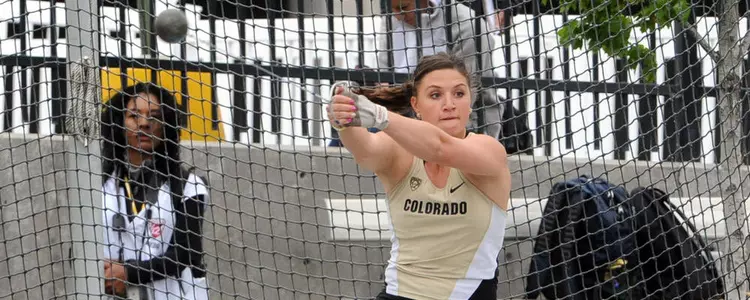
Brooks: Hunsucker Taking Hammer As Far As Possible
June 10, 2014 | Track and Field, B.G. Brooks
BOULDER - By Casey Malone's calculations, throwers of the hammer - that 4 kilo steel ball that demands near-perfection in windup and release - begin to peak about 10 years into serious competition.
And that timeline draws a chuckle and a little on-the-spot math from maybe Malone's top protogy - Emily Hunsucker.
"I had no idea it (the hammer) even existed five years ago," she told me last week. "Literally, I didn't know. I want to continue throwing and as far as another six years, who knows? I'm only 23. I'm extremely proud of where I've gotten with this thing. I figure I will keep doing this for as long as I love to do the sport and as long as I can technically afford to do it, I guess."
There are plenty of good reasons why Hunsucker, a University of Colorado senior, should stick with this relatively new pursuit. Reason No. 1: She loves it. Reason No. 2: She's really, really good at it. The list can end there, but her achievements are just beginning.
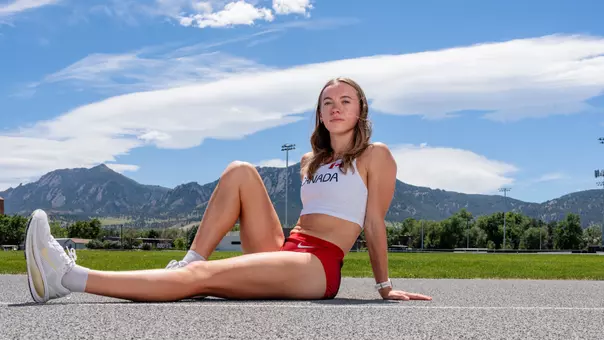
Hunsucker is CU's best female hammer thrower. Ever. At last year's Mt. SAC Relays, she became the school's first female to reach 200 feet (61 meters) with a whirl-and-heave of 61.03 (200 feet, 3 inches). That surpassed her school record of 197-8 (60.25 meters), set less than a month earlier, by nearly 21/2 feet.
Her progress continues, which is no surprise to Malone, her CU coach and a two-time Olympian in the discus. Hunsucker, says Malone, "thrives on progression . . . she's had a pretty astronomical trajectory since her freshman year. She's has just absorbed and progressed through more technical information and challenges than anyone I've ever coached in the hammer. It's almost like we're working on something new every day, and she'll take it, apply it and say, 'OK, what's next?' I've had other athletes who might have worked on one problem for two or three years. With Emily it's something new every day."
How's this for progression? As a freshman, Hunsucker's best throw in her new event was about 49 meters. Four and a half years later, she has a personal (and, of course, school) record of 64.91 meters (212 feet, 11 inches). She won the NCAA West Regional competition two weeks ago in Fayetteville, Ark., with a throw only slightly shorter - 64.05 meters (210 feet, 1 inch).
By winning the West Regional, Hunsucker has stationed herself among the throwers to watch in this week's NCAA Championships in Eugene, Ore. Her competition arrives early; it's on the first day (Wednesday) of the four-day meet, meaning she needs to settle in/down fast and step into the ring focused.
|
||||||||||||||||||||||||||||||||||
HUNSUCKER, WHO FINISHED NINTH in the 2013 championships in Eugene and earned second-team All-America recognition, has the NCAA's eighth-best throw this season (64.91). She finished fourth (62.44) in last month's Pac-12 Championships.
The Pac-12 winner, Oregon's Jillian Weir (67.43), will be considered among the NCAA favorites by virtue of throwing from a familiar ring, but Malone says Weir's inconsistency might offset the home track advantage. Meanwhile, Hunsucker has kept the ebbs and flows in check, consistently coming in with 64-meter throws "even when we're working on things," Malone said. "To have as many meets over 64 meters as she's had is phenomenal."
"(Weir) hasn't been consistently near her top distance," Malone continued. "She's thrown it once this season, and the rest of her throws have been in the 60-meter range. But put her in her home ring, hometown crowd around her and she could certainly come up with something huge. I think something between 66 and 68 meters will win the championship. I think Emily is certainly capable of that. She's had practice throws in the last week and a half in that range.
"But it's very difficult to say who might be the favorite. There are good throwers from the East Region (Princeton's Julia Ratcliffe won the region at 67.51), and Emily won the West so theoretically you could say she's on pace to represent our half of the country."
A Pac-12 women's thrower - Arizona State's Chelsea Cassulo at 69.12 - won the 2013 NCAA title, and four of the top nine NCAA finishers were from the Pac-12. But Cassulo has graduated and another of the conference's top competitors - UCLA's Ida Storm - redshirted the 2014 outdoor season.
"I would say overall the (NCAA) field this year is a little different, just because last year it seemed like there were quite a few girls that were really close to the 70 meter mark," Hunsucker said. "This year there's a lot of girls right about where I am. So I really feel like it could be anybody's game. It could be a very tight clump.
"Anybody can pull out a big throw or flounder. It's kind of exciting that way. It's kind of like what happened at regionals for me. I really wasn't supposed to win that on paper, but . . ."
But . . . coming into the regional as the No. 3 seed, she won - and Malone wasn't surprised, mainly because of Hunsucker's swift acclimation to the sport and a work ethic that hasn't diminished. The yearly strides Hunsucker has taken in an event that requires the body to do something so totally new reminds Malone of a physical therapist "helping somebody walk for the first time . . .
"To do (the hammer) very fast and very powerfully is enormously challenging. It makes me appreciate, being in the position I'm in and watching athletes develop, her going from a sport she's never done and not really designed to do . . . Emily is not learning to walk again but it's a similar challenge in that she's learning a new bi-motor pattern. To continue to refine and progress in that is an enormous emotional challenge as well as physical. It can be very stressful at times. Your mind is telling your body it likes to do this, so why is it not working? Emily has been able to be very consistent emotionally when it comes to that. She's very driven for the task at hand."
A perfect hammer throw, said Malone, is akin to the perfect golf swing - a worthy but largely unattainable goal. "There are moments where you can feel it's perfect for where you're at on a certain day," he said, adding he likes to think of it as "art - perfect synergy and movement - all of the thousands of muscles, bones, ligaments, everything in a sort of synergistic, rhythmic acceleration through the air. If one of those muscles is too tight or loose or out of balance, then the whole thing falls apart.
"Imagine a giant top and spinning it. To get it to spin perfectly is sort of what some of the best throws would feel like. Everything functioning as it should. If you're a little out of balance, imagine tapping that top. It wobbles. And it doesn't take much of a tap to throw it off. Have a four-kilo ball and spinning it 30 to 40 mph, there's a lot of things that can go wrong. A perfect throw is like the perfect swing in golf - elusive. But chasing it is part of the fun of throwing."
AND IT'S ONE OF THE THINGS that keeps Hunsucker in the sport. With her best throw this season coming early - 64.91 meters on March 21 in the Jerry Quiller Classic, her outdoor debut - Malone said it would have been too easy for both of them to declare and celebrate her arrival: "That's a great throw. A lot of coaches would say, 'Let's stay here; let's just keep doing this one thing.' With the way she is and the way I am, that's nice, but what's it going to take for us to be a national champion? That 64.91 is not going to be a national champion. Now, 68 would, so what can we do to get those extra three meters in the next two months? We started attacking that next problem."
As a result, Malone noted, "the next couple of meets were hard on her. She was trying to implement new techniques in the middle of a season. That's her nature. If we had let things be stagnant, I think she would be bored and frustrated. She thrives on progression."
If there's anything Hunsucker wants to avoid, it's boredom. Toss in leveling off, too. "I think it's part of the reason I've found success," she said. "I'm a little more humble about it because every day matters. The day-to-day activities matter. It's true; I'm never really satisfied. Even on my PR throw this year, I didn't know that was going to be my best this year and I wasn't satisfied with it. I was ready to keep going.
"It was cool to win regionals and be the best in the West, but I knew it wasn't my best performance. I was excited that on that day it was good enough. But in my own mind there can always be a better throw, and that's definitely a blessing and a curse in this sport. You can spend a lot of time chasing that perfect throw."
In chasing perfection, Hunsucker said she always tries to remember why she loves the sport - and that is "it just feels so good to throw every single day . . . that whole chasing the better mark thing is kind of ingrained in me in everything I do. I think the reason I love throwing, love the hammer, is that because it plays to my strength athletically but it also is extremely challenging. And I really like that."
Hunsucker's exposure to Eugene is limited to last spring's national meet. But she saw enough, experienced enough, last June to achieve something close to a comfort level for this week's competition. But comfort level here is a relative term; the only real comfort gained from competing on a national stage is offering a performance worthy of it.
And that's what she intends to do. "It's exciting because it's not my first time," she said. "I'm still a little nervous, a little anxious, but I know what to do now, know the drill. I know where to check in, those kinds of things . . .
"I love Eugene. It's really cool. It's Track Town, USA; there's season-ticket holders for track! People know what the hammer is. It's just an amazing place to compete."
Another amazing thing: Emily Hunsucker will be competing in the NCAA Championships. Give her another five years in the sport and who knows where it might take her.
Contact: BG.Brooks@Colorado.EDU