Colorado University Athletics
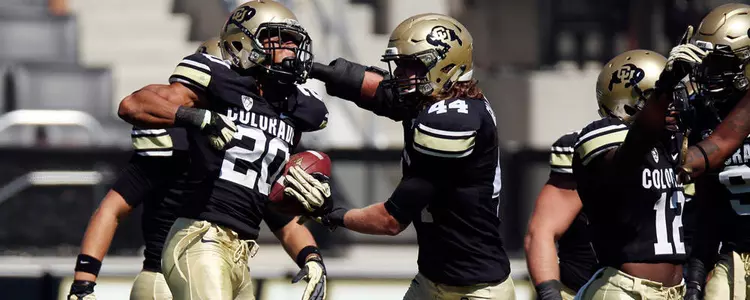
Brooks: Lining Up Fast, Playing Faster Keys For CU 'D'
September 25, 2014 | Football, B.G. Brooks
BOULDER - Getting lined up correctly and quickly might seem so rudimentary in college football that it shouldn't be an issue. But in the era of the no-huddle, up-tempo offense, doing the simple things faster and maintaining efficiency is what prevents defenses from getting scorched - and scored on with embarrassing frequency.
That's what California's offense is doing in its second season under fastball football guru Sonny Dykes. The Golden Bears are averaging 43.7 points a game, fourth in the Pac-12 Conference behind Oregon (48.5) and Arizona State and Utah (47.0 each).
For defensive coordinators, Dykes' spread offense has been a first-quarter blur. The Bears (2-1, 0-1) have outscored their three opponents 56-0 in the opening 15 minutes and 97-20 in the first half. Slowing Cal down - or at least keeping pace - is Colorado's task Saturday afternoon (2 p.m. MDT, Pac-12 Networks) in Berkeley in the Buffaloes' first conference road trip of 2014.
Dykes' second Cal team has become the big-play Bears. Through three games, they've posted 12 plays of at least 50 or more yards, with four of 40 or more coming last weekend in a gut-wrenching final-play 49-45 loss at Arizona. Cal has produced six plays of 50 or more yards, three of 60 or more, two of 70 or more and one 80-yard touchdown pass against the Wildcats.
Limiting the long ball is among the Buffs' defensive chores this week, as is acclimating themselves to the Bears' tempo. In reality, the up-tempo adjustment shouldn't be that extreme. Hawai'i, CU's last opponent, is third nationally in plays per game (89.3) and was just under that (87) in a 21-12 loss to the Buffs last weekend.
And here's a second reality check: the pace the Buffs defense has seen from the Buffs offense in practice is thisfast. CU actually averages more plays per game than Cal - 85.0 to 80.5. Cal's average is down from 88.7 in 2013, while CU's average is up from 72.8 last season. The Buffs rank 10th nationally in that category, the Bears are 29th.
In the hurry-up-and-snap-it category, the Pac-12 has four top 20 teams - No. 6 Arizona (86.8 plays per game), No. 10 CU, No. 15 UCLA (83.7) and No. 20 Southern California (80.3). Oddly, Oregon is poking along at 71.0 plays a game - No. 88 nationally.
Regardless of those numbers and comparisons, Cal's tempo is fast enough to pose fundamental defensive problems. "It hurts defenses when they don't get lined up . . . when you don't get lined up against an offense like that you get confused - and that's when they create their big plays," said Buffs sophomore safety Tedric Thompson.
Added his coach, Charles Clark: "One thing you have to do is stop them from getting in a rhythm. Once they get in a rhythm with that fast-paced offense it's hard to stop. We've got some different things we're working on this week to adjust to and get ready for that."
In a league brimming with high-profile passers, Cal sophomore quarterback Jared Goff ranks fourth in passing at 296.7 yards a game. He's coming off a 380-yard, three-TD performance (192.7 QB rating) at Arizona. Goff has thrown for 890 yards, with 10 TDs and two interceptions.
Goff has had nine multi-TD pass games in his brief Cal career, including six games with three or more TD passes. Clark said the experience Goff gained last season shows in his play as well as in that of the entire Cal offense: "A year in that system has definitely brought them along. (Goff) started as a freshman so he's got a lot of experience. All of his receivers are back and basically all their running backs. They've got the core of their offense back and that allows them to play faster. But we've got a lot of guys back on defense and that allows us to play faster, too."
But, said senior safety Terrel Smith, even faster communication will be key to the Buffs aligning themselves more quickly and correctly on Saturday: "We just have to communicate faster . . . you have to get lined up and make sure everybody is doing what they're doing and getting the call fast. That's the main thing."
CU defeated Cal 41-24 last season in Boulder, but the Bears, continued Smith, "are faster than last year . . . we've got to be right with them. They beat teams that aren't as fast as them and don't get lined up. That's what gives defenses problems. If we can correct that and get lined up we'll be good."
If "up-tempo communication" is a CU goal this week, overall communication in the secondary has improved in the past three games. Clark pointed to that as one reason for better overall back-end play, as well as a more thorough understanding of "what we're trying to accomplish on defense against each team. Our execution has been good, but we can always improve on that."
Thompson, who leads the Buffs in tackles (38 total, 27 solo) and has CU's only two interceptions, also said his unit is playing with more confidence and that was bolstered by holding Hawai'i without a touchdown last week. It was the first time in 51 games a CU defense has accomplished that.
"Our confidence is going up . . . that's the main thing (in the improvement)," Thompson contended. "I think our confidence going into the Pac-12 is good; we're look forward to playing this game."
While dealing with Goff is critical for the Buffs, the Bears' running game also poses problems. Tailbacks Daniel Lasco (123 yards, one TD) and Khalfani Muhammad (95 yards, two TDs) enjoyed career-best rushing games at Arizona and helped push Cal to a season-high 193 ground yards. The Bears are averaging 187.3 rushing yards a game.
Cal doesn't have a receiver ranked in the Pac-12's top 10 in either receptions per game or yards per game. That's mainly because Goff has thrown to 11 different receivers, with five of them having eight or more receptions. Bryce Treggs (5-11, 185) and Kenny Lawler (6-3, 195) have made 10 receptions each and have five TD catches between them.
CU's tackling has improved since the opening loss to Colorado State, but still more of an upgrade will be needed Saturday - especially tackling the Bears "in space." Said Clark: "Tackling in the open field isn't always the prettiest but you've just got to get them down."
Against Hawai'i, said Clark, the Buffs "did a really good job of tackling . . . we didn't miss too many and we had a lot of open field, one-on-one tackles. I think our corners basically led the team in tackles last week. Those guys did a great job on the edge."
Thompson believes that surer tackling and better pursuit have helped the defense, "And that's because the coaches have emphasized it a lot more," he said.
Thompson might lead the team in tackles, but it's not a stat he checks weekly. "I have no idea to tell you the truth," he said. "I just look for the wins; I don't look at individual stats or anything like that."
But Clark said Thompson has played well in subbing for sidelined senior Jared Bell, who is out for the season after undergoing knee surgery. "Tedric understands the checks, the defenses and how to get us lined up," Clark said. "We can adjust with him because he's played a lot and 'Chido' (safety Chidobe Awuzie) has played a lot as well. (Thompson) has stepped up; he's a little more vocal now. He's doing a good job."
The secondary received an emotional lift this week when Bell returned to the meeting room. Clark called that "a good thing for us. He's off his crutches a little more now and has been in there and been encouraging for us."
Given the task Saturday in Berkeley, it's a good week for the Buffs secondary to get encouragement from any source.
Contact: BG.Brooks@Colorado.EDU