Colorado University Athletics
Buff Volleyball Team Set For 'Dig Pink Match'
October 07, 2015 | Volleyball, Neill Woelk
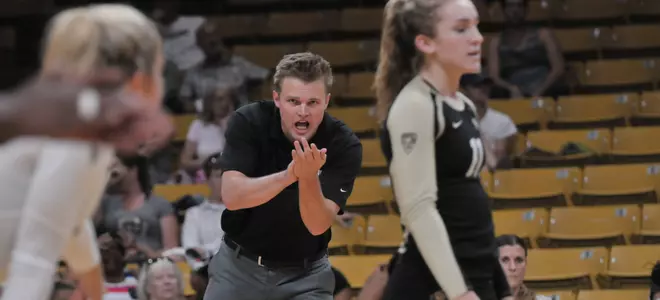
BOULDER — Ryal Jagd remembers handing out pink bracelets to his football teammates in high school. He remembers people asking what they were for, and he explained that they were to help raise awareness for breast cancer, a disease he became intimately familiar with after his mother had been diagnosed.
Now, a decade later, Jagd looks back with a deep sense of gratification — not just because his friends wore the bracelets, but because the symbolism of the color and the awareness it has generated for breast cancer has become so prevalent.
“I remember worrying that it would become a fad, that people would wear pink just because they saw their favorite NFL team wearing it, or their favorite NBA player,” said Jagd, currently an assistant coach for the Colorado volleyball team. “But what you are seeing is people genuinely taking an interest in it and supporting the cause. It's more than a fad. People are understanding why we're wearing pink and what it really means. They're asking questions and asking what they can do to support the cause.”
Jagd was introduced to breast cancer the way millions of others first hear of the disease: the diagnosis of a loved one. His mother, Kim — a former CU assistant volleyball coach — got the news in 2005.
“Not only did she survive it, she didn't take a day off from her job,” Jagd said. “That shows you not only the strength she had as a person, it also shows the support she had from the people around her — the team she was coaching at UCLA and the head coach, Andy Banachowski. That's what was so important, the support from everyone around her.”
And, Jagd says, it's why the Pink Movement is so important, why October — national Breast Cancer Awareness Month — has such an integral role in battling the disease.
“What it's done is help people gravitate to the cause, actually understand what breast cancer is and how prevalent it is in women,” Jagd said. “People that never asked questions about their health are now asking questions. They know the responsible thing is to go in and get checked because there's such a high rate of success if you find it early.”
Sports teams from the high school level to the pros will do their part this month by wearing pink at different times of the month. Friday, the CU volleyball team will host No. 1 ranked Southern California in an 8 p.m. match at the Coors Events Center. It's being billed as the “Dig Pink Match,” and fans are being asked to “pink out Coors.” Breast cancer survivors, their friends and families are also being offered free tickets.
“What you're seeing is that people genuinely care,” Jagd said. “It's not just wearing pink, it's the idea of supporting our women. There are so many tough guys out there — football players, guys riding bulls — who will wear pink shirts right now because they truly believe in supporting the cause and supporting our women. It's not a fad, it's people who care.”
At the same time Jagd's mother was diagnosed with breast cancer, his grandfather was also undergoing cancer treatments. His grandfather finally succumbed to the disease — “he lasted eight years longer than doctors said he would” — but his mother is now cancer free and proudly counts herself among the survivors.
“It's such a dark word,” Jagd said. “But, there are a lot of bright lights that come out of something like this. To see the 'pink movement' move forward has been a blessing. I find it unique that the color pink has been such a great influence in helping fight this dark disease.”
When Jagd's mother was diagnosed, he admits he felt as if his life was “under attack.”
But since then, he's learned to apply what he learned then to his coaching.
“What we teach every day in the gym is about being supportive of your teammates, being a good person and genuinely caring about what you're doing,” Jagd said. “Sports really just reinforces what we're trying to do as humans in this world. In life, things are going to happen that are out of your control. How you support others when those things happen, how you talk about them — that's a big part of it.
“I know it sounds a little weird, but I'm kind of blessed in a certain way. Having all those things happen to me in the past has helped me be able to get our kids through tough times. You learn to be there for others.”
Friday night, Jagd will be wearing pink. He'll be thinking not only of his mother, but also of all the millions of other women who are diagnosed annually. If even a few people at the Coors Events Center see a sea of pink and ask “Why?” it will be a success.
“I like the fact that people are asking why,” he said. “To watch the world take on the challenge of not just wearing pink but to understand why we're doing it — that's the gratifying part.”
For more information on Friday night's “Dig Pink Match” with USC, or to find out how breast cancer survivors and their families and friends can pick up free tickets, click here.