Colorado University Athletics

Brooks: Steeplechase Finally Clicks For Connor Winter
June 05, 2015 | Track and Field, B.G. Brooks
BOULDER - Connor Winter didn't come to the University of Colorado enamored with the steeplechase. Fact is, he never envisioned it, and his introduction to the event was, well, somewhere south of promising.
But veteran CU track and field coach Mark Wetmore, a guy who can lean toward the philosophical, likes to talk of "the point of readiness" in athletics and beyond.
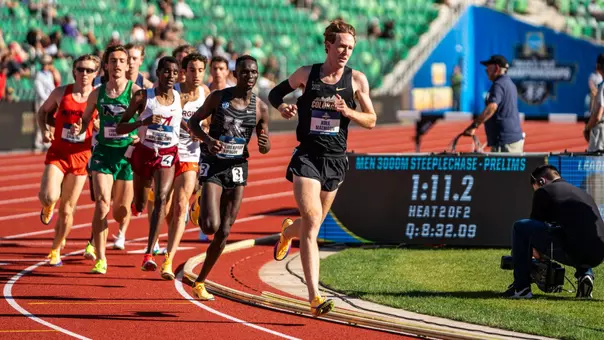
It took two demanding years for Winter to reach that point as a steeplechaser, but once there he blossomed. His point of readiness became a point of gratifying returns. He's headed for his first trip to the NCAA Championships next week at Oregon's historic Hayward Field - also a first visit - to compete in the 3,000 meter steeplechase.
It's already been quite a trip for the CU junior, who won six individual state titles (800, 1600, 3200 meters - twice each in his junior and senior years) at Arapahoe High School and saw his among Sports Illustrated's Faces In The Crowd after the distance events sweep in 5A state competition.
Winter also played football at Arapahoe (corner/receiver), explaining, "I was the quick guy who never got tired. I could go forever." But he didn't want to go that long in football, preferring as a junior to start concentrating on running. It was a nice career turn, one that attracted CU's and Wetmore's attention.
Arriving in Boulder in 2012, Winter competed indoors (800, mile) then redshirted that outdoor season. Somewhere in that first year Wetmore spied the makings of a steeplechaser, but he initially believed his eyes had deceived him. And Winter's outlook wasn't much better.
"I could run, jump, I was pretty athletic and not afraid of many things - so it was kind of fun to try it," said Winter, who is closing in on a mechanical engineering degree and is interning this summer at IBM. "But I wasn't strong enough and flexible enough to do it. I was learning . . . I wasn't quite ready at that point. It was awkward, I would go over the girls' hurdles and say, 'My gosh, this is never going to happen.'"
Neither did it happen after another try in his sophomore year, and Winter remembers thinking that his running future with the Buffs probably would consist of distance work and cross country. Wetmore agreed: "We played with the steeplechase for a year or two and kind of concluded that it wasn't right for him."
So Winter embarked on his junior year believing "we'd given it up," he said. "Coach had the aspiring steeplers to do some drills in the winter and said, 'We don't need you to do it.' But the next day, after whatever ungodly hour he gets up to run, he came to me and said, 'Why don't we try it?'"
AFTER HIS CHANGE OF HEART/MIND, Wetmore gave Winter a target time in the 8:40s and said if Winter could hit that he could be competitive in the NCAAs.
"So we tried it and it worked," Winter said. "I felt good, felt strong. I had been stretching and had gotten stronger. I thought I could be better at the hurdles. That worked, it wasn't great but it was much, much better than it had been."
Other than pointing to Winter reaching his "point of readiness," Wetmore is semi-stumped as to why Winter's third attempt at steepling finally paid off. "He had some sort of a technical breakthrough this year," Wetmore said. "We revisited it, as they say, early in the season and he was different technically than he was in the past. So we thought let's keep trying.
"There's a term in psychology called the 'period of readiness.' For months and months a kid can't tie his shoe, then one day they tie their shoe. They pass through their period of readiness. I guess he achieved his in the steeplechase."
Winter isn't that casual in pinpointing why he improved, citing the CU coaching staff for its detailed analysis of his trials and errors in the steeplechase - particularly in the hurdles - and helping him get over them. Literally.
"That's what shows the coaching staff here is amazing . . . they're the best coaches in the nation for steepling," Winter said, noting CU's track record for producing Olympians and American record holders in both men's and women's events. "That's coaching; it's common throughout the whole team. They know what to focus on. They break it down into details about what it takes to be a great steeplechaser - what you're thinking in going over a dry barrier, over the water. They're really nitpicking that."
Winter said his biggest hurdle in the hurdles was relaxing and achieving maximum efficiency: "You go over tight, tense, you lose energy and you only have so much during the race. Fitness has to be there, but you trust your technique. It's not so much getting over the hurdles, it's getting over them more relaxed than everybody else. It's not about being the most beautiful, just the most efficient. Being smooth, relaxed and not letting people pull away from you. You want to be pulling away from people."
There's also a fun factor in finally achieving success as a steepler - and Winter has also reached his point of readiness in the enjoyment category. Although he's only four races into his steeplechase career, he's done remarkably well, winning the Pac-12 championship (8:48.93) and finishing second (8:49.88) in his heat of the recent NCAA West Prelims in Austin, Texas.
Said Wetmore: "In the steeplechase there's a period of time when it's growing on you - or maybe not. And the better you get technically, the more you like it. As the season went on he got to like it better and better. So while he's always totally cooperative and up for whatever we ask, I think he's finding the steeplechase more and more fun - or as students say, 'Funner.'"
WETMORE'S CHARACTERIZATION OF WINTER as "totally cooperative" might be selling Winter short. He could be Miss Manners' poster boy. Wetmore calls him "basically the Jack Armstrong, All-American boy of our team. Yes, sir; no, sir. He thanks us for driving him home from practice when we had to anyway."
Despite his relative late start, Winter already has a place on CU's impressive list of steeplechasers. But where is subjective. "Depends on the categories," Wetmore said, adding that if Winter is compared to "21-year-old veterans with 15 or 20 races under their belt he's got some room to improve. But among first-year people he's very good."
Residing in that room for improvement is OK with Winter. Realizing the opportunity for fractional improvement followed by repeated trips to the drawing board after each race constitutes "the fun part," he said.
Winter claims he hasn't missed out on anything and simply wasn't ready to be a steeplechaser until his third try. He had events (5k, 10k, XC) that held his attention until what he calls "a perfect storm" of fitness, stretching, strength and technique collaborated to launch him into steepling.
"You have to be able to handle the beating that the steeplechase gives you," he said. "I just wasn't ready. Now, I'm just glad that coach had the foresight and said, 'Hey, let's try it.' I just happened to have the ability to do it."
Next week he'll do it at the NCAA Championships, which isn't a bad reward for a first-year steepler with so few races on his resume. His goal in Eugene: reach the finals and have a day "where I feel like everything is cooking - fitness, technique, strength. I want everything to be there on the same day. From there I have next year, so that'll be fun too," he said.
"But you don't want to look too far ahead because you'll miss out on the journey that gets you there. You have to have high goals, but you also have to keep them realistic. You take it day by day and get pleasantly surprised by where you're at."
All things considered, Connor Winter is in a pretty good place in his new world.
Contact: BG.Brooks@Colorado.EDU