Colorado University Athletics
Update: McKnight Catches On To Hollywood Career
March 24, 2016 | Football, Alumni C Club, Neill Woelk
BOULDER — What do you do when your NFL career is cut short by injuries and your college degree is in sociology?
You start writing television scripts, of course. Despite no background in writing, acting, or film and story development, you make that your second career — and just for the heck of it, you start that career by writing about cyber crime, with the extent of your computer training pretty much limited to knowing how to type on one.
That, at least, is what you do if you are former Colorado standout Scotty McKnight, who never met a challenge he was afraid to accept. The player who once rewrote CU's records for catching footballs has now caught on as a writer, with his most recent work as the lead for an episode of “CSI: Cyber.”
It's a journey McKnight admits has been “kind of crazy,” and one that has opened doors he never actually even considered knocking on until the opportunity arose.
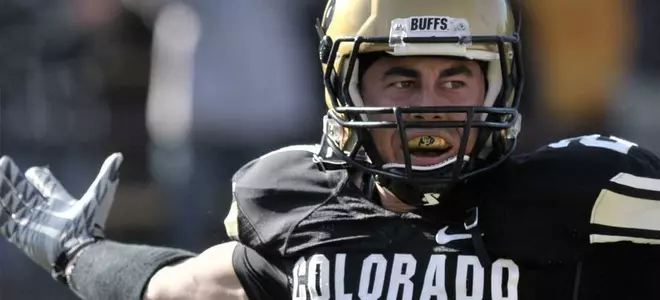
After a brilliant career with the Buffs (2007-10) that saw him leave as CU's career leader in receptions and touchdown catches and third all-time in receiving yards, McKnight was drafted by the Philadelphia Eagles and traded to the Jets. He spent most of his first year in New York on the practice squad before suffering a knee injury — torn ACL, MCL, PCL and meniscus — that sidelined him for the rest of the season.
That led to an offseason of intense rehabilitation and another training camp with the Jets — only to see that stay cut short by a fractured kneecap.
Then came a long rehabilitation session in Nashville at Vanderbilt University. During his down time there, he began working on project that he'd been toying with for a couple of years: a treatment for a television show that centered around a college football program.
“My time in Colorado really opened my eyes in terms of how many different demographics were represented by the players, where those players were coming from in the different walks of life and the bond that was established,” McKnight said. “You all come from these different worlds — every type of background possible — and it collides full speed under this umbrella of, 'Hey, you're not a kid anymore. You're an adult and there are expectations for you to go out there and work hard and compete and win games.'”
McKnight had some help in the project. Thanks to another example of worlds colliding, he knew television writer and producer Pam Veasey, who had previously worked on such shows as “In Living Color” and “CSI: New York.” Veasey's ex-husband had played football at USC and one of her sons played high school ball for McKnight's father, Scott McKnight, in California.
“She taught me a ton,” McKnight said. “How to create a world, how to create characters — really, how to go about writing for television.”
The treatment drummed up some interest and it was actually optioned. But along the way, Veasey landed a spot as showrunner for CSI: Cyber, and she asked McKnight if he'd be interested in working as a researcher for the show.
Once again, McKnight found himself traveling down a road for which he had no map: researching a television show centering on computer crime. Not exactly the perfect fit for that sociology degree.
“An incredible grind,” McKnight said. “Trying to figure out how computers and technology worked — stuff I had no idea about — and making sure it was all plausible. Like what a backdoor Trojan virus was and how you could track people down with an IP address and how you could find a physical address with that information.
“In the beginning, I have to admit — I had no idea what any of that stuff was and I had to learn about it all.”
But the one thing McKnight did have in his corner was a background in Division I athletics — a background he said prepared him for such a grind and gave him the confidence to tackle such a task.
“When people ask me what I took away from the sport — and it was mainly what I learned at Colorado — is that you develop a work ethic,” McKnight said. “You learn about time management and discipline, how to stick with a task once you've started it, how to juggle a multitude of assignments. The adversity that you face — especially in a sport like football, where it comes at you from so many different levels on a day-to-day basis — teaches you a resiliency that's essential. You go through those periods that are incredibly difficult, but you know there's a light at the end of the tunnel if you trust yourself and trust the people around you.”
So, McKnight tapped into every resource possible. He leaned on his father, who had served as an undercover narcotics agent for a variety of agencies. He read case studies online and cold called people who might prove to be research resources in everything from criminal investigations to computer science.
“I would cold call these people and say, 'Hey, I'm working as a researcher for this television show and I'm very limited in my knowledge,'” McKnight said. “I was brutally honest. I'd tell them we couldn't pay them — but if they were near an NFL team, I could get them tickets.”
His strategy worked.
“There were a lot of all-nighters,” he said. “It was a grind, but I was able to be in the writer's room and be in that environment. I got the opportunity to learn what it takes in the process of creating episodes, creating storylines, how to execute them on the page — all those kinds of things. It was great hands-on experience and I got to meet a lot of very talented people.”
In the meantime, he continued to take acting classes, improv classes and writing classes — basically, putting himself through mock film school.
“Looking back, it's obviously something I wish I'd studied, but I didn't know I had any interest there,” McKnight said.
When CSI: Cyber was renewed for a second season, McKnight was promoted to writer's assistant.
“A whole other animal,” McKnight said with a laugh. “You're in the room every single day. My responsibility every day was taking notes on everything everyone said from start to finish. It's 30 to 40 pages of notes a day — then going home and organizing it all based on characters, A story, B story, potential art for the episode, how we could possibly turn it into another episode — anything and everything.
“And then on top of that, I'm expected to pitch ideas, stay involved in the conversation and contribute in that way.”
Evidently, McKnight's pitches were heard. Halfway through this season, he helped “break” a portion of the storyline for the episode “Fit and Run.” He was asked if he'd be willing to write a portion of the script. He agreed, spent an entire night putting it together and ended up receiving his first writing credit.
Then came an assignment to write a couple of acts for another episode, and another writing credit. That was followed by McKnight pitching an original idea for an episode which his bosses liked and one that was fully credited to him: “Flash Squad.”
What followed was yet another entirely new experience.
“When you're the writer of the episode, you are also the on-set producer for that episode,” McKnight explained. “I had the opportunity to not only go through the job of writing the script, but going through the notes with the network, the studio and with Jerry Bruckheimer Television — that whole process.”
Then came the task of going on-set with the cast and crew. That meant working directly with people such as Ted Danson, Oscar winner Patricia Arquette, Kelly Preston and director Howard Deutch (Pretty in Pink, The Replacements).
“It was interesting,” McKnight said. “You grow up having watched a lot of these people. But in a work environment like that, there's so much on the line … you realize there's this responsibility on your shoulders and you have to get to work. You want to be the one that makes it better, not the guy that messes it up.”
Now, McKnight and the rest of his CSI: Cyber cohorts will wait to see if the show is renewed for a third season. Meanwhile, he'll go to some select auditions as an actor (he had a role as a detective in an episode in the first season of the show) and he'll also continue working on another original pilot as well as a feature project he's working on with some other people.
“I'm just trying to explore all areas of the industry,” McKnight said. “I really enjoy the writing aspect because it allows me to explore from a creative standpoint, but I don't want to close the other to other opportunities. I really just want to continue exploring all the avenues possible and create a path for myself.”
McKnight chuckles when he considers that career path — where it started and where it's led so far. It's not, he admits, what he envisioned even a few short years ago.
“I can't even tell you how fortunate I feel to be in this position,” he said. “I understand my story is unique and how lucky I am to be here. There are so many talented people in this town who are trying to break into this business and trying to get some of the opportunities that I've had.”
And as crazy as it sounds, it all started with his football career and his time at CU. He still keeps close tabs on the Buffs and he's confident that the program is headed back in the right direction. That belief that was solidified earlier this year when he had a chance to tour the new Champions Center, a facility he termed “amazing.”
“I owe a lot to football and to my time in Colorado,” he said. “It's a unique part of my background that has helped in a lot of ways. That environment molded me in a huge way to the person I've become. There's a lot of love for CU and all the things I learned in my time there. You never lose those relationships, and it's something that will always be a part of me.”
Contact: Neill.Woelk@Colorado.edu