Colorado University Athletics
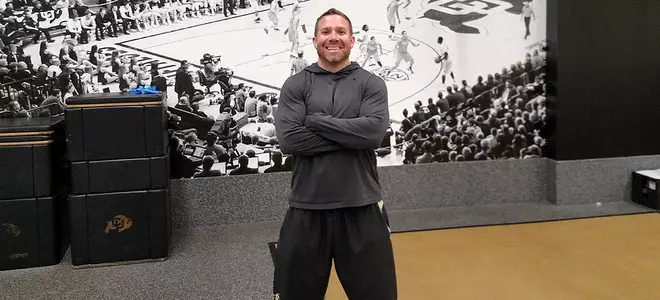
Englehart New CU Hoops Strength/Conditioning Boss
May 10, 2016 | Men's Basketball, Neill Woelk
BOULDER — Colorado basketball coach Tad Boyle didn't have to go very far to find a new strength and conditioning coach.
What began as a national search ended up with Boyle hiring someone from virtually next door to the Coors Events Center — the CU Champions Center, to be exact. That's where Steve Englehart had been working as an assistant strength coach with the Colorado football team, as well as heading up the women's soccer, golf and tennis strength and conditioning programs.
James Hardy, the man Englehart is replacing, left the Buffs just a few days after their season ended in mid-March to assume his new duties with the New England Patriots. That left Boyle searching not only for a replacement, but also needing someone who could put his players through their first round of offseason workouts.
“Steve is the one coach internally who actually came into my office and told me he wanted the job,” Boyle said. “Honestly, I didn't know Steve. I knew of him, and saw him around, but I'd never really had the opportunity to interact with him.
“About a week after that, we needed someone to work our guys out, and Steve stepped up and took our guys for the week.”
Boyle was out of town recruiting at the time, but by Thursday of that week, he began receiving unsolicited text messages from his players.
“They were telling me, 'Hey, coach, we really like this guy. He's been awesome,'” Boyle said.
When Boyle returned from his recruiting trip, he met with several of his players and again heard the same message. “They were asking if there was any way we could just get Steve full time right away,” Boyle said.
At the time, Boyle was in the midst of the hiring process. He'd been reviewing resumes, making calls and was preparing to bring candidates on campus for interviews. That's when he realized the man for the job was already here.
“Two things are critical with that position,” Boyle said. “The number one thing is you have to have somebody who knows their stuff about the weight room, because I don't and our coaching staff doesn't. The second thing that's just as important is that your players have to respond to that person — and that happened, just naturally. If it wouldn't have happened, Steve probably wouldn't be our weight coach.
“I always say luck is defined by when preparation meets opportunity. Steve was prepared, he got the opportunity — and now he's our full-time weight coach.”
Boyle's story is actually a snapshot of Englehart's philosophy: be prepared, build relationships, meet the needs of the athletes, challenge them to improve, be a motivator, stay positive, produce results — and have fun.
Accomplish them all, and it's a strong part of a formula for success.
“In just about any sport, strength and conditioning coaches spend more time with their athletes than any of their other coaches,” said Englehart, who came to CU from Southern Methodist in April 2011. “We build a relationship with these young men and women. Part of my regimen is life lessons with them. We teach them life lessons and we help make them better in their particular sport.
“If it's a hard workout — trust me, life's going to be hard. You have to find a positive. The weight's not going to change, and life's not going to change. You think better, you live better. That's our mindset in here — we're going to go hard, we're going to be positive and we're going to have fun.”
It's a philosophy Englehart has been crafting since he first became involved in the profession, which came about as another example of preparation and opportunity coming together at the right moment.
Englehart, 34, is a graduate of Southeast Louisiana, where he earned a degree in exercise science in 2005. While there, he had a chance meeting with Kurt Hester (now the head strength coach at Louisiana Tech), who was running a private athletic performance business at the time.
It led to a meeting with Hester for Englehart and his twin brother, Chad (now strength coach for the Washington Redskins), which then quickly developed into a career. It produced a position at Hawaii (where he earned his master's degree in kinesiology and rehabilitation science), followed by jobs at Portland State and SMU — and finally, Colorado.
Even ending up at CU was a merging of preparation and opportunity. Englehart was working at SMU and had no thoughts of leaving. He attended a Cowboys-Redskins game, where one of his brother's colleague's told him of a possible opportunity in Boulder.
“At the time, I was only about eight hours from New Orleans (his home) and was very happy,” Englehart said. “SMU treated me great and leaving never crossed my mind.
“But my wife (Laura) was never really a big-city girl, so I flew to Colorado to see if she might like it. I stepped on campus and it was a no-brainer. Next to marrying my wife, coming here was the best choice I've ever made.”
Englehart is no stranger to basketball. He's loved the sport since he was a youngster and he worked with the hoops program at Hawaii for three years.
Now, he's in charge of training athletes for a program that has produced success unparalleled at CU — and his job will be to help take the program to the next level.
He also has to do it in a sport in which weight training is oftentimes seen by players as a necessary evil rather than a required step toward improvement.
“To me, basketball players are unique,” Englehart said. “I think they're the best athletes in the world. They're tall, long — and yet they have to be able to move quickly, stop on a dime and have an explosive jump. It's a game I've always loved and one that's always been very intriguing to me.
“What you have to realize is that they didn't come here to be a bodybuilder, a power lifter or an Olympic lifter. They came here to get their degree and play basketball. My job is to make this weight room fun and still produce consistent results. This is the generation of 'why?' They want to know, 'Why am I doing this' and if you can show them the why and show them the results, they'll buy in.”
The Buffs have evidently bought in. Despite this being their off time before organized summer workouts begin in June, a steady stream of players have been showing up on a regular basis to the weight room.
“I know they've bought in because we've got guys still coming in to work out,” Englehart said. “I thought everybody went home, but they're still coming in. I know they're having fun because they're telling me that.”
Englehart makes sure the Buffs know what's ahead when they begin a program with him. Englehart tailors each program specifically to each player's needs, body type, mobility and position. Along with working with them in the weight room, he also works with other CU staffers to make sure recovery and nutrition are a regular part of the process, as well as injury prevention.
And he makes it clear — continually — that improvement and results don't come without the required effort.
“I get to learn what makes each individual click, what makes them go, what drives them to produce results,” Englehart said. “Yes, it's hard work. They know I'm a blue-collar guy and they know I'm going to bust their tail.
“I say it all the time when the workouts get tough — hate me now, love me later. When I say that, I mean it. When you see those results on the court, when you see those results in life, when you become a better citizen, a better basketball player, you're going to see how those results came about. Hate me now, love me later.'”
Over the years, Englehart has refined his approach, a process he says is always ongoing and one that certainly won't stop now. He's already developed programs for each of his players, and will continue to refine them as long as they are on campus.
“From a foundation perspective, I love Olympic lifts,” Englehart said. “I'm a ground-based guy — squat, power clean, all those things. But I'm also a results guy. I look at my athletes and what their needs are, and then we develop a program for that specific individual. We're going to get results for them and we're going to reach their genetic potential.
“But to get there, your players have to trust you. You have to know your team and your team has to know that you care about them. Once that happens, you get results — and you have fun doing it.”
Contact: Neill.Woelk@Colorado.edu