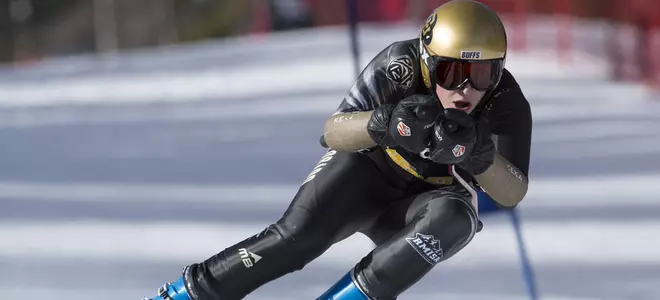
For CU's Wise, Athletics And Academics The Perfect Match
May 04, 2016 | General, Skiing, Herbst Academic Center, Neill Woelk
This is the second in a series this week on CU's graduating student-athletes.
BOULDER — When Clare Wise joined the Colorado ski team as a freshman in 2012, the message from team leaders was simple and to the point:
“It is made clear that when you join the CU ski team the expectation is that we have the highest team GPA and we win national championships,” Wise says with a grin. “That's just how it is. That's our legacy and that's what we strive to do.”
Mission: Accomplished.
Wise, from Wenatchee, Wash., will graduate this week with a 3.88 grade point average and a degree in chemical and biological engineering. She is a member of the Dean's List and will own the highest grade-point average in her discipline — generally regarded as one of the most difficult on campus — and has been named as this year's Distinguished Senior in Chemical and Biological Engineering. Her academic achievements were a big part of the CU women's skiers earning recognition as owning the best team grade point average in the CU Athletic Department (3.593) for 2015.
On the athletic side of the ledger, Wise will also leave CU with plenty of memories of success. An alpine specialist, Wise was part of two NCAA Championship teams (2013 and 2015), a run that included nine top-20 career finishes and three-time status as an academic All-American. She also served as chair of the Pac-12's inaugural Student Athlete Leadership team and president of CU's Student Athlete Advisory Council.
Oh, and she also had time to serve as an active member of the Society of Women Engineers, helping organize campus events and author the weekly newsletter, and participate in a variety of volunteer efforts, including Girls Explore Engineering Day at CU, STEM workshops and Girl Scout Days.
Those, of course, are just the highlights of what Wise managed to squeeze into four years at CU. She will obviously leave Boulder with a memory bank overflowing with deposits.
But the moments that stand out most aren't all of the awards or celebratory moments. Rather, Wise fondly remembers the “normal” times she spent with teammates.
“It's all the time I got to spend with my team,” Wise said. “That's my favorite part. Some of my best memories are of us traveling together, like when we went to Spain as part of the World University Games. Normal stuff, like getting to have breakfast together after training at Eldora. Team potlucks. Sitting around the kitchen table with my roommates, doing homework.
“Those are really the things that I will take with me for a long time.”
The time required to compete at the Division I level in any sport is well documented. The key to success — in both — is developing strong time-management skills, something that all athletes learn quickly.
Wise described a “typical” day during ski season as one that involved a 4:50 a.m. wakeup call, giving her enough time to get to the CU ski building at 5:20 a.m. to prepare her skis. Then into a van and off to training for a couple of hours before returning to campus in time for class. After that, lunch, more classes, office hours, dinner, several hours of studying and a quick tune of her skis before bed.
“Then you get to do it all over again the next day,” Wise said.
It's is a schedule that demands dedication, discipline, a strong work ethic and — of course — the desire to succeed.
“What you find is that academics and athletics are the perfect mesh,” Wise said. “They're either both working together or nothing is working at all. You get used to running at about 100 mph and you get good at it. You become highly functioning in both and you have to be time efficient in both. There's no doubt being an athlete helped my academics because you learn to apply the same techniques.”
While the numbers are slowing growing, the overall percentage of women in STEM disciplines (Science, Technology, Engineering and Math) is still relatively small. Add “varsity athlete” to the equation, and and it meant Wise was part of a small group in CU's engineering classes. But she never even considered another field of study.
“I started in engineering because I knew I liked math and science and I was good at it,” Wise said. “I figured that would be a good place to start and I never left — and I'm glad I decided to continue. It's one of the most intensive programs in the whole university. Knowing that I worked so incredibly hard for my degree is pretty satisfying.”
Wise's senior thesis was described by one of her professors, Joel Kaar, as involving “uncovering the molecular basis for the unfolding of proteins upon interaction with surfaces. Specifically, she has been investigating protein unfolding on surfaces using sophisticated single molecule methods that enable unprecedented insight to surface-induced changes in protein structure.”
In case you are wondering, that type of research is “critical given that the retention of protein structure and function on surfaces is vital in virtually all areas of biotechnology, including the development and formulation of vaccines, the use of synthetic materials as implantable scaffolds to re-grow damaged or injured tissue, and the application of biosenors for the detection of toxic compounds and biomarkers for diseases.”
Kaar had high praise for Wise's efforts.
“Perhaps most impressive has been how she has immersed herself in the scientific literature to better understand the field as well as in becoming an expert in single-molecule biophysical methods, which is nothing short of remarkable given her other commitments,” Kaar wrote.
For Wise, it has been a challenge that she has treated as an opportunity.
“In the athletic world, when people ask me what my major is, they always seem surprised when I say I'm an engineer,” Wise said with a laugh. “But I've always been proud of it. I love the hard work ethic that comes with it, I love the problem solving, the discipline — everything that goes with it.”
But when it comes to which was the more difficult — academics or athletics — Wise doesn't hesitate with her answer.
With academics, she could control outcomes and there were few surprises. With athletics, it was a different story.
“Engineering is hard but ski racing is still the hardest thing I've ever done,” Wise said. “That has taught me everything. With academics, I learned how to study and I learned how to take tests. It's very linear. You put the work in and it's a straight line — if you put so much work in, you get an A. That's just how it works.
“Skiing isn't like that at all. That's why it's taught me so much. You can be incredibly prepared and you can be skiing really well and you can have put in all the time necessary — and there are so many external factors on race day you still don't know what's going to happen. Sometimes things don't go the way they're planned. That's my big lesson learned from athletics.”
There's no doubt Wise could have kept her plate full with academics without the skiing portion of her equation. She also no doubt would have survived without the other extracurriculars — Student Athlete Leadership team, Student Athlete Advisory Council and Society of Women Engineers.
But it was those extracurriculars, she said, that made the difference between a good and great experience. Her advice to incoming freshmen is to find that activity that will provide that necessary outlet.
“It's important to find something else that you like to do besides school,” Wise said. “Being an athlete made me a better student. Having that extra thing going on helped me take my mind off school when school was frustrating — and likewise, I would throw myself back into school when I wasn't skiing well. Having that kind of balance made me a better athlete and made me better academically. It's so stereotypical to say get involved, but find something that you like to do, that you are passionate about, and incorporate that into your undergraduate career.”
Her other bit of advice? Seek help when you need it — and don't wait until it's too late.
“I wouldn't be able to be an engineer and do athletics without the support the athletic department gives, and without the support from the school,” Wise said. “We have great academic coordinators. Chris Howlett been mine since I've been a freshman and he's been absolutely wonderful. Dr. Clough (David, CU engineering professor and faculty athletic representative) — I pretty much owe my whole degree to him.
“The one thing I learned early was that if you need help, ask for it. Don't wait. Go ask before you end up in a giant hole.”
With her degree in hand, Wise's next step will be the Medical College Admission Test in early June, followed by applications to medical school. She will apply to a variety of schools — including CU, Washington and Stanford — and then weigh her options.
But first, she'll take a little time off.
“I'm giving myself the entire rest of the week off,” she said with a laugh. “But Monday, I'm right back in it.”
Contact: Neill.Woelk@Colorado.edu