Colorado University Athletics
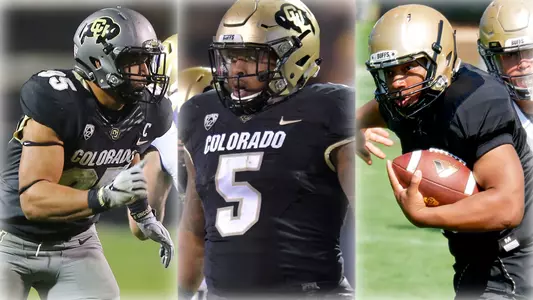
Masterful Work: Three Buffs Football Players Earn Advanced Degrees
December 08, 2017 | Football, Neill Woelk
BOULDER — Someday, George Frazier plans on having a family — and when the time comes, he will tell his children about his accomplishments at the University of Colorado.
There will be plenty to tell. The former CU tight end and defensive lineman will able to regale them with tales of how, in an era of extreme specialization, he was an ironman of sorts, playing offense, defense and special teams. He will be able to show them his 2016 Pac-12 South championship ring, then explain that he was part of a group of players who helped rejuvenate the program and bring the Buffs back to respectability.
But the first thing Frazier will tell them, the accomplishment of which he is most proud?
In his 4½ years at Colorado, Frazier managed to earn not only a bachelor's degree, but also a master's. Despite the rigors of playing Division I football for the last four years— spring conditioning, spring ball, summer conditioning and the fall season — Frazier will leave CU this month with a bachelor's in Ethnic Studies and a master's in Education.
All in 4½ years.
"That's what I will tell my kids first," Frazier said recently. "One thing my dad always stressed growing up was education over everything. Football can be taken away from you on one play, but education will be there for you forever. Nobody can take that degree from you. I will always be proud of that."
No doubt, an impressive accomplishment.
But even more impressive is the fact that Frazier is not the only member of the 2017 Buffs who will earn his master's this month. Also walking away with advanced degrees will be defensive end Derek McCartney (bachelor's and master's in Integrative Physiology) and running back Michael Adkins II (bachelor's and master's in Business-Finance/Accounting).
That is three master's recipients on one team, with all three being significant contributors to the Buffs over the course of their football careers as well as receiving All-Academic Pac-12 recognition in their careers.
While there are no statistics on such occurrences, having three master's recipients in the same semester is without doubt a rarity.
"I can't say it hasn't happened, but I've certainly never seen it before," said Katie Bason, CU's Director of Football Academics. "To have three in one year makes me really, really happy. Those guys worked so hard. They set their mind to what they wanted to do, they set a goal and they achieved it. It is certainly rare — very rare. Sometimes student-athletes get a bad rap in terms of their identity on campus, but these are three guys who are the epitome of student-athlete."
Bason and head coach Mike MacIntyre are clearly proud of their student-athletes' accomplishments. What makes this year's three master's degrees even more notable is the fact that the three come in distinctly different fields.
Frazier will someday pursue a job in education. Adkins is already considering job offers in the financial industry. McCartney plans to apply to medical school.
""I hear stories about other places where students get clustered, or pushed into majors," Bason said. "It's a case of the path of least resistance. Here, we want our students to find a passion. We want them to graduate from the University of Colorado knowing what they care about. That doesn't necessarily mean you need to major in something that you think is going to directly equal a job. If you're doing it for that reason, you miss out on all the real cool stuff about college — the critical thinking, the classes that really open up your mind and give you a new perspective."
That "path of least resistance" is not uncommon in today's world of college athletics. Student-athletes at some institutions are often encouraged to pursue "easy" majors, which accomplishes two things: keeping the student-athlete eligible while also maintaining acceptable Academic Progress Rates (an NCAA measure) and acceptable graduation rates.
But, Frazier, said, that isn't the case at CU.
"They don't force you into anything," Frazier said. "They help you find what you love. They help you find that good fit and they stress that coming to CU is more than being a football player. They want you to be able to grow as a person. They want you to become a better man for your future."
That approach has not hindered Colorado's APR or graduation rates. Rather, the opposite has occurred. CU has in the last few years produced some of the best APR scores, grade-point averages and graduation rates since the department started keeping records.
"We talk to them all the time about how their future is their academics," MacIntyre said. "Football is the temporary future, even if they play after this. They have to make sure they have all of the tools available to them for their long-term future and we are always very proud of the fact that our guys take advantage of that."
Over the last couple of seasons, McCartney, Adkins and Frazier have all talked about the diligence required to graduate early, then begin pursuit of an advanced degree while still playing football. It requires a disciplined work ethic, great time management skills — and a desire to succeed
"The main thing was readjusting my time and figuring out what worked best in terms of my schedule — football practice, the training room, all those things," Frazier said. "It was a matter of time management and making sure I set aside time to get it all done."
One key, Frazier said, is making sure you are pursuing a degree that stirs passion.
"It's like football in a lot of ways," Frazier said. "You get a major that you enjoy so going to class will not be a hassle. Instead, it's something you enjoy. You look forward to what you're going to learn next. You have conversations in class, you have great interactions, you even create new relationships. What you find is that it's a challenge more than it's work."
The process of discovering that passion begins almost as soon as football players arrive on campus. Bason and MacIntyre have honed a "bridge program" over the years that helps student-athletes become familiar with what's ahead as soon as they arrive for their freshman year. It includes a variety of orientation activities that help Bason and the rest of the academic staff begin to develop a long-term, individualized plan.
"For me, helping them find what they like learning about is paramount," Bason said. "If you enjoy what you are learning about, you are going to be more successful and doors are going to open. What I try to emphasize is that the world is wide open — you can do anything you want to do and you need your degree to do it. But while you are here, spend your time enjoying learning."
For Frazier — and many of his teammates — that process obviously paid off.
But now, 4½ years after the process began, Frazier admits that what he has accomplished has yet to truly sink in. His last football game as a Buffs is still fresh in his memory, and he is still busy finishing up his final classwork as the semester comes to an end.
"I think it might sink in a year or two from now," he said with a laugh. "Sitting back then and looking at getting my master's in 4½ years will be pretty cool. But right now … I guess I haven't had a lot of time to think about it. It's just something I did."
— Colorado is one of 29 programs nationally that will be recognized by the American Football Coaches Association in January for recording at least a 90 percent graduation rate for members of freshman football student-athlete class of 2010. Fifty-three other schools had at least a 75 percent graduation rate.
It is the 10th year the NCAA's Graduation Success Rate (GSR)?formula has been used to select the winner. The GSR is based on a six-year graduation window for student-athletes. The GSR was developed by the NCAA as part of its academic reform initiative to more accurately assess the academic success of student-athletes. The GSR holds institutions accountable for transfer students, unlike the federal graduation rate. The GSR also accounts for midyear enrollees. Under GSR calculation, institutions are not penalized for outgoing transfer students who leave in good academic standing. These outgoing transfers are passed to the receiving institution's GSR cohort. By counting incoming transfer students and midyear enrollees, the GSR increases the total number of student-athletes tracked for graduation by more than 37 percent.
Contact: Neill.Woelk@Colorado.edu