Colorado University Athletics
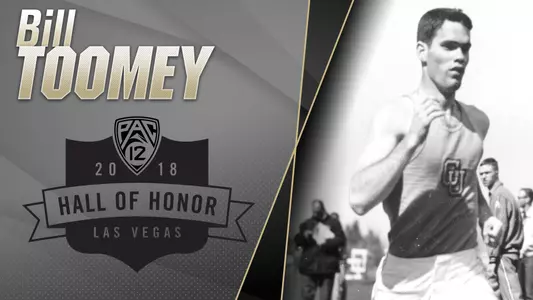
Olympic Decathlon Champ Toomey Still Has Fond Memories Of CU
March 08, 2018 | Track and Field, Alumni C Club, Neill Woelk, Scripps Leadership & Career Development
LAS VEGAS — Of all the accomplishments and honors Bill Toomey accumulated over his legendary track and field career, one still amazes him perhaps more than any other:
Toomey, an All-American track and field athlete for Colorado in the early 1960s, is still the only Buff to ever win an individual Olympic gold medal. This year marks the 50th anniversary of Toomey's gold medal performance in the decathlon in the 1968 Olympics in Mexico City.
"When I heard that, I couldn't believe it," Toomey said recently from his California home. "I thought surely one of our skiers had won one. We had a lot of good skiers back then."
Indeed — but Toomey, a two-time All-American in the pentathlon and a standout in a variety of individual events during his time at CU, is still the Buffs only individual gold medalist. Friday night, he will officially be inducted into the Pac-12 Hall of Honor before the semifinal games of the Pac-12 men's basketball tournament at T-Mobile Arena.
(Former Buffs basketball star Burdette Haldorson, also a Hall of Honor member, won two Olympic golds as part of the 1958 and 1960 U.S. basketball teams, with Bob Jeangerard also claiming one playing on the '56 team.)
Toomey credits his time in Boulder as integral in his gold medal pursuit.
In fact, he said, he may not have ever even competed in the decathlon had he not attended CU, the beginning of a long list of circumstances he believes played a major role in paving the road to Mexico City gold.
Toomey, who attended high school in California, was planning on attending Holy Cross and playing basketball — "that was my sport" — after spending a year at Worcester Academy in Massachusetts, then enrolling at Menlo College in California.
But a former high school track and field teammate was attending CU and competing for legendary Buffs track and field coach Frank Potts. The teammate suggested that Potts contact Toomey, which he did.
"I'd never even been on a plane before," Toomey said. "I fly to Denver and we drive into Boulder and I was awestruck when I saw that view. When I got to campus, I asked, 'Where do I sign?' It was like a movie set. It was the most beautiful place you could imagine."
Toomey quickly became a standout for Potts' track teams. He ran the hurdles, long jumped — and just about every other event he could finagle his way into.
"I just loved to compete, I loved to run," Toomey said. "I didn't care what event, I just liked to compete. The only thing Coach Potts wouldn't let me do was run cross country."
Toomey performed well in a variety of events. He was among the nation's better intermediate hurdlers, won the Big Eight long jump title and once finished second in the triple jump at the Kansas Relays in his first-ever try at the event.
But it was when he was looking at the records board in Balch Fieldhouse that he finally discovered his true love — the decathlon.
"There used to be a giant board in the fieldhouse and that board had all the names of the record holders in the events," Toomey said. "I saw the decathlon up there — and I didn't even know for sure what it was. So I went back to Coach Potts' office and I asked him what's in the decathlon? He pulled out a scoring table and a metric conversion chart. So right away, I'm scoring a decathlon in my head. I'm figuring what I could do in each event, or what I think I could do, and figuring up my score."
Toomey wasn't exactly overjoyed when he learned pole vault was part of the competition — "I couldn't clear my throat in the pole vault" — but he still decided to give the event a try.
It didn't go well. He barely cleared 7-feet, 6-inches in the pole vault in his first decathlon.
"So, I said, this wasn't for me," Toomey remembers.
But he gave the event one more chance, promising himself that if he scored at least 6,000 points, he would stick with it. He scored 6,300 points in an all-comers meet.
"It wasn't any score that was going to scare anybody," he said. "I think I vaulted 9-6, threw the discus about 70 feet and the shot put 34 feet. Nobody was going to be afraid of me."
Toomey did perform well enough in the pentathlon at CU to earn All-American honors twice (1960 and 1961). After graduating from CU, he went on to Stanford to pursue his master's degree, taking with him his love for the decathlon, where he continued to train. He steadily improved, and by 1964, was good enough to finish fourth at the Olympic Trials.
"Fourth at the trials is like light beer — not very good," Toomey said. "You don't get to go anywhere but home."
But after the Olympic Trials, Toomey's father bought him a ticket for a tour group for the 1964 Olympics in Tokyo. Toomey at first said he would not attend, but finally gave in and went.
"I sat in the stands and watched every second of the decathlon," he said. "I saw guys in the field that I was better than and that gave me a little courage to start thinking about 1968. I actually told a guy in the stands next to me, 'I'm coming back in four years and I'm going to win this.' And he looked at me like I was crazy."
Toomey resumed training the minute he returned home, working out with Canadian Olympian Bill Gairdner.
"We lived in this tiny apartment," he said. "It was so small that our pole vault poles were permanently sticking out of the windows because they wouldn't fit in any room."
Toomey also began weight training, which helped him improve in all of his events, including the shot put and discus. In 1965, he won the first of his five AAU decathlon titles, then won Pan American Games in 1967. In 1968, he won the U.S. Olympic Trials and finally, Olympic gold in Mexico City.
But even that didn't come without plenty of drama.
On day 2 of the competition, the decathletes were at the warmup track, about a half mile from the Olympic stadium. Officials told the athletes to leave their pole vault poles at the warmup track and they would be transported to the stadium.
Before the pole vault was to begin, the poles arrived — but Toomey's wasn't in the bunch. He was forced to run from the stadium back to the warmup track and hunt for his pole. He finally found it and ran back to the stadium, entering just in time to hear an announcement: "Warmups have completed."
That was not good news for someone who still was not comfortable in the pole vault. Toomey missed his first try at 11-foot-9, then also missed his second attempt.
"I have to start that low because I at least need to get a height and get a score," Toomey said. "Nobody else was even jumping that low, and I miss the first two and I'm a little rattled. I have one vault left. If I miss, it's over. No score. It occurs to me that maybe if I miss again, I can at least impale myself on the pole and they would feel sorry for me. … But really what's hitting me is I had trained for years and all of a sudden I'm about to blow it on an 11-9 pole vault."
So he changed his strategy. Everything. His first step, his hand placement, his approach — everything.
"I told myself, 'You have a master's from Stanford, a BA from Colorado. That's smart enough to figure out whatever you did the first two times isn't working,'" Toomey said. "So I did everything backward."
It worked. Toomey cleared the height and continued to clear the bar, going all the way up to almost 14 feet.
That was enough to keep him in the lead, a position he held the rest of the day, culminating with a dramatic 1,500-meter run that saw him pass West Germany's Hans Joachim-Walde on the final lap to clinch the gold.
"Making that vault was probably the most successful thing I ever engineered in my entire life," Toomey said. "I was competing against the Russians, the Germans, the East Germans — the best guys in the world."
Toomey did, however, have an ace in the hole at Mexico City, the first — and still only — Olympics to be contested at high altitude (7,300 feet).
Toomey wasn't afraid of the altitude. He had trained in Boulder, knew the challenges altitude presented — and the advantages it could provide.
It was just one more of those circumstances stemming from his time at CU that led to a gold medal.
"I still think about it," he said. "If I had not gone to the University of Colorado, I never would have been in the decathlon. I never would have gotten the scoring table and a metric conversion table from Coach Potts. If I hadn't gone to Colorado and learned that when I run at altitude I do my best, I never would have succeeded. Because I went to the University of Colorado, I was probably the only guy in Mexico City who liked the altitude. I was used to it and believed that I actually ran better at altitude."
Toomey did indeed run well in Mexico City, not only winning the 1,500, but also the 400 meters in 45.68 seconds.
Toomey went on to set the world decathlon record in 1969, then worked in a variety of roles, including a four-year stint on an advisory council for the Peace Corps, where he worked with astronaut Neil Armstrong. He also had careers in broadcasting, marketing and teaching.
And, it all began at the University of Colorado.
"I am a Buff," Toomey said. "I've always had a warm spot in my heart for Colorado and have such great memories."
was inducted in CU's Athletic HOF in 2004, the fifth class; the second track athlete behind our first Olympian, David Bolen.
Toomey was inducted into CU's Athletic Hall of Fame in 2004, the hall's fifth class. He became the second track athlete inducted, following Colorado's first Olympian, David Bolen.
Toomey was also at CU when numerous other legendary Buffs were making their mark. He became good friends with a number of CU's skiing greats, including Buddy Werner; and he remembers Carroll Hardy — who played major league baseball and in the NFL — leaving baseball games to come to the track and long jump in between games.
"He long jumped 24 feet in his baseball uniform," Toomey said with a laugh.
Toomey's brother, Taylor, was a standout pitcher for the CU baseball team, and also pitched for the U.S. gold medal winning team at the Pan Am Games — beating the famed Cuban team in the process — the same year Bill won his Pan Am decathlon gold.
Today, Toomey still follows CU athletics. He watched in the summer of 2016 when Buffs Jenny Simpson and Emma Coburn won track and field bronze medals at the Rio Olympics.
"I was so excited to see CU scoring in the Olympics again," he said. "I'm hoping they'll get another gold one of these days."
But until then, he will be the Buffs' only individual Olympic gold medalist — and the place that it all started still has a special place in his heart that has not diminished in more than 50 years.
"Nobody loves the Buffaloes and Colorado any more than I do," Toomey said. "Everything that happened at Colorado changed my life forever. It was an inspiration to me, some of the best years of my entire life. You can't go back in time, but if I could go back in time, I'd go back to CU. What a great place."
Contact: Neill.Woelk@Colorado.edu