University of Colorado Athletics
Woelk: Takeaways From Buffs Game At Oregon
October 13, 2019 | Football, Neill Woelk
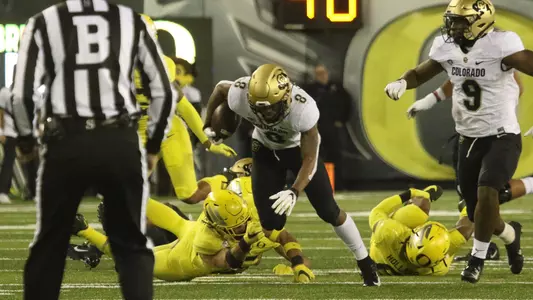
BOULDER — Odds are the film didn't look any better than the live action when Colorado coach Mel Tucker and his staff gathered Saturday to review Friday night's 45-3 loss in Oregon.
No doubt, CU coaches saw numerous issues that need to be addressed before they head back on the road again, this week to Pullman, Wash., for a Saturday matchup with Washington State (5 p.m., ESPNU).
But while Friday's loss was no doubt "gut-wrenching" — Tucker's description — the Buffs must still remember to take a step back and look at the big picture.
Even with a 1-2 record Pac-12 record (3-3 overall), Colorado is just one game away from the four teams tied for the Pac-12 South lead, and they still have a chance to play three of those teams (USC, UCLA and Utah). With six games remaining, there's still plenty on the line. As long as they don't let one sub-par effort define their season, they obviously have the opportunity to do some good things down the last-half stretch.
What we learned from the Buffs' most recent game:
1. Speed matters. When it comes to pure speed — in space, off the edge, in the secondary — the Buffs hadn't seen anyone with Oregon's ability in that department, and it showed.
Of the four interceptions thrown by quarterback Steven Montez, three were 50-50 jump balls, with a couple caused by defenders getting to the spot much faster than the CU senior anticipated. Against many teams, the passes would have been incompletions at worst. But against a team with that kind of closing speed on the ball, they turned into tipped passes — and the Ducks were then on the spot to pick them off.
It was the same with the pass rush off the edge and up the middle, and it showed every time Colorado tried to get its skill players in space on the edge. Oregon recorded two sacks and eight quarterback hurries without using exotic blitzes, and the Ducks' linebackers and secondary prevented CU from making plays outside all night long.
Meanwhile, that speed on offense turned what normally would have been shorter gains into explosive plays that inflicted some serious damage. Which brings us to …
2. Explosive plays are a huge difference. By game's end, the Ducks had nine plays of 20 yards or more; the Buffs had just two.
Now figure this: those nine Oregon explosion plays accounted for 299 yards of the Ducks' 527 yards total offense. That means 13 percent of Oregon's offensive plays accounted for 57 percent of the Ducks' offensive output.
Colorado's two big plays, meanwhile, covered just 44 yards, with a 24-yard pass CU's longest play of the night. Again, team speed on Oregon's defense kept Colorado from ever creating one of those momentum-switching moments.
3. Every opportunity matters. It's always dangerous to play the "what if" game, particularly in a 45-3 loss.
But guaranteed, every CU player and coach wondered what might have transpired had the Buffs scored when they had a first-and-goal from the Oregon 3-yard line — and then second-and-goal from the 1 — late in the second quarter.
We all know what happened. A couple penalties, an incompletion and an interception resulted in an empty drive instead of a touchdown that would have pulled CU to within 17-10.
Under the 17-10 scenario, the Buffs would have sent their defense onto the field with a little extra juice, and they then could have taken possession to open the third quarter trailing by just one score.
Instead, the Buffs were buried under an avalanche of penalties and turnovers that turned what could have been a 17-10 game into a 38-3 blowout in a span of seven minutes. It's a great example of how one series — one play — can turn the tide of a game.
Which brings us to …
4. Unforced errors — particularly penalties — are killers. In any game, the margin for error is almost always slim. Between two evenly matched teams, an error or two can be the difference in the ball game. Against a very good team such as Oregon, errors can turn a close game into a runaway.
Understand, mistakes are part of any game. A missed tackle, a missed block, a bad throw, a dropped ball — those all happen. But it is the unforced errors — false start or unsportsmanlike conduct penalties, blown assignments — that are particularly hard for a coach to stomach.
Tucker has good reason to be upset with CU's penalty situation. After reducing the yellow flags two games in a row — the Buffs had just three penalties in their win over Arizona State — the trend has gone back up. Eight last week against Arizona; a season-high 14 against the Ducks. That includes seven false starts and three personal fouls, all of which fall under Tucker's description of "undisciplined penalties."
Late Friday night, Tucker vowed to fix those kinds of mistakes. Those mistakes, he knows, reflect on a coaching staff.
"Having the discipline to do your job in the crunch on a consistent basis, that's how you become successful," Tucker said. "Undisciplined penalties — I hate undisciplined penalties. Whatever I've got to do to eliminate those, I will get that done."
5. Second-down efficiency is important. We bring you this stat courtesy of CU Sports Information Director and numbers guru David Plati: Oregon converted 14 of its 25 second-down attempts into first downs while the Buffs were just 3-for-23 in those situations.
While third-down plays get all the attention — and for good reason — second-down plays might be one of the more overlooked stats of importance. Not only does the defense have to start over with the offense getting a fresh set of downs, it also prevents the defense from putting the offense in an unfavorable position. Force a third down and the defense can have an edge. But give up a second-down conversion and the defense is on its heels, starting from scratch — and the Buffs were on the short end of that equation on both sides of the ball all night.
6. Takeaways are critical for CU defense. Every team wants to force turnovers. But for the Buffs — who are playing an inordinate number of young players — they are crucial.
Not only do takeaways end an offensive possession, they oftentimes provide a huge switch in field position. When you don't get at least a couple of those moments in a game, it makes it that much more difficult on your offense.
Friday was the first time this year Colorado did not have at least one takeaway (the Buffs had recorded at least one interception in every previous game) and they gave the ball away four times.
When the margin is that pronounced, the result is predictable.
7. CU's young players continue to get some valuable experience. Not that Tucker and his staff are anxious to throw so many freshmen and other newcomers into the fire. But fact is, because of injuries, they don't have a choice.
The good news is some of those youngsters are growing up in a hurry. Friday against Oregon, true freshman cornerback K.J. Trujillo played 73 snaps. According to Pro Football Focus, he was targeted three times and gave up just one completion — a healthy percentage.
Meanwhile, freshman Mark Perry had 17 snaps as a nickel/star back and finished with three tackles; freshman defensive lineman Lloyd Murray played 27 snaps and had three tackles; and freshman D-lineman Austin Williams had one tackle in 18 snaps.
Those are all youngsters who will be significant contributors in the future.
8. Replay review has been big against the Ducks. This is a bit esoteric, but nonetheless didn't escape our attention.
Three years ago, the Buffs picked up a huge touchdown late in the game when a Bryce Bobo catch — originally ruled incomplete — was called a touchdown. It gave the Buffs their winning score.
Friday, in virtually the exact same place in the same end zone, a play originally called an incomplete pass was ruled an Oregon interception after review — and the Buffs came away empty handed in what was a key series of the game.
9. Colorado's run game is still making progress. Lost in the big picture was the fact that the Buffs pounded out 168 yards on the ground, averaging a respectable 4.2 yards per carry. That includes 71 yards on 15 carries from Alex Fontenot — who becomes more impressive each week — and 41 yards on seven carries from Deion Smith, who continues to show some good wiggle and a nice burst.
That effort came against an Oregon defense that was giving up less than 100 yards per game on the ground — and the Buffs did some damage with the run game when it was still a close game. On CU's 69-yard drive late in the second quarter, the second-longest of the night, 39 of those yards came on the ground. CU's offensive line opened holes and the Buffs running backs found them.
It's something the Buffs will continue to develop, and part of their game that will become more and more valuable down the stretch.
10. There is still plenty of opportunity ahead. This is a good time to remember that it was just three weeks ago that Colorado traveled to Arizona State and beat a good Sun Devils team on their home turf. It is ASU's only loss so far, and the Sun Devils are now ranked 17th in the nation in both polls.
It was a quality win, and an example of how well the Buffs can play when they limit their unforced errors.
We are still convinced that Tucker is changing the culture of this team. It's not an overnight process, and as he said, sometimes you have to go through games like the Oregon thrashing to get to the other side.
But with six games remaining, the Buffs still have plenty of opportunity to prove they are going in the right direction. If they are indeed taking on the personality of their head coach, they will bounce back.
Guaranteed, Tucker will do everything in his power to get them there.
Contact: Neill.Woelk@Colorado.edu