Colorado University Athletics
Friday Fast Five: Keys For Buffs Vs. Utes
November 29, 2019 | Football, Neill Woelk
SALT LAKE CITY — Finding a weakness in the sixth-ranked Utah Utes isn't an easy task. Just ask Colorado coach Mel Tucker.
"Big, strong, physical football team, very well coached," was Tucker's assessment earlier this week. "They play with a lot of confidence. They have a lot of good players on both sides of the ball. Special teams are solid. They really don't have weaknesses overall as a team."
Indeed, the 10-1 Utes (7-1 Pac-12) are likely the best overall team the Buffs (5-6, 3-5) have seen this year. Utah has the league's leading scoring defense (10.9 points per game), the third-leading offense (34.7) points per game and, as always, very good special teams.
Both teams have plenty at stake. The Buffs have a chance to become bowl eligible for the first time since 2016 (and only the second time since 2007), but the stakes for the Utes are much bigger. A win would give them the Pac-12 South title and keep their College Football Playoff hopes alive.
Saturday's game is very much a back-to-the-basics affair. As Tucker said, the Utes are big and physical. They love to run the ball and they play excellent run defense. That is also the style of ball Tucker envisions implementing in Boulder.
So what do the Buffs need to do to ruin the Utes' day and come back to Boulder with bowl eligibility in their pockets?
1. Stop the Utah run game. A huge task, considering that Utah is far and away the best running team in the Pac-12. Led by Zack Moss (league-leading 115.8 yards per game) and a veteran offensive line, the Utes are averaging 215.3 yards per game on the ground, nearly 50 more than any other Pac-12 school.
Utah has been held under 150 yards rushing only once this season, a 115-yard effort in a 33-28 win over Washington (one of only two games decided by one score the Utes have played all year). In that game, the Utes had to overcome an early 11-point deficit, and they didn't lead until the fourth quarter.
The Buffs need to give themselves the same opportunity.
CU's run defense has been at its best the last two weeks, holding opponents to an average of 79.5 yards per game on the ground in two straight wins. If Colorado can keep Moss in check and force the Utes to throw, it will give the Buffs a chance to get Utah's offense off the field and prevent the Utes from controlling the tempo.
2. Find the holes in Utah's secondary. As Tucker said, the Utes don't have any weaknesses. But in a 30-23 loss to USC early in the season, Utah did give up 368 yards and three touchdowns passing to the Trojans. That allowed USC to build an early lead and hold off a Utah comeback.
For Colorado, the key to finding holes in the Utah secondary will be giving quarterback Steven Montez enough time to throw. The Utes have an outstanding pass rush, with 24 sacks to their credit, and they do it without the help of a ton of extra pressure. Defensive end Bradlee Anae has 11 sacks, and he will be a force the Buffs have to contain in order to provide Montez time to find open receivers.
3. Run the ball with authority. If the Buffs are going to keep Utah's defense honest and make the Utes respect the pass, they have to run the ball early and create manageable third-down situations.
The Utes are very good at not allowing that to happen, as they are giving up just 55.9 yards per game on the ground. As a result, they are 14th in the nation (and first in the Pac-12) in third-down defense, allowing opponents to convert just 30.3 percent of their third-down tries.
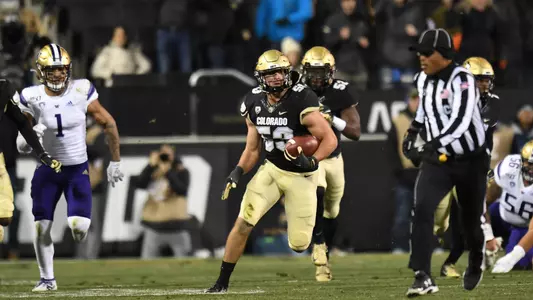
But the Buffs' run game has been solid the last couple of weeks against two very respectable defenses. Colorado ran for 172 yards in a win over Stanford, then ground out 207 in the win over Washington. CU's offensive line has shown a good push recently — the Buffs will need that kind of effort again Saturday against a Utah defensive line that boasts a pair of 330-pounders.
Then, if the Buffs can establish a run game, it will allow the passing game to open up, especially via play action.
4. Limit explosive plays. After allowing 53 plays of 20 yards or longer in the first nine games (nearly six per game), the Buffs allowed just five in the last two games combined. That includes 18 touchdowns of 25 yards or longer in the first nine games and just one in the last two.
Limiting explosive plays means opponents have to put together long, sustained drives. That increases the chances of forcing a mistake — something as simple as an incompletion on third down — and getting the offense off the field.
The Buffs have been outstanding in that area in the last two games. They have forced opponents to settle for field goals and limited exposure in their own territory. If they can do that again Saturday and make the Utes earn every yard, the Buffs can keep the pace of the game at a level that will see them have an opportunity to win in the fourth quarter.
5. Produce a couple momentum-changing moments. It's no secret the Utes are heavily favored. But the Buffs can keep themselves in the game by coming up with a big play or two on offense early, a big turnover on defense or a big special teams play.
Those are the kinds of plays that give heavy underdogs a chance. They are also the kinds of plays that can make a heavy favorite — especially a favorite with so much on the line — tighten up just a little.
To be blunt, the Buffs have nothing to lose in this one. They have some momentum and confidence and would love to go to a bowl game, but the fact is, all the pressure is on the Utes. Colorado needs to make a couple big plays early, get some momentum and force Utah out of its comfort zone.
If the Buffs can do that, they'll have a chance to be in the game down the stretch — and then, one more big play could be the difference.
Contact: Neill.Woelk@Colorado.edu