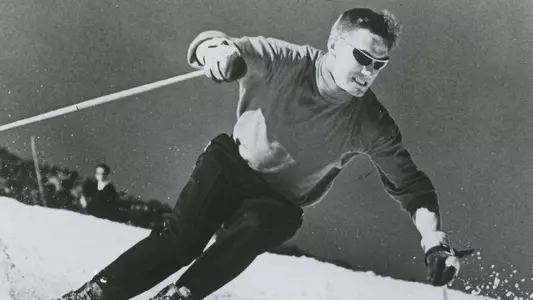
Skimeisters: Buddy Werner Left An Impact On CU And Beyond
April 16, 2020 | Skiing
Note: This is the second in an on-going series of stories on those who have impacted the Colorado Ski program.
BOULDER—Throughout the illustrious 130-year history of University of Colorado athletics, some of the best student-athletes in the world have donned the Buffs jersey in their respective sports.
Kathleen Cummings was ranked the No. 1 amateur women's tennis player in the world. Chauncey Billups, David Harrison and others were McDonald's All-Americans; the football team has more than once signed the top prospect in the country; the short-lived women's gymnastics program signed 1976 Olympian Debbie Wilcox, and the list goes on.
But it could be argued that the best signee the Buffs ever received came in 1960, when Buddy Werner, considered the top alpine skier in the United States if not the world, told coach Bob Beattie that he'd be enrolling at the University of Colorado to ski for the Buffs.
Werner wasn't your typical freshman. For starters, he was already 23 years old when he decided to pursue an education. An Olympian in 1956, Werner became the first American to win the Kitzbuhel downhill, widely proclaimed as the most dangerous ski race in the world in 1959 (through 2020, only two Americans have won at Kitzbuhel, Werner and another Buff, Darron Rahlves in 2003).
While training for the 1960 Olympics in Aspen, Werner was in a training accident that left his left leg in shambles. Broken in multiple places, it had to be set twice before doctors were satisfied with its stability. Prior to that injury, he was considered America's best chance to medal for the first time in alpine skiing at the 1960 Olympics.
It was shortly after the injury that he decided to enroll at CU and ski for Beattie, then the alpine coach for Team USA. Werner told the Denver Post at the time, "Everything before the accident pointed to competitive skiing. Now my interests are broadening. I've known all along it is essential to have a college background. I certainly wouldn't be in CU now if I hadn't had the accident. I'd be preparing for the Olympics. I had planned to enroll at CU next fall."
Entering the 1961 season, Werner was considered a sophomore, but prior to the season Beattie wasn't sure if he'd return to top form after his injury. Those fears were soon put to rest, however, as in what is believed to be his first college meet at the Western State Invitational, Werner not only won the downhill and slalom races, but the jumping event, as well.
That season at the RMISA Championships, he didn't finish either alpine race but was second in the jumping and at the NCAA Championships, he won the individual championship in the slalom and was second in the downhill, earning the alpine combined title, and was fifth in the jumping.
Those results are typical of his mentality to go all out in every race. He told the Denver Post, "There are only two places in a ski race as far as I am concerned — first and last. If I'm not first, I'm not going to be satisfied with any other place."
By the end of the first season back from injury, he had reestablished himself as the top alpine skier in the United States and made Beattie's World Championship team in 1962. At those World Championships, he took fifth in the downhill and eighth in giant slalom while not finishing the slalom race. He missed the 1962 college season due to his training for the world championships.
Back at CU for his senior season in 1963, he won five of the eight alpine races throughout the season, sweeping alpine events at the Wyoming and Colorado invitationals. With only four college meets that season, he took fourth in the slalom at the RMISA Championships and won the downhill title at the NCAA Championships. He took second in the slalom to teammate Jimmie Heuga and again won the alpine combined title, his fourth individual NCAA Championship.
He was the first of now three skiers to win four individual titles for the Buffs and he was the second skier nationally to accomplish that feat, even more impressively doing so in his only two appearances at the NCAA Championships. He likely would've won more if he had competed more than twice, and also if he had competed in cross country.
The Skimeister was awarded to the best overall skier who competes in all four categories. Werner didn't compete in cross country, his weakest event, likely because of his mentality of finishing first or last. Beattie told the Daily Camera at the time, "I'm sure Bud could win the skimeister (top four-way skier) award in any collegiate meet by just walking around the cross-country course, but he's not interested in winning any titles that way."
That may sound like an exaggeration, but taking the 1963 NCAA Championships as a case study, Werner would've needed to simply finish the race in less than 2 hours and 20 minutes to earn the Skimeister award. The winner of the race won in a time of 1:06:51 and the last place finisher came in a time of 1:59.46, so he could have finished 20 minutes behind the final skier of the race to win another title. It's hard to imagine that wouldn't have happened.
As the 1960s progressed, fewer and fewer skiers participated in all four events and by 1970 it was vanquished from the NCAA Championships as alpine and Nordic skiers specialized. Werner was for sure a dynamic and versatile skier, but that doesn't begin to tell the story of how versatile an athlete he was.
In a Daily Camera article of the time, legendary sports editor Dan Creedon wrote that Werner was a 10-second runner in the 100 yard dash and a talented quarterback and shortstop that likely could've played on any of those CU teams, as well. The predecessor to Jeremy Bloom, perhaps?
After his eligibility had run its course at CU, Werner competed in the 1964 Olympics that put American skiing on the map. While he watched Jimmie Heuga and Billy Kidd become the first American medalists in the Olympics, it is still Werner who's considered to be the first alpine superstar in American history.
Shortly after the Olympics, he retired from ski racing. Willie Bogner, a fellow ski racer was beginning his career in filmmaking and convinced Werner to head to Switzerland to star in his movie along with a dozen or so other ski racers. While filming, an avalanche hit the hill they were skiing and Werner and Bogner's fiance, Barbie Henneberger, were able to outrace the first avalanche, but were led into an adjacent avalanche triggered by the first and were swept up and died. (Bogner would become renowned for his skiing filmmaking and was best known in that field for working on the James Bond movies from 1969-85).
The news of Werner's death spread quickly and rocked the entire ski world, turning his hometown of Steamboat Springs upside down. His funeral overflowed the local Methodist church and others gathered at the local high school gymnasium where the audio of his funeral was played.
His younger brother, Loris, recalled in a 2015 Denver Post article (LINK) that he was filling up with gas in Boulder when the attendant struck up a conversation, and not knowing who he was, talked about the crazy news about Buddy Werner. At first Loris thought he was talking about his near miss in the Olympics, but soon asked him exactly what he meant.
Werner wasn't the first Olympian out of Steamboat Springs nor the most competitive person in the Werner household. That title went, according to Loris, to their older sister, Skeeter, who narrowly missed the team in 1952 before joining Buddy in 1956. Loris would compete in the 1964 and '68 Olympics himself before settling down and helping run a ski shop that Buddy and Loris began.
Skeeter married Doak Walker, 1948 Heisman Trophy winner and namesake of the collegiate running back of the year trophy, after meeting when he was in Steamboat Springs learning to ski in 1966.
Since his passing, Buddy has been inducted into just about every hall of fame imaginable. The U.S. Ski Hall inducted him immediately upon his death in 1964 and the Colorado Sports Hall of Fame followed in 1967, the Colorado Ski and Snowboard in 1977 and ultimately our own Hall of Fame in 2010 (the CU athletic Hall of Fame wasn't in existence until the 1990s).
While it's hard to state the impact Werner had on skiing at CU, Steamboat Springs and the ski world in general, it's also hard to get away from his name for most who ski competitively or recreationally. CU has the Buddy Werner Memorial Scholarship, a team award given annually to a deserving skier. The USSA has the Buddy Werner Award given annually in the name of sportsmanship. Winter Park has retired No. 9 from its major races as it was the bib number of the final race Werner competed there. The Buddy Werner Race League began in his name as a youth ski league in the Vail area and is still thriving.
And in his hometown of Steamboat Springs, it took help from the U.S. government to happen, but Storm Mountain was renamed Mount Werner. There is a Mount Werner Drive and at the top of Buddy's Run, there is a statue of Werner. The local library there is the Buddy Werner Library. In the Denver Post article, Loris Werner recalled getting help from a U.S. Senator named Ted Kennedy, who was motivated to help by his own love for skiing and the loss of a brother.
Skimeister in the true sense of the word? No, but with an asterisk. Skimeister in terms of being a Buff legend? Absolutely.
BOULDER—Throughout the illustrious 130-year history of University of Colorado athletics, some of the best student-athletes in the world have donned the Buffs jersey in their respective sports.
Kathleen Cummings was ranked the No. 1 amateur women's tennis player in the world. Chauncey Billups, David Harrison and others were McDonald's All-Americans; the football team has more than once signed the top prospect in the country; the short-lived women's gymnastics program signed 1976 Olympian Debbie Wilcox, and the list goes on.
But it could be argued that the best signee the Buffs ever received came in 1960, when Buddy Werner, considered the top alpine skier in the United States if not the world, told coach Bob Beattie that he'd be enrolling at the University of Colorado to ski for the Buffs.
Werner wasn't your typical freshman. For starters, he was already 23 years old when he decided to pursue an education. An Olympian in 1956, Werner became the first American to win the Kitzbuhel downhill, widely proclaimed as the most dangerous ski race in the world in 1959 (through 2020, only two Americans have won at Kitzbuhel, Werner and another Buff, Darron Rahlves in 2003).
While training for the 1960 Olympics in Aspen, Werner was in a training accident that left his left leg in shambles. Broken in multiple places, it had to be set twice before doctors were satisfied with its stability. Prior to that injury, he was considered America's best chance to medal for the first time in alpine skiing at the 1960 Olympics.
It was shortly after the injury that he decided to enroll at CU and ski for Beattie, then the alpine coach for Team USA. Werner told the Denver Post at the time, "Everything before the accident pointed to competitive skiing. Now my interests are broadening. I've known all along it is essential to have a college background. I certainly wouldn't be in CU now if I hadn't had the accident. I'd be preparing for the Olympics. I had planned to enroll at CU next fall."
Entering the 1961 season, Werner was considered a sophomore, but prior to the season Beattie wasn't sure if he'd return to top form after his injury. Those fears were soon put to rest, however, as in what is believed to be his first college meet at the Western State Invitational, Werner not only won the downhill and slalom races, but the jumping event, as well.
That season at the RMISA Championships, he didn't finish either alpine race but was second in the jumping and at the NCAA Championships, he won the individual championship in the slalom and was second in the downhill, earning the alpine combined title, and was fifth in the jumping.
Those results are typical of his mentality to go all out in every race. He told the Denver Post, "There are only two places in a ski race as far as I am concerned — first and last. If I'm not first, I'm not going to be satisfied with any other place."
By the end of the first season back from injury, he had reestablished himself as the top alpine skier in the United States and made Beattie's World Championship team in 1962. At those World Championships, he took fifth in the downhill and eighth in giant slalom while not finishing the slalom race. He missed the 1962 college season due to his training for the world championships.
Back at CU for his senior season in 1963, he won five of the eight alpine races throughout the season, sweeping alpine events at the Wyoming and Colorado invitationals. With only four college meets that season, he took fourth in the slalom at the RMISA Championships and won the downhill title at the NCAA Championships. He took second in the slalom to teammate Jimmie Heuga and again won the alpine combined title, his fourth individual NCAA Championship.
He was the first of now three skiers to win four individual titles for the Buffs and he was the second skier nationally to accomplish that feat, even more impressively doing so in his only two appearances at the NCAA Championships. He likely would've won more if he had competed more than twice, and also if he had competed in cross country.
The Skimeister was awarded to the best overall skier who competes in all four categories. Werner didn't compete in cross country, his weakest event, likely because of his mentality of finishing first or last. Beattie told the Daily Camera at the time, "I'm sure Bud could win the skimeister (top four-way skier) award in any collegiate meet by just walking around the cross-country course, but he's not interested in winning any titles that way."
That may sound like an exaggeration, but taking the 1963 NCAA Championships as a case study, Werner would've needed to simply finish the race in less than 2 hours and 20 minutes to earn the Skimeister award. The winner of the race won in a time of 1:06:51 and the last place finisher came in a time of 1:59.46, so he could have finished 20 minutes behind the final skier of the race to win another title. It's hard to imagine that wouldn't have happened.
As the 1960s progressed, fewer and fewer skiers participated in all four events and by 1970 it was vanquished from the NCAA Championships as alpine and Nordic skiers specialized. Werner was for sure a dynamic and versatile skier, but that doesn't begin to tell the story of how versatile an athlete he was.
In a Daily Camera article of the time, legendary sports editor Dan Creedon wrote that Werner was a 10-second runner in the 100 yard dash and a talented quarterback and shortstop that likely could've played on any of those CU teams, as well. The predecessor to Jeremy Bloom, perhaps?
After his eligibility had run its course at CU, Werner competed in the 1964 Olympics that put American skiing on the map. While he watched Jimmie Heuga and Billy Kidd become the first American medalists in the Olympics, it is still Werner who's considered to be the first alpine superstar in American history.
Shortly after the Olympics, he retired from ski racing. Willie Bogner, a fellow ski racer was beginning his career in filmmaking and convinced Werner to head to Switzerland to star in his movie along with a dozen or so other ski racers. While filming, an avalanche hit the hill they were skiing and Werner and Bogner's fiance, Barbie Henneberger, were able to outrace the first avalanche, but were led into an adjacent avalanche triggered by the first and were swept up and died. (Bogner would become renowned for his skiing filmmaking and was best known in that field for working on the James Bond movies from 1969-85).
The news of Werner's death spread quickly and rocked the entire ski world, turning his hometown of Steamboat Springs upside down. His funeral overflowed the local Methodist church and others gathered at the local high school gymnasium where the audio of his funeral was played.
His younger brother, Loris, recalled in a 2015 Denver Post article (LINK) that he was filling up with gas in Boulder when the attendant struck up a conversation, and not knowing who he was, talked about the crazy news about Buddy Werner. At first Loris thought he was talking about his near miss in the Olympics, but soon asked him exactly what he meant.
Werner wasn't the first Olympian out of Steamboat Springs nor the most competitive person in the Werner household. That title went, according to Loris, to their older sister, Skeeter, who narrowly missed the team in 1952 before joining Buddy in 1956. Loris would compete in the 1964 and '68 Olympics himself before settling down and helping run a ski shop that Buddy and Loris began.
Skeeter married Doak Walker, 1948 Heisman Trophy winner and namesake of the collegiate running back of the year trophy, after meeting when he was in Steamboat Springs learning to ski in 1966.
Since his passing, Buddy has been inducted into just about every hall of fame imaginable. The U.S. Ski Hall inducted him immediately upon his death in 1964 and the Colorado Sports Hall of Fame followed in 1967, the Colorado Ski and Snowboard in 1977 and ultimately our own Hall of Fame in 2010 (the CU athletic Hall of Fame wasn't in existence until the 1990s).
While it's hard to state the impact Werner had on skiing at CU, Steamboat Springs and the ski world in general, it's also hard to get away from his name for most who ski competitively or recreationally. CU has the Buddy Werner Memorial Scholarship, a team award given annually to a deserving skier. The USSA has the Buddy Werner Award given annually in the name of sportsmanship. Winter Park has retired No. 9 from its major races as it was the bib number of the final race Werner competed there. The Buddy Werner Race League began in his name as a youth ski league in the Vail area and is still thriving.
And in his hometown of Steamboat Springs, it took help from the U.S. government to happen, but Storm Mountain was renamed Mount Werner. There is a Mount Werner Drive and at the top of Buddy's Run, there is a statue of Werner. The local library there is the Buddy Werner Library. In the Denver Post article, Loris Werner recalled getting help from a U.S. Senator named Ted Kennedy, who was motivated to help by his own love for skiing and the loss of a brother.
Skimeister in the true sense of the word? No, but with an asterisk. Skimeister in terms of being a Buff legend? Absolutely.


Tuesday, April 21
Friday, June 27
Tuesday, June 10
Tuesday, April 22