University of Colorado Athletics
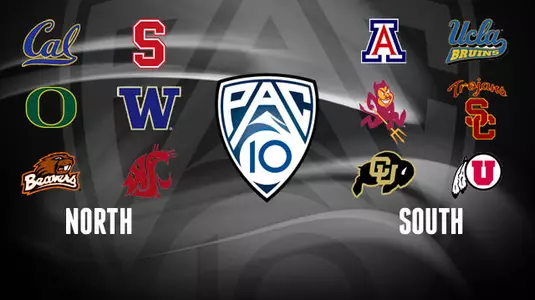
Buffs To Be In Pac-12 South Division
October 21, 2010 | Football, B.G. Brooks
BOULDER - The University of Colorado will begin athletic competition next year in a South Division of the Pac-12 Conference that guarantees CU the broadest possible exposure for its expansive California alumni base.
Following a vote Thursday morning in San Francisco by the newly expanded conference's presidents and chancellors, Pac-12 Commissioner Larry Scott announced the divisional alignment, plans for revenue sharing and a championship football game format.
- CU will compete in a Pac-12 South Division that includes UCLA, Southern California, Arizona, Arizona State and Utah, which also joins the league in 2011. The North Division will be composed of Washington, Washington State, Oregon, Oregon State, Stanford and California. In football, Pac-12 schools will play five divisional opponents and four cross-divisional opponents each year. No other sports will have divisions, with schools playing an 18-game conference schedule in basketball. Football schedules for 2011 should be finalized and released by individual schools within 30 to 45 days, Scott said. CU's placement in the South Division should appease the school's large (approximately 24,000) California alumni base. Another positive factor in the divisional format is recruiting: the Buffs view Southern California as one of their prime talent bases.
CU Athletic Director Mike Bohn said landing in a division that includes the Southern California and Arizona schools "just makes a lot of sense. That's where the majority of our alumni are and so many of our fans that travel between Arizona and Colorado live. Having the ability to build some excitement with those institutions is certainly part of the planned vision that we had from Day 1. We were hopeful it would come together."
- Revenue ultimately will be shared equally among conference members, with this provision: Until a $170 million threshold is reached, USC and UCLA - traditionally the league's pair of most televised schools in football - will receive an additional $2 million each based on the conference's appearance-based system. After that point, most likely beginning in 2012, revenue will be shared equally among the conference's 12 schools. The Southeastern Conference and Big Ten reportedly have TV contracts worth about $200 million annually, but the Pac-10 combined football/basketball deal is only about $53 million annually. Scott, however, will begin contract talks next year for a 2012-13 TV pact expected to dramatically increase his conference's take.
"The good news is that everybody is on the same playing field and that's certainly a healthy decision and a healthy piece of the formula for everyone," Bohn said.
Equal revenue sharing in the Pac-12 will allow CU more monetary flexibility and to curtail its scrambling for mid- or late-week televised football games - such as last season's Toledo trip for a Friday night ESPN game - to help with budget issues.
In the Big 12, Bohn added, CU routinely was "in the top half of conference distributions and one of the most televised programs in the country - in the top 10 for the last three years straight. So we've been carrying our weight with our conference in that category in the past. We recognize that sometimes we're above that line, if you will, in conference distribution and sometimes we're below it. But for the most part, we benefitted from more than the average in the Big 12."
- A championship football game will be played in December 2011 in the stadium of the division champion with the best overall conference record. In case of a tie, Scott said a tie-breaking mechanism - head-to-head competition, possibly BCS standings, etc. - would come into play to determine divisional champions as well as the championship game host. With the Big 12 Conference having lost two teams - Nebraska is leaving next season for the Big Ten - the Pac-12 will become the fourth BCS automatic-qualifying conference with a football championship game (SEC, ACC, Big Ten, Pac-12). NCAA by-laws require conferences to have 12 members to hold title games in football. Playing at a home site, said Scott, "promises to deliver a full house in one of the historic stadia in our conference and the excitement and energy befitting a championship." He believes those factors outweigh any potential travel inconveniences incurred by fans or weather issues.
In a teleconference streamed live on the conference's website, Scott called Thursday "a historic day for the Pac-12 Conference. We've achieved some monumental goals in a very short period of time that bodes very well for the future."
Scott, who has made a major impact in a very short time in college athletics, cited the "passion and engagement" displayed in a process that officially will bring CU and Utah, which is competing in its final season in the Mountain West Conference, into the Pac-10 on July 1, 2011. For purposes of conference scheduling, the Buffs and Utes will be "travel partners" - much the same as Washington and Washington State and other geographically aligned conference members.
The expansion process focused on creating "a modern 12-team conference for the long term that was going to provide increased value for our members, competitive balance and one that's fan friendly. I think we've done that," Scott said.
"Our rivalries have been kept completely intact - and this is an important focal point for the conference going forward. Part of the DNA of the Pac-10 is the importance of traditional rivalries."
A point of contention in splitting the conference into North-South sectors came from North schools fearful of losing annual games in Southern California. Scott said the plan to play four cross-divisional games every year "locks in" a scheduling model that allows the Northern California schools to play the Los Angeles-based schools every year, "preserving their long-standing rivalries that date back to the 1930s."
CU is not "locked in" to play any schools other than its five South opponents. But, Bohn noted, with Cal and Stanford being part of a "5-2-2" scheduling model that annually pairs them against USC and UCLA, the Bears and the Cardinal "will not be available to us as often as the other four teams in the North."
The other four North Division schools, said Scott, will play at UCLA or USC every other year. Said Scott: "If you compare ours to other conferences and their divisions, there's still a lot of frequency in terms of interdivisional play that you see in other conferences. Again, I think this was taking a broad view of getting to divisions that made sense for the long term but having a high degree of respect for the historical rivalries in this conference - not just the in-state rivalries (like) Arizona-Arizona State but also the fact that Northern California and Southern California schools have played each other since the early 1900s."
Conference football schedules should be approved by schools' athletic directors in early- to mid-November. After CU played in Berkeley last month, Cal is scheduled to play Cal in Boulder next Sept. 10, but Bohn said whether that return trip is made, as well as a possible non-conference replacement game, are to be determined.
CU is expected to have a minimum of four home Pac-12 games in 2011, which Bohn called "a little challenge for us because we prefer to play six home games" as well as the annual game in Denver against Colorado State. Bohn said CU is committed to opening the 2011 season at Hawaii (Sept. 3), playing CSU in Denver (Sept. 17) and traveling to Ohio State on Sept. 24. Following the trip to Columbus, Ohio, CU will embark on its inaugural nine-game Pac-12 schedule.
"We're going to work on keeping high profile games in Boulder," Bohn added. "I believe our fans will recognize this is a historic move and one that does have some challenges in our overall scheduling models. But in the long run it'll be attractive to them."
Scott believes the North-South divisional alignment will "preserve our traditional rivalries." He said four primary criteria were used to determine the alignment: "The importance of rivalry games, competitive balance, geography and fan friendliness."
Arizona State President Michael Crow, chairman of the Pac-10 CEO Group, said all issues were approved Thursday by unanimous votes from the presidents and chancellors. He described the transformation of the Pac-10 into a 12-team league as "a very thorough process that created a lot of discussion and has delivered results that we are all very excited about.
"The engagement we have received from all 12 member institutions and their presidents and chancellors has been tremendous. We have an ambitious plan for the future of our conference and all of that input was vital in allowing us to take these transformational steps."
Since the Pac-10 announced its expansion plans in June, conference ADs - including Bohn and Utah's Dr. Chris Hill - have worked on the various issues that were voted on Thursday by the presidents and chancellors.
Bohn characterized all those meetings as focused, collegial and productive.
"That's one of the exciting things about being in this conference: I truly believe that everyone from the CEO level, to ADs, to senior women's administrators to faculty athletic reps, they're trying to do everything they can in the best interest of the league," Bohn said. "That is extremely refreshing. It's a great way to begin building a successful league.
"I'm thrilled to be part of a new initiative with unanimous support from CEOs and chancellors on significant issues. That just creates a clear sailing path with a lot of wind at all of our backs in ADs' chairs across the conference. We're looking forward to competing in a very competitive league."
Contact: BG.Brooks@Colorado.EDU