Colorado University Athletics
Brooks: Malones Have All The Basics - Track, Each Other
July 02, 2010 | Track and Field, B.G. Brooks
That doesn't matter much to Malone, who is quite comfortable and content with who he is, what he does and the goals he has set for himself. But on occasion, he does reflect on their days in the mid-1990s at Arvada West High School, where Malone was hurling the discus and Halladay was flinging fastballs past baffled batters.
Malone remembers him and Halladay having "similar skill sets" and physically being in the same ballpark - Halladay in the 6-foot-5 range (he's now 6-6) and Malone standing about 6-8 (he's now 6-9).
Practicing on adjacent fields, Malone sometimes would scale the fence separating the two to retrieve a wayward discus. Catching some good-natured grief from Halladay and the baseballers, Malone shrugged it off and didn't give much thought then to where their sports might steer them.
Halladay, the first pick by the Toronto Blue Jays in the 1995 Major League Baseball draft, now pitches for the Philadelphia Phillies. There are big bucks in Halladay's sport. A perfect game on May 29, 2010 against Florida (1-0) was the 20th in MLB and assured him a nice niche in the sport's history. (Didn't hurt his earnings potential either.)
Meanwhile, Malone just finished his 10th season as the men's and women's throws coach at Colorado. He still competes in the discus and last month won his event for a second consecutive year at the USA Track & Field Championships. There are not big bucks in Malone's sport, only large dreams.
Malone's winning throw in 2009 was 213-03, while he won last month's event at 205-03 (the wind can be a huge factor, as it was on June 25 in Des Moines, Iowa). His personal best is a toss of 224-08; the world record is 243-0.5.
MALONE HAS COMPETED in two Olympics (2004, 2008), with his sixth-place finish in '04 ranking as a personal runner-up in Athens to an accepted marriage proposal (more on that later). He's hopeful of competing in London in 2012, citing a belief based on the careers of two top American discus throwers - Anthony Washington and the late Al Oerter, both of whom were in their early- or mid-30s when they excelled.
Oerter, who died in 2007, was a four-time Olympic discus champion and the first man to break 200 feet in the event. After competing in the 1968 Games at age 32, he retired.
Washington appeared in three Olympics, finishing fourth in Atlanta in 1996. He was 30 at the time.
Malone is 33; if he makes the 2012 USA Olympic team, he'll be 35. He believes he'll be in his prime.
"Fortunately, discus throwers seem to age well in their sport," Malone said. "I think it's because it's a highly technical area and there's so much skill involved. It just takes time to hone that . . . I'd love to think that I'm starting to reach my best in athletic competition."
The reasons discus throwers can count on career longevity are fairly obvious to Malone: "Compared to football/basketball, where you're putting hundreds of miles on your knees and hips and feet in practices, we don't have to do nearly as much as that. Or we're not running into anything or having anything run into us," he said.
"The big impact thing for us is more in the twisting movements, the one-sided movements that tend to make your body maybe overdeveloped on one side. The other thing that takes its toll is the amount of lifting you have to do. You need to spend a lot of time in the weight room, and that tends to be the cause of most injuries for discus throwers, shot putters.
"I've tried to be a little overly cautious in what I do in the weight room. I've been going at it with the mentality that I want to be throwing for a long time - and not so much the mentality that 'I want to throw it as far as I can this year and I don't care what happens next year.' I like the sport and I want to keep at it."
When will enough be enough? He'll listen to his body, and at the moment his body is offering a green light.
"I really feel healthier and stronger than I was at 22," he said. "I've felt a positive change over the last 10 years. I know about genetic and hormonal changes - all those things - but I just have this hope that I can continue that trend for another 10 years."
AT ONE TIME, MALONE, who also played high school football, believed basketball might be his athletic calling. One of his earliest and best hoops memories is playing on a junior team that defeated a Chauncey Billups-led squad by a point. "A great confidence builder," Malone recalled.
But by his senior year at A-West, faced with attending a big man's camp for hoops or a thrower's camp in track, Malone opted for the latter and got very serious about the sport. One reason: Olympic gold medalist Mac Wilkins was at the thrower's camp and provided "a big eye-opener for me - a real turning point toward track," Malone said.
He enrolled at Colorado State as a spindly 6-8, 200-pounder, but quickly realized that throwers fare better if they weigh more. "I saw throwers were bigger and realized 'the heavier you are, the lighter the implements' . . . that's when I started trying to put on weight," he said.
The pounds didn't arrive easily. Before college, he was "eating mountains of food" but gaining no weight. "I was going up - not out. I still felt like a basketball player and was using speed and explosiveness from that (in track)."
In his sophomore year at CSU, more poundage appeared. How could it not when he was drinking a gallon of whole milk and eating 18 eggs a day? Dinner often was a loaf of French bread sliced and slathered with cheese and ground beef. Not many crumbs were left.
"The amount of food I was eating was unbelievable," Malone said. "I was probably hitting 7,000 calories a day."
He gained 30 pounds over his first two years at CSU and, through healthier and smarter eating, has put on another 60. That's 90 pounds since 1995, and at 6-9, 290, he's as taut as a tree trunk.
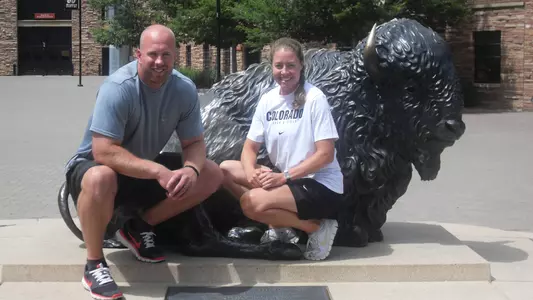
He and wife Lindsey, also a CSU alum (they were art majors and met while on the Rams track team) and now a CU assistant coach, have tried sharing the cooking responsibilities. But they've found that preparing the proper portions for Casey is better left to him; Lindsey simply doesn't need that much food.
"I tried to eat like he does and I was gaining weight," she said. "He was trying to eat like I do and he was losing weight."
Added Casey: "I started to feel bad because when I cooked, she was only taking a small portion out of this big pot of what I made. When she cooked, she had to significantly increase the amount of what she'd make - just for me. Now I try to cook for myself . . .
"When you tell someone you have to eat a large amount of calories, they think, 'That's so much fun.' But think about the shopping, preparing, cooking, cleaning - all that stuff. It's almost like a full-time job, just feeding yourself."
THE MALONES STILL LIVE in Fort Collins and commute together to Boulder daily. Once there, they share the same office at CU (she coaches the long jump, triple jump, high jump, pentathlon, heptathlon and decathlon) and travel together when the Buffs make road trips. That might seem an inordinate and potentially uncomfortable amount of "togetherness," but they have friends in the coaching profession and know how the job's demands can strain a relationship.
"We're pretty lucky," Lindsey said. "I wouldn't have it any other way . . . he can't get rid of me."
Not that Casey would want to. Their courtship culminated in a proposal that neither will forget . . . picture Casey on one knee in Athens at the 2004 Games - underneath the Olympic torch. He planned it that way, but as they both conceded, a number of pieces had to fall exactly right for it happen.
The first piece was his making the USA team, which he did. Then came a successful rush order on a ring from a Colorado Springs jeweler. Then there was the matter of getting Lindsey's ring into the stadium (Casey tucked it in one of his shoes). Then he had to lure her under the torch once he finished competing.
"At the end of the night, they were closing down stadium and had guards at every gate, ushering people out," Casey said. "We walked around the stadium until I saw a gate with no guard and we went up (into the stands) . . . I said, 'Let's go look at the torch.'"
Lindsey complied, mainly because she was "just gushing over the whole night . . . he had just placed seventh (later moved to sixth because of disqualification ahead of him). His parents were there, his brother and sister . . . it was just a wonderful, amazing experience and I'm just gushing about it all.
"I was getting into my camera case and when I turned around, he was on one knee with the ring. I didn't turn off the video and it got the whole thing - it was a view of the seats, but it recorded everything that was said. I don't know if I could have asked for anything more perfect."
They were married in September, 2005.
JULY FINDS THE MALONES on the road again - together of course. After he competes in the Prefontaine Classic this weekend in Eugene, Ore., they will go to Gateshead (Great Britain) for competition in the IAAF's new Diamond League. Other July league stops include Monaco, then a return to London.
Also, Lindsey has been selected as a Thorpe Cup (USA vs. Germany) coach this summer, which will take the couple to Marsburg, Germany, for the Aug. 7-8 competition. In addition to being her first Thorpe Cup coaching experience, she'll be directing Emily Pearson, a second-year CU volunteer assistant and former CSU competitor (heptathlon, relays) who ran for Lindsey in Fort Collins.
"It's an honor to be coaching in the Thorpe Cup and so neat to be able to coach Emily again," she said.
Once Casey is done competing, the Malones don't see their lives changing course. Track, they agree, "has given so much to both of us we want to continue giving back," Casey said. "The nice thing about college coaching is that for the most part you can do it as long as you want . . . and it's something I could see myself doing for a long time.
"I'm beginning to feel like I'm able to mentor athletes - the ones who've graduated and say, 'I'm lost, what do I do now?' Pro discus throwers don't make a lot of money; a lot of athletes struggle after graduation. You have to stick with it.
"I was four years out of college before I made the Olympic team, and I still feel like I'm learning things now. A lot of other countries can support their athletes and they kind of know you're not going to do your best until you're 28 or 30 - so they kind of help that along. I want to be committed to helping American throwers, whether that's in some capacity through the U.S. Olympic Committee or USA Track and Field . . . I could see that, helping out in some way, for a long time."
He's obviously not in it for the money. If that were the case, he'd be in another sport, throwing something the size of, say, a baseball.
Contact: BG.Brooks@Colorado.EDU