Colorado University Athletics
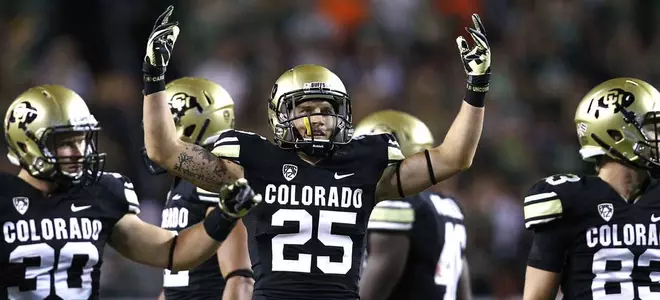
Brooks: Ryan Moeller Making His Mark Without Carrying The Football
August 11, 2015 | Football, B.G. Brooks
BOULDER – Ryan Moeller left Rifle High School four years ago wanting to be a Division I running back – and anyone who had seen him frolic with the football through the state's 3A competition could easily imagine a place for him in a big school's backfield.
Moeller mostly made it look easy. As a senior, he posted career numbers, running for 3,002 yards and 43 touchdowns. He finished his career with 7,084 rushing yards and 84 TDs. In 31 of his high school games he surpassed 100 yards rushing, including 16 games of 200-plus yards and one monster night (414 yards, 5 TDs) against Moffat County.
Nonetheless, there was no flood of scholarship offers. A trickle was more like it, and his coach at Rifle was baffled.
"He's going to be an asset to whatever Division I program finally sees it," Damon Wells told the Denver Post during Moeller's senior season. "I grew up and played in South Florida and have been around plenty of Division I football talent, and people are flat missing the boat. If I offend anyone by saying that, so be it."
Idaho State, an FCS school, made a call, as did Division II CSU-Pueblo and Colorado Mesa. But the inquiries from the University of Colorado and Colorado State were invitations to walk on.
“This is a tough one for me,” a dismayed Wells said. “All I can say is we would have expected a (Division I) offer, as well. I don't know what else the kid could have done in the classroom and on the field.”
If Moeller was downcast, he hid it well. In reality, he wasn't downcast and there was no need to hide anything. He accepted CU's offer as an invited walk-on and arrived on campus in the summer of 2013 still envisioning himself as a running back but open-minded and passionate enough about the game to play wherever he was needed during a redshirt season spent as a scout teamer.
HIS RUNNING BACK DREAM MIGHT still flicker occasionally, but Moeller has tamped it down. Special teams play showed head coach Mike MacIntyre and the defensive staff that Moeller was athletic, aggressive and instinctive. On the opening kickoff at Southern California last season – a 56-28 CU loss – eyes opened on the Buffs sideline when Moeller pinned the Trojans returner inside the 15-yard line.
“I just think he woke up and said, 'I can do this,'” MacIntyre said. “He's definitely a heck of an athlete, no doubt about that.”
He finished the season with 20 special teams points (fifth on the team), but for Moeller to be a regular contributor in the secondary a break was needed. It arrived in late November.
An injury epidemic at safety – “I've never seen anything like it,” MacIntyre said at the time – had sidelined five Buffs safeties, three of them for the season and leaving two questionable. CU went into its Nov. 22 game at No. 3 Oregon minus Jered Bell (knee), Marques Mosley (knee) and Chidobe Awuzie (lacerated kidney) and with Tedric Thompson and Evan White questionable due to concussions.
Moeller got the first start of his career in Eugene – and responded with 14 solo tackles, a school record for a first-time starter. Some of those stops, said MacIntyre, could be attributed to the Ducks' offensive scheme: “They do a lot of bubble passes, a lot of short passes to the tailback spot. He was having to get in there and fit them up.
“You know, you don't like your safety to make that many tackles, but in their offense (opposing) safeties have to make open field tackles. They weren't all just running backs (and) he was ready to do it. He made some tackles when we blitzed him in the backfield, too. I was excited to see that.”
Moeller had played defense (and played it well) at Rifle, but he couldn't remember a game with 14 tackles. Reciting a MacIntyre mantra, Moeller explained his defensive debut against the Ducks like this: “Knowledge equals confidence equals playing fast . . . being in position for what that team runs, fortunately for me I was able to run around the field and get a couple of them.”
Oregon won 44-10, but Moeller's performance earned him a start in the season finale the following week against Utah. He contributed four unassisted tackles, giving him 18 in the final two games (21 for the season). The momentum Moeller achieved in November streamed into winter conditioning, then into spring practice and summer work. He never slowed down, mainly because he's not used to downshifting.
“To me there really isn't much of an off-season – just different stages of training and what we do,” he said. “Growing up in small town, having a family ranch and helping build your own house, you learn that there's always work to be done. I'm used to not having an offseason.”
MacIntyre noticed. Before August camp began last week, that scholarship Moeller and his high school coach believed was due and deserved finally arrived. “He earned it,” MacIntyre said, noting that his decision had been “real easy, no doubt.” And Moeller termed getting it “a big relief.”
It seems like a lengthy journey, but getting on the field actually has been pretty swift when Moeller reflects on it. “I came in as athlete, started out as a running back, which is what I wanted to play,” he said. “But I'm one of those guys who just wants to play. They moved me to defense and it all kind of came a lot quicker than I anticipated.”
UP SEVEN POUNDS NOW (212) from his 2014 playing weight, the 6-1 Moeller has enjoyed a fast start in August camp. Playing both safety spots (free, strong), he continues to turn heads and figures to play regularly – if not start – in new position coach Joe Tumpkin's rotation at safety or possibly nickel back.
“Yeah, I would say I stood out (in winter/spring work), but I'm definitely doing my best to continue to stand out,” he said. “A lot of other guys stood out, too. I can't knock any of the defensive backs; they all worked their butts off and improved tremendously . . . we're all learning how to play both (positions); it'll help you out and get you more time on the field. A handful of DBs, if not all, are learning all the positions. We saw last year that kids can go down and we need someone else to step up.”
Moeller's position coach last season was Charles Clark, who now concentrates on coaching the corners and also will help Tumpkin with the nickels. Plus, the Buffs' defense is now coordinated by Jim Leavitt, who replaced Kent Baer.
The transition, said Moeller, has been smooth: “These coaches have done a great job of trying to adopt our terminology, our verbiage. Most of it means the same thing, but it's not all said the same way. They came from different programs. But concepts are concepts; if you understand those you'll probably be a little better off in playing faster.”
Among the biggest differences on defense this season will be at Moeller's position. The safeties, rather than the linebackers, have taken on the responsibility of making the defensive calls. Thus, the calls coming in from the sideline will flow from the backend forward, which Moeller likens to “a chain reaction . . .
“We get the play, make our call and it trickles down to the linebackers. They make their call off of that. Communicating and being on the same page is definitely the biggest key. If we all are on the same page but mess the play up we can live with that. But we don't want a couple of us doing something and a couple of others doing something else. We want it coming down right from the 'backend' – kind of like a waterfall.”
His camp goals are just what you'd expect – making overall improvement, being an overall asset to the defense, and entering September as a starter. Even if he's not at the position he wanted to play when he arrived, the position he's worked himself into really isn't too bad. It's pretty good for the Buffs, too.
Contact: BG.Brooks@Colorado.EDU