Colorado University Athletics
CU's Stadiums, Part I: From Gamble Field To Colorado Stadium
September 09, 2016 | Football
This is the first installment of a three-part series, written by CU student David Collins, on the history of football stadiums on the CU campus, from Gamble Field to the current version of Folsom Field.
BOULDER – Oct. 11, 1924, was a cold, rainy day with a slight dusting of snow in Boulder.
The weather didn't stop 3,000 fans of the University of Colorado's football team from descending on Colorado Stadium, the brand new facility built on the northeastern part of campus.
Fans had been excited over the conception of the new stadium, built into a ravine in the shape of a massive bowl, that could seat up to 26,000 people and was designed for easy expansion over time. It was rated at the time by the Silver and Gold, CU's campus newspaper, as "one of the biggest and best in the West", and was home to a CU team coming off a 1923 undefeated season.
That 1923 season, which saw the Colorado 11 (CU wouldn't go by the name "Buffaloes" until the 1934 season) go 9-0-0, created a movement on campus to build a new stadium to replace Gamble Field, which had been CU's first on-campus athletic field. The football team's successes had outgrown Gamble Field rather quickly, as 1923 saw a total attendance record of 42,480, more than five times the capacity of Gamble Field.
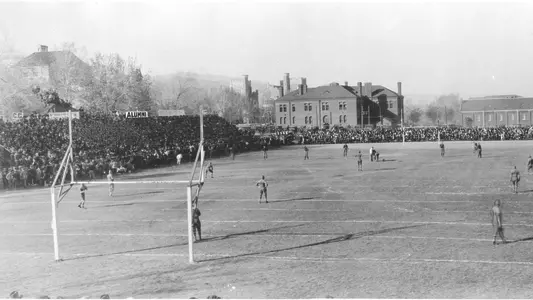
But Gamble Field served the early football program and campus well, as it held track and field events, baseball games, and campus rallies and events starting in 1901, when it was built by the collected efforts of the CU student body.
Near the end of the 1900 season, the student body decided it was time for an on-campus athletic field for the rapidly growing campus, which at the time was only in its infancy. Gamble Field was built on the southeast corner of campus, where the University Memorial Center now sits on the modern campus.
It consisted of a 160-foot wooden grandstand on the western side of the field that could seat 1,000 people, and at the start was the only side that had stands. There was a quarter-mile track built around the field, and baseball was played there with some adjustments to the field and original ground rules specific to Gamble Field.
The facility also had 28-foot dressing rooms at each end so teams could get out of the elements. The entire complex was surrounded by a wooden wall to create a unique field, unlike anything seen in Colorado to that point. With the mountains to the west and the plains to the east the Silver and Gold called it "a field of fields, a perfect home for the young eleven from Colorado."
The field was named after an early star for CU, Judge Harry P. Gamble, who had lettered six times from 1891-96, and was a team captain for two of those years. When the 1901 season began, Gamble Field was a new field made possible by a broader activity along all lines of athletics.
The Denver Times, in 1903, called Gamble Field "an ideal gridiron which was a credit to a football team that was quickly earning a reputation of being the best eleven in the state. It was an atmosphere that was unique to college football, and was a place that couldn't be replicated anywhere else in Colorado."
Fans first got their look at the new campus field on Sept. 21, 1901 as the CU footballers defeated the State Prep School (later to be known as Boulder High School) 5-0 for the first win at the new field. During the game fans were exposed to an extraordinary view of Mackey Auditorium and Old Main sitting with the Rocky Mountains behind them to create a view that made it hard to focus on the game at hand.
The win was one of many, as Colorado compiled a record of 112-45-12 during the 24 years they played on the field. The stretch included a 21-game winning streak, starting with a 15-0 win against the Colorado School of Mines on Nov. 26, 1908, and ending with a loss at Colorado State on Oct. 12, 1912. The streak lasted five seasons, and is still the longest winning streak in CU history.
Along with the winning streak, Gamble Field also saw Colorado get its first win ever against historic rival and next door neighbor Nebraska. Having played the Cornhuskers (also known as the Bugeaters at the time) three times prior, CU finally broke through for a 6-0 victory on Oct. 8, 1904.
But it was the 1923 season that really put the Buffs on the map in Colorado and the surrounding areas. Playing one of the toughest and longest schedules in school history, CU crushed the competition, winning all nine games. The season showed that CU was ready to take the next step to becoming a major college football program.
All through the offseason, a movement for a new facility pushed through the campus. With the help of University President George Norlin and coach Fred Folsom, a new stadium was planned and ground was broken quickly.
Folsom had been CU's first true coach, coming from Dartmouth in 1895. He coached the team from 1985-99; again in 1901-02; and finally from 1908-1915. Eventually the stadium would bear his name, but Colorado Stadium would be the new bowl's first name.
As the 1924 season began, CU had a glorious new bowl on campus, but when the first game rolled around, the field wasn't entirely ready. So Gamble Field took center stage for one last time, hosting its final season opener.
Western State was the opponent, and the Colorado 11 continued to show why they had earned a new stadium, producing a 31-0 win on Oct. 4, 1924, in the last game at Gamble Field.
At last, it was time to open the doors to Colorado Stadium. CU answered the call in front of 3,000 fans, winning in dominating fashion, 39-0, against Regis University on that chilly October day.
Colorado gained 310 yards from scrimmage, all on the ground, on the way to victory. Junior Hatfield Chilson scored the first touchdown in the new stadium, crashing through the Regis defense for a 55-yard run only five minutes into the game.
Fans also witnessed what would become one of the earliest traditions in Colorado's football history, as a tunnel had been built connecting the field to Carlson Gymnasium, where the dressing rooms were located. The team walked the tunnel and entered the stadium through the western stands as the fans exploded when seeing their gridiron stars enter the field of play.
The stadium still needed a name, as it was being called Colorado Stadium. And with the dedication coming on Nov. 1, the students began to push for the stadium to be named. The original idea was for the stadium to be named after President Norlin, and the students supported the idea.
But Norlin, who was still in the role of CU president, turned down the honor, as he believed no new buildings should be named after someone who is still working as a leader for the university.
Thus, when Homecoming weekend rolled around, the stadium was dedicated as Colorado Stadium and 13,000 people filled the stands. CU won the game 3-0 against Utah on their way to an 8-1-1 1924 season. In fact, Colorado didn't lose in the new stadium through that whole season, losing their first game in the new bowl at the start of 1925.
With their new glorious stadium and a foundation of success having been built, CU was ready to head into the 1930s and beyond ready for big time college football.