Colorado University Athletics
Colorado


NCAA Championships (Nordic)
Skiers Finish Second; Kjoelhamar NCAA Freestyle Champ
March 14, 2009 | Skiing
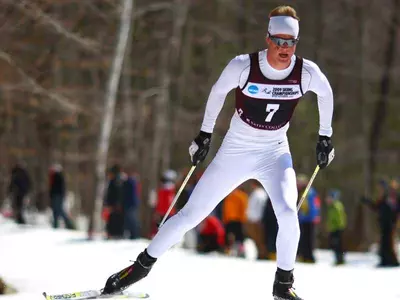
RUMFORD, Maine ? University of Colorado sophomore Vegard Kjoelhamar won the NCAA freestyle title here Saturday, but the Buffaloes fell short in their bid for the team title despite jumping from fifth into second in the final standings as the 56th Annual NCAA Ski Championships came to a close.
Denver successfully defended its title, coming from behind a second straight year to win it. Vermont held a slight 2-point lead over the Pioneers heading into Saturday's final two events, but DU had a full Nordic team of six skiers while UVM skied with just four. DU easily took the lead and won with 659 points. The third day (or six-event) leader had won the previous 13 titles prior to the Denver comebacks this year and in 2008. DU did not win a regular season meet but reached the top of the podium when it counted most.
The battle turned out to be for second, with Colorado claiming runner-up honors by the slimmest of possible margins. The Buffs started the day in fifth, moved into third after the women's freestyle race, trailing second place UVM at that point by 12.5 points and owning a 9.5-point edge over New Mexico. In the men's race, UVM fell out of podium contention but the Lobos were only able make up nine of the points and when everything was settled, the Buffs took second with 602.5 points to UNM's 602.
Alaska-Anchorage used three top five finishes to take fourth with 584 points, with Vermont fifth (573) and Utah sixth (568) to give western schools five of the top six finishers. DU, UAA and Utah fielded full 12-skier teams, Colorado had 11 here and New Mexico and UVM 10.
This was the 13th time in the 56 NCAA championships that DU and CU both finished in the top two; all eight times that Colorado has finished as the national runner-up, the only team ahead of it was the Pioneers. This marked just the second time the Buffaloes recorded back-to-back runner-up finishes at nationals, having previously done so the 1962 and 1963 seasons.
“Second place is not exactly what we came here for, our ambitions are the highest,” head coach Richard Rokos said. “With everything that happened during these three days and with a little bit of misfortune, this is probably the best that we could hope for.
“However, with the individual results and outstanding but inconsistent performance by our team, we have a great outlook for next year,” he continued. “We're returning most of the athletes for next season and we need to do very little to maintain a team capable of winning. It's not too early to start thinking right now about next year's championships and we will be investing all our work and ourselves into it, both mentally and physically.”
Considering what did happen to the Buffs, second place and “only” 56.5 points of the lead was a decent performance. The Buffs lost 21 points when one skier was disqualified for straddling a gate, had their best women's Nordic performer catch a ski tip on a gate late in a run costing as many as 20 spots in the standings, and a disappointing result in the men's freestyle aside from Kjoelhamar's win, as CU's other two skiers finished 20th and 31st; the same trio logged CU's first 1-2-3 sweep since 1962, and two of them at that, earlier in the winter. All that in addition to skiing one skier short, perhaps it was fitting at least the Buffs wound up on the high side of the ?-point margin with New Mexico for runner-up honors.
The Buffaloes did win a “sub-title” this week, as Colorado led the meet in men's points with 352.5, just the fourth time CU has accomplished that feat since the sport went coed in 1983, last doing so in 1999.
In the men's 20-kilometer race, Buff sophomore Vegard Kjoelhamar took a significant early lead en route to blowing out the field in winning his first NCAA title. He finished in a 44:07.9 time, well ahead of runner-up Lex Treinen (Alaska-Anchorage), who was timed in 44:27.3 and edged out teammate Raphael Wunderle by half-a-second.
Junior Matt Gelso struggled after a starting well. He was hanging around fifth and sixth place in the order until the midway point of the race, when he started to fall back; he eventually finished 20th in 46:10.5. Sophomore Jesper Ostensen, who was third in Thursday's classical, never really got untracked and was back in the field, his 47:28.1 time placing him 31st.
Kjoelhamar became the fourth Buffalo to be crowned the NCAA freestyle champion, the first since Kit Richmond who won in 2006 at Steamboat Springs. The other two were Per Kare Jakobsen in 1989 and Bjorn Svensson in 1991. It was Kjoelhamar's third win this winter, going with wins in the first race of the season, the freestyle at the Alaska Invitational, and the classic event in CU's own invitational in Aspen.
“I just started skiing for myself today as if it was a 20K individual start,” Kjoelhamar said. “I didn't try to attack or make a gap, so it was nice and a very good feeling when I saw the end results. It's a great feeling to end my season with a win. I am sad that the season is over but I am already thinking about next year and I will start next season with a bunch of training and try to be better. I was in really good shape early in the year but I kind of lost some of that in the middle. I have felt a lot better recently and I felt strong in the classic race and much better in the skate race today.”
Kjoelhamar's win was also the 80th overall individual title by a CU skier, which continues to be the most by any school. Denver is second (73), followed by Utah (63) and Vermont (54). It was CU's 10th individual title over the last four years, the second this year with Gabriel Rivas' Friday slalom win; that matches two other times Colorado skiers have won 10 titles in a four year span, joining the 1960-63 and 1986-89 teams.
“Before coming here we were a little nervous about where Vegard was at,” CU Nordic coach Bruce Cranmer said. “He hadn't really had great races prior to right before NCAAs. He's been a little sick and it makes you wonder a little bit, but I thought his classic race was good and obviously today was great. We saw some of that in Alaska (start of the year) that he has abilities like today, but sometimes you just don't know. I was surprised not to see him do well but to see him ski so comfortably and strong the entire race. He just skied his own race from the beginning to the end.”
“I am not totally sure what happened with the other to guys,” Cranmer continued. “I have small little ideas but I don't know for sure, it was a pretty big surprise. I know we have the ability and potential to all go top 10 but these races can throw different stuff at you all the time. You never know for sure what's going to happen, but based on what we've done in the past this season, they obviously didn't have the kind of races they wanted and that we expected. It was a tough day and it can happen to anybody, everyone has a race where your body just isn't there for you.”
The women's 15-kilometer freestyle opened the final day of competition, and it would end in a classic sprint for the finish line between two sophomores. Denver's Antje Maempel, who won the classical race Thursday, just edged Colorado's Alexa Turzian as the two emerged from a pack of six skiers over the final kilometer. Turzian was in first for a short time at the start of the sprint but Maempel was able to catch her in posting a winning time of 38:35.0. Turzian closed just a half-second behind in 38:35.5; both garnered first-team All-America honors.
“I felt really good today; the race was a super slow tempo because it was long and I was just waiting to make my move, I just didn't know where,” Turzian said. “In the past I've gone out too hard but today I focused on when to make that move and I did. When I took that lead I was feeling really good, high energy through the sprint to the finish but I just didn't get my technique right for the sprint. It wasn't that I was too tired or didn't have energy but I just didn't have the technique to sprint her out and she did.
“I think racing in the western circuit definitely helped me this season,” she added, referring to her transfer from Middlebury. “Training with one of the top skiers, Maria, helped a lot too. It helps you learn how to train, keep the intensity and develop good training habits. I think when you ski in the west you feel a lot more comfortable coming into NCAAs. You have fewer nerves and kind of have a good idea how you are going to do since a good majority of the competition comes from the west and going to low altitude makes it a lot easier.”
Colorado senior Maria Grevsgaard, the defending champion in the event, led at several points during the race and was among the six battling to get ahead at the end. However, she suffered a fall that took her out of the mix and she eventually finished sixth in 39:00.5, earning second-team All-America mention. The Buffs were one skier short of the maximum on the women's Nordic side, but still finished with the third most points in the event (84), trailing Dartmouth (113) and DU (103).
“It was kind of emotional this morning knowing that it was my last race,” Grevsgaard said. “I was super excited and super nervous. I really just enjoyed every second of the race, I fought hard and had two crashes but it didn't hurt me too much, I just had to make it up the hills faster. Just finishing sixth people would think that it's a disappointment because I've won before but I felt good finishing sixth. I am very proud and excited about what I have accomplished the last four years. It's been an amazing time and I can't believe it went by so fast. Even though I'm done ski racing, I have made so many great friends that will still be there and I will always have the Buffs in my heart.”
Grevsgaard finished her CU career with several school records, most notably atop the charts in career wins (24) and tied for the most career podium (top three) finishes with 34. She won two NCAA titles, both coming last year.
“The girls were great. You never know for sure again what's going to happen but they're always solid,” Cranmer said. “I was hoping that Alexa could break away in the sprint with Antje at the end, but sprinting isn't exactly her strongest point and Antje is tough. Maria had a strong race. She has set the bar so high for herself that everyone has such high expectations, she does a great job but doesn't win all the time. She had a great race and skied her heart out and other than a couple of glitches with the guys it was overall very good. Team-wise, coming fifth to second is also positive, and I've never had any races be a half a point difference before.”
NCAA Championship Final Team Scores?1. Denver 659; 2. Colorado 602.5; 3. New Mexico 602; 4. Alaska-Anchorage 584; 5. Vermont 573; 6. Utah 568; 7. Dartmouth 555; 8. Middlebury 426; 9. New Hampshire 394; 10. Nevada 284; 11. Colby 209; 12. Northern Michigan 195; 13. Bates 175; 14. Williams 147.5; 15 (tie). Alaska-Fairbanks and St. Lawrence 122; 17. Michigan Tech 121; 18. Montana State 85; 19. Wisconsin-Green Bay 35; 20. St. Michael's 31; 21. Gustavus Adolphus 17; 22. St. Scholastica 13. Women's 15K Freestyle (38 finishers)?1. Antje Maempel, DU, 38:35.0; 2. Alexa Turzian, CU, 38:35.5; 3. Rosie Brennan, Dart., 38:41.2; 4. Annelise Bailly, DU, 38:43.4; 5. Sophie Caldwell, Dart., 38:49.8; 6. Maria Grevsgaard, CU, 39:00.5; 7. Caitlin Patterson, UVM, 39:10.9; 8. Polina Ermoshina, UNM, 39:15.4; 9. Annelies Cook, Utah, 39:18.3; 10. Hannah Dreissigacker, Dart., 39:20.3. Other Front Range Finisher: 28. Kate Dolan, DU, 41:00.0. Men's 20K Freestyle (39 finishers)?1. Vegard Kjoelhamar, CU, 44:07.9; 2. Lex Treinen, UAA, 44:27.4; 3. Raphael Wunderle, UAA, 44;27.9; 4. Martin Kaas, UNM, 44:28.4; 5. Max Treinen, UAA, 44:29.9; 6. Mike Hinkley, DU, 44:39.0; 7. Patrick O'Brien, Dart., 44:42.6; 8. Jesse Lang, MTU, 44:43.2; 9. Simeon Hamilton, Midd., 44:44.7; 10. Simon Reissmann, UNM, 44:45.1. Other Front Range Finishers: 19. Harald Loevenskiold, DU, 45:42.4; 20. Matt Gelso, CU, 45:45.1; 24. Daniel Clark, DU, 46:10.5; 31. Jesper Ostensen, CU, 47:28.1. CU SKIING / 2009 NCAA CHAMPIONSHIP NOTES CRACKING THE TOP: NCAA West schools have now won 14 of the last 15 championships, as the skiing elite fraternity remains hard to crack; only seven different schools have claimed the title since the sport went coed in 1983: Utah (9 titles), Denver (6), Colorado (5), Vermont (4), Dartmouth (1), New Mexico (1) and Wyoming (1). But since the '67 title meet, Colorado (19 first or second place finishes, including 14 wins), Utah (19; 10, 9), Vermont (19; 5, 14) and Denver (15; 10, 5) have dominated college skiing over these 43 seasons. Only three other schools, Wyoming (two wins and four seconds), Dartmouth (two wins, two seconds) and New Mexico (one title and two seconds) have been able to crack the top two in this span (note: adds to 44 titles since CU and Dartmouth shared '76 crown). CU ALL-TIME: The Buffaloes have won 17 national championships in skiing: 11 men's (1959-60-72-73-74-75-76-77-78-79-82), five coed (1991-95-98-99-2006) and one women's (1982, AIAW). The 16 NCAA titles by Colorado trail Denver by four, as the Pioneers caught and passed CU by winning three straight to open the 21st century and have extended their lead with two straight wins. After DU and CU (36 combined), Utah has won 10, Vermont 5, Dartmouth 3, Wyoming 2 and New Mexico 1 (CU and Dartmouth tied for the '76 crown). INDIVIDUAL CHAMPIONS: The Buffs had two individual NCAA champions this winter, the fourth time in school history, and posted seven top five efforts overall, including one runner-up finish. Colorado leads all-time with 80 individual titles, topping Denver (73), Utah (63), Vermont (54), Dartmouth (34), Wyoming (19), New Mexico (11) and Middlebury (10); skiers from Denver and Vermont (two each), New Mexico and St. Lawrence won the other individual crowns. The Buffs have had two or more individual champions 26 times (three or more 13 times), including four occasions when CU skiers topped the podium four times: 1960, John Dendahl (skimeister, nordic, cross country) and Dave Butts (downhill); in 1963, Buddy Werner (alpine combined, downhill), Bill Marolt (downhill) and Jimmie Heuga (slalom); in 2006, Jana Rehemaa (classical, freestyle), Kit Richmond (freestyle) and Lucie Zikova (downhill); and in 2008, Maria Grevsgaard (freestyle, classical) and Lucie Zikova (giant slalom, slalom). CU has had at least one individual winner 21 of the last 28 years, and the 10 titles CU has won in the last four championships (2006-09) matches the school best over any four-year NCAA stretch (1960-63, 1986-89). LUCKY 7's: CU's two individual winners here both wore Bib No. 7, Gabriel Rivas in the slalom and Vegard Kjoelhamar in the freestyle. It was a near-hat trick: Alexa Turzian wore No. 7 in the women's freestyle, finishing as the runner-up by a mere half-second. NACDA DIRECTORS' CUP: Colorado's second place effort earned the Buffaloes 90 points in the NACDA Directors' Cup Standings, as skiing is the first of nine NCAA winter titles decided for 2008-09. CU was 67th in the final fall standings with 79 points (Stanford led with 394, Oregon was second with 323). The 90 points moved CU into the No. 24 position with 169. Denver had 50 points prior to finishing first (94th), and earned 100 in zooming to 30th on the list. The Buffs have been perennial top 10 standing members in the final fall standings, but rare non-postseason appearances by football, volleyball and women's cross country hurt CU's fall point total. HEAD COACH RICHARD ROKOS: Richard Rokos wrapped up his 19th season as head coach of the Buffaloes, and is now poised to become just the ninth person to coach 20 seasons in any sport at Colorado. He has guided the Buffaloes to national championships in 1991 (his first season), 1995, 1998, 1999 and 2006, to second place finishes in 2000, 2002, 2008 and 2009, third place efforts in 1997, 2001, 2003 and 2007, fourth place showings in 1993, 1994, 1996 and 2004, fifth place in 1992 and sixth in 2005. Under Rokos, the Buffaloes have won 47 of 117 meets they have skied in, including 42 of 98 in the west (with nine RMISA Championships/NCAA West Regionals titles). In his tenure, CU has had 93 first-team All-Americans and 150 first- or second-team selections (alpine and Nordic), all adding to 220 top 10 finishes in NCAA championship competition. IN-THE-END: The Colorado men scored 352.5 points to be the top scoring men's unit for just the fourth time since 1983 (the first since 1999). The women scored 250 to finish sixth, tied for the lowest in the same period. Here's how the 2009 championship broke down: MEN'S TEAM SCORING: Colorado 352.5, Denver 337, Alaska-Anchorage 311, Vermont 289, New Mexico 282, Utah 276, Middlebury 224, Dartmouth 216 WOMEN'S TEAM SCORING: Dartmouth 339, Denver 322, New Mexico 320, Utah 292, Vermont 284, Alaska-Anchorage 273, Colorado 250, New Hampshire 217 ALPINE POINT LEADERS: New Mexico 354, New Hampshire 353, Vermont 328, Utah 319, Denver 284, Colorado 255.5, Middlebury 237, Dartmouth 212, Alaska- Anchorage 201. Men's Leader: New Hampshire 187 (2nd?Denver 186). Women's Leader: New Mexico 240 (2nd?New Hampshire 176). NORDIC POINT LEADERS: Alaska-Anchorage 383, Denver 375, Colorado 347, Dartmouth 343, Utah 249, New Mexico 248, Vermont 245, Northern Michigan 195 Men's Leader: Alaska-Anchorage 228 (2nd?Colorado 189). Women's Leader: Denver 214 (2nd?Dartmouth 207). SCORING FORMAT: Had the scoring format for the last 12 years been utilized, DU still won handily with 607 points, but Utah would be second (557), followed by CU (552.5), UNM (544), UAA (541), Dartmouth (531), UVM (528), Middlebury (416) and New Hampshire (380.5). ALL-AMERICANS: Seven Buffaloes earned All-America honors in the meet, five gaining first-team status: Maria Grevsgaard (classical), Vegard Kjoelhamar (freestyle), Jesper Ostensen (classical), Gabriel Rivas (slalom) and Alexa Turzian (freestyle). In addition, Grevsgaard, Kjoelhamar and Turzian also earned second-team All-America honors in their other disciplines, and were joined by Stefan Hughes (slalom) and Drew Roberts (giant slalom). Top five finishes earn skiers the first-team honor, while finishing sixth through 10th nets a second-team honor. NCAA SKIING ALL-ACADEMIC TEAM: CU placed a nine team members on the NCAA Skiing All-Academic Team (its version of Academic All-America), as the qualifications included owning a 3.50 or better grade point average and participation in the NCAA regionals. Ashley Babcock, Matt Gelso, Katie Hartman, Vegard Kjoelhamar, Carolina Nordh, Karl Nygren, Reid Pletcher, Arman Serebrakian and Katie Stege all made the prestigious team. LOOKING AHEAD: Nine of the 11 student-athletes who competed for Colorado in Maine are scheduled to return for the 2009-10 school year, as CU graduates seven seniors, including two who competed here, Maria Grevsgaard (Nordic) and Lisa Perricone (alpine). Also graduating are Nordic performers Joaquin Goodpaster, Karl Nygren, Josh Smith and Megan Wilder, and alpine skier Tony Cesolini. FUTURE SITES: The University of Colorado will again play host to the NCAA Championships for the second time in five years, as the Buffaloes will host the event at Steamboat Springs. In 2006, the first time the Buffs hosted the meet since 1993, the championships featured the first-ever night competition (slalom) which was extremely popular among the skiers and town folk. The committee is reviewing bids from eastern schools for the 2011 championships and will announce that site later this spring.